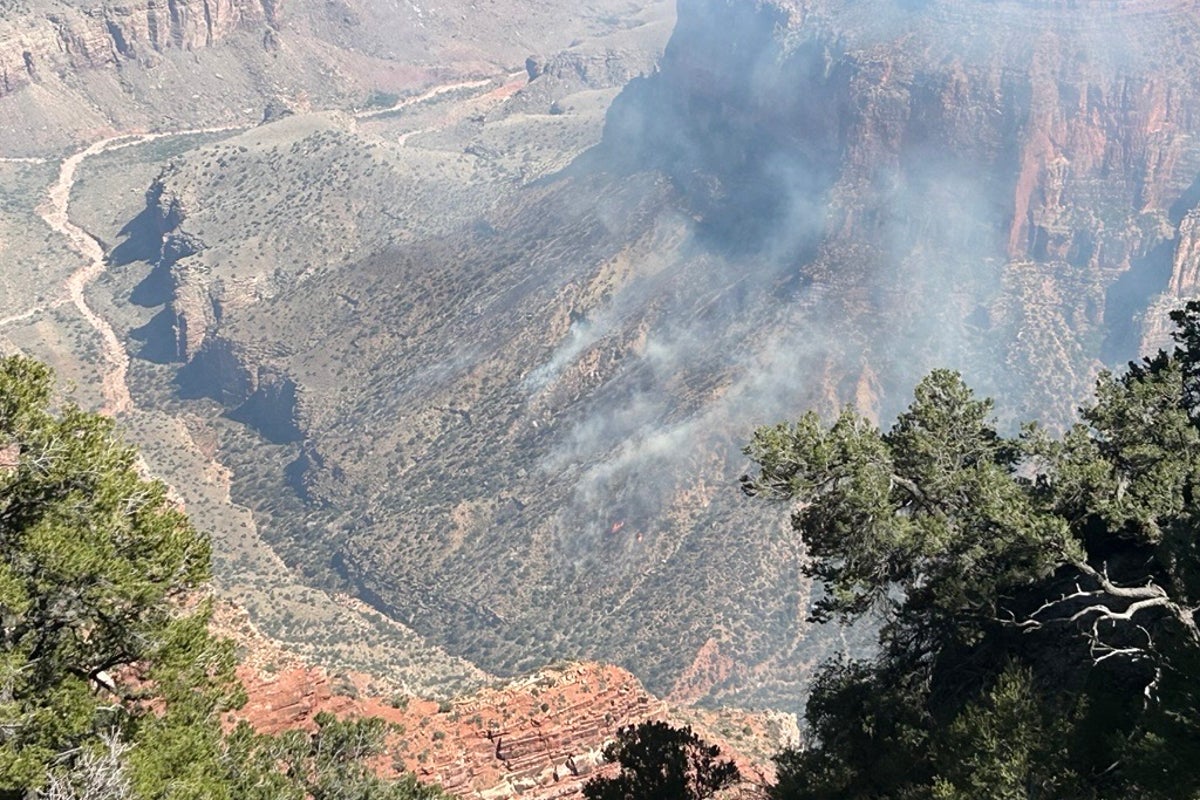
The escalation of wildfire activity within the Grand Canyon ecosystem represents a predictable failure of historical suppression strategies compounded by acute shifts in fuel moisture volatility. When a single geographic region sustains nearly 150,000 acres of burned territory within a single calendar year, only to face immediate, compounding ignitions the following season, the phenomenon ceases to be an isolated natural disaster. It becomes a systemic operational challenge. To understand why fire rages continuously across these critical zones, one must move past superficial reporting and analyze the structural variables driving modern combustion dynamics: fuel load accumulation, microclimate degradation, and the logistical bottlenecks of deep-canyon suppression.
The primary impediment to effective land management in the southwestern United States is the legacy of total fire exclusion. For over a century, federal directives prioritized the immediate extinguishment of all wildland fires. This intervention disrupted the natural low-intensity fire regimes that historically cleared forest floors of organic debris. Today, the consequence of this policy is an unprecedented accumulation of biomass.
The Three Pillars of Fuel Volatility
To evaluate the probability of a catastrophic thermal event, analysts use a tri-archic framework that governs ignition potential and rate of spread.
1. Live Fuel Moisture Content (LFMC)
LFMC measures the ratio of water weight to dry weight in living vegetation. In the sub-alpine and ponderosa pine forests bordering the Grand Canyon, prolonged meteorological droughts have driven LFMC levels below critical thresholds. When living plants drop below 60% moisture content, they cease to act as thermal sinks that absorb heat; instead, they transition into active fuels that accelerate flame front propagation.
2. Contiguous Canopy Architecture
Decades of suppression have altered the spatial distribution of the forest. Trees that once grew in isolated clusters now form dense, unbroken canopies. This structural continuity allows surface fires to transition into crown fires—high-intensity events where flames move horizontally through the tops of trees. Crown fires generate their own localized weather patterns, making direct containment impossible.
3. Surface Fuel Stratification
The forest floor is categorized by the time required for dead fuels to respond to atmospheric moisture changes.
- 1-hour fuels (fine grasses, pine needles) ignite instantly under high temperatures.
- 10-hour and 100-hour fuels (twigs and small branches) sustain the initial build-up of heat.
- 1000-hour fuels (heavy logs exceeding three inches in diameter) dictate the total energy output and duration of the burn.
The current accumulation of 1000-hour fuels within the Grand Canyon basin means that once an ignition occurs, the total thermal output exceeds the suppression capacity of standard ground crews.
The Topographic Chimney Effect
Topography dictates fire behavior within canyon systems, acting as a force multiplier for wind and thermal energy. The Grand Canyon features extreme vertical relief, creating distinct microclimates and complex wind shear patterns that confound traditional modeling software.
As diurnal temperatures rise, air travels upward along the canyon walls. This upslope flow creates a chimney effect. When a fire ignites at the base of a ravine or within the inner gorge, the thermal plume heats the unburned vegetation directly above it via convection and radiation. The rate of upslope fire spread increases exponentially relative to the degree of the incline. A fire moving up a 30-degree slope can travel twice as fast as a fire on flat terrain, independent of wind speed.
This topographic reality introduces severe operational risks for containment crews. Traditional firebreaks, such as dirt roads or hand-cleared lines, are rendered useless when convective heat currents loft burning embers thousands of feet into the air, crossing major geographical barriers and igniting spot fires miles ahead of the main front.
Resource Allocation Boundaries and Suppression Logistics
The logistical complexity of suppressing fires within the Grand Canyon National Park boundary involves a permanent trade-off between personnel safety and resource expenditure. The physical terrain restricts the deployment of heavy mechanized equipment, such as bulldozers, which are standard tools for creating containment lines in flatter jurisdictions.
The primary operational bottlenecks include:
- Access Limitations: Large portions of the inner canyon are accessible exclusively by foot trails or aviation assets. Type 1 hotshot crews must be inserted via helicopter, a process highly dependent on stable atmospheric conditions.
- Aviation Inefficiencies: High-altitude environments alter air density, reducing the maximum payload capacity of air tankers and helicopters. Water and retardant drops carry less volume per sortie compared to operations executed at sea level.
- Hydrological Scarcity: Securing reliable water sources within the canyon to feed ground operations requires extensive pumping infrastructure or continuous aerial transport, diverting critical flight hours away from direct suppression.
Because of these constraints, fire management personnel must rely on indirect suppression strategies. Rather than fighting the fire at its burning edge, teams retreat to defensible ridges or pre-existing road networks, conceding significant acreage to the flame front in exchange for a higher probability of eventual containment.
The Financial Realities of Managed Wildfire
The economic cost function of modern wildland firefighting has shifted from seasonal emergency spending to a permanent capital drain. The traditional metric of success—total acres suppressed—fails to capture the long-term ecological and economic liabilities incurred by continuous high-intensity burns.
When 150,000 acres burn in a single cycle, the immediate fiscal impact includes suppression expenditures, aviation fuel, and emergency personnel overtime. The secondary, long-term costs are often greater. These include the destruction of critical watershed infrastructure, the eradication of old-growth seed sources, and the subsequent cost of post-fire stabilization to prevent catastrophic debris flows during monsoon seasons.
Soil scorched by high-intensity crown fires undergoes a chemical transformation, becoming hydrophobic. When rain falls on hydrophobic soil, water cannot penetrate the surface. This leads to immediate runoff, generating flash floods laden with ash and heavy debris that scour trout streams and compromise municipal water supplies downstream.
Operational Transition Toward Pyrosilviculture
To break the cycle of annual emergency response, land management agencies must transition from a reactive posture to a proactive model based on pyrosilviculture—the deliberate use of fire as a silvicultural tool to manage forest density and resilience.
Executing this strategy requires a calculated acceptance of short-term risk. Prescribed burning operations must be scaled up significantly during the shoulder seasons (late autumn and early spring) when atmospheric moisture and wind profiles are highly predictable. These managed burns target the fine 1-hour and 10-hour surface fuels, effectively breaking the fuel continuity required for low-intensity surface ignitions to transition into catastrophic crown fires.
The limiting factor in this approach is the narrow regulatory and environmental window available for execution. Air quality standards, proximity to urban centers, and the unpredictable nature of sudden wind shifts mean that only a fraction of scheduled prescribed burns can be safely initiated each year. Nevertheless, failing to expand these operations guarantees that atmospheric conditions will eventually choose the time and place of the next ignition, under conditions optimized for maximum destruction.
The current fire activity at the Grand Canyon is not a statistical anomaly. It is the mathematical equilibrium of an over-accumulated fuel system meeting unavoidable atmospheric triggers. True stabilization of the basin requires a structural shift in management philosophy: acknowledging that fire cannot be entirely eliminated from the ecosystem, but its intensity can be negotiated through aggressive, systematic fuel reduction programs before the next dry lightning front arrives.