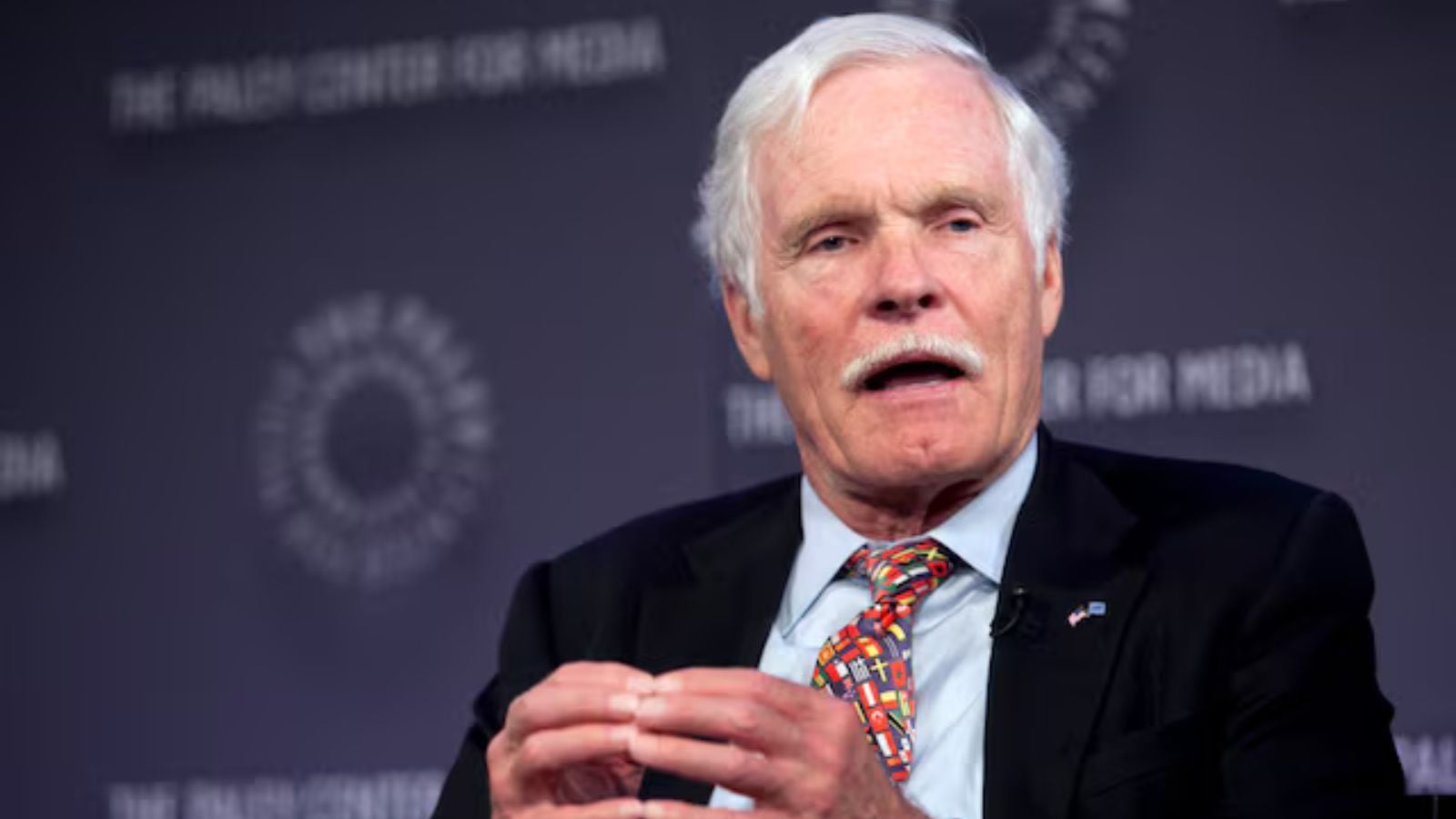
The death of Ted Turner at 87 marks the end of the pioneer who transitioned the global information economy from a scarcity model to an abundance model. Before Turner, the American media environment operated as a high-barrier oligopoly, controlled by three broadcast networks (ABC, CBS, NBC) that dictated the timing and selection of "the news." Turner’s intervention was not merely the creation of a 24-hour channel; it was a fundamental re-engineering of the information supply chain. By decoupling news consumption from a fixed schedule, Turner shifted power from the gatekeeper to the consumer, establishing the blueprint for the real-time, fragmented digital ecosystem that exists today.
The Mechanics of the News-as-a-Utility Framework
Turner’s primary strategic innovation was treating news as a continuous utility rather than a scheduled event. This shift can be analyzed through three distinct operational pillars:
- Temporal Arbitrage: In the pre-CNN era, news had a "shelf life" of 24 hours, condensed into a 30-minute evening window. Turner realized that news events happen on a continuous spectrum. By filling 1,440 minutes of airtime daily, he captured the value of "breaking" information long before the broadcast incumbents could respond.
- Infrastructure Over Content: While rivals focused on the prestige of anchors, Turner focused on the distribution network. He utilized satellite technology (specifically RCA's Satcom 1) to bypass traditional local affiliate structures. This allowed for a direct-to-cable model that scaled horizontally across the United States at a fraction of the cost of maintaining a physical broadcast towers network.
- Low-Cost Content Aggregation: Early CNN operated on "The Turner Discount"—the ability to hire young, hungry talent and leverage non-union labor to produce high volumes of content. This permitted a high-output, low-margin model that the high-cost broadcast giants could not replicate without cannibalizing their own profit margins.
The Network Effect and the CNN Effect
Turner’s second major contribution was the internationalization of the American perspective, often referred to as the "CNN Effect." This term describes the phenomenon where real-time imagery of global crises forces immediate policy responses from world leaders.
The logic follows a specific causality loop:
- Presence: CNN’s 24-hour cycle required global bureaus to feed the "beast" of constant airtime.
- Visibility: Real-time footage of a conflict or famine enters the living rooms of the electorate.
- Public Pressure: The electorate demands action based on the emotional weight of the imagery.
- Policy Acceleration: Governments are forced to act on compressed timelines, often before intelligence agencies have fully vetted the situation.
This mechanism fundamentally changed the speed of diplomacy. Turner realized that a news network could function as a non-state actor with more influence than middle-power nations. His decision to broadcast live from Baghdad during the 1991 Gulf War proved that the "front line" was no longer a geographic boundary but a broadcast signal.
The Vertical Integration of Entertainment and Sports
Turner was an early practitioner of ecosystem lock-in. He recognized that news alone was a volatile commodity subject to the fluctuations of the news cycle. To stabilize revenue, he built a vertically integrated media stack that utilized the same satellite infrastructure:
- WTBS and the Superstation Concept: By broadcasting his local Atlanta station via satellite to cable systems nationwide, he created a national advertising platform overnight.
- Asset Acquisition as Content Strategy: Purchasing the Atlanta Braves (MLB) and the Atlanta Hawks (NBA) was not a vanity project; it was a move to secure low-cost, high-engagement live programming for his channels. He owned the team, the stadium, the broadcast rights, and the network that aired them.
- Library Accumulation: The acquisition of the MGM film library and the Hanna-Barbera catalog provided the "long-tail" content necessary to launch TCM and Cartoon Network. This transformed Turner Broadcasting System (TBS) from a news organization into a diversified media conglomerate.
The Cost of Consolidation: The Time Warner Error
The 1996 merger of Turner Broadcasting System with Time Warner represents the definitive case study in the risks of over-leverage and cultural misalignment. Turner, who became the largest individual shareholder of the combined entity, saw his operational control diluted in a move designed to achieve "synergy."
The subsequent 2000 merger with AOL is widely cited as the worst deal in corporate history. The failure of this merger highlights a critical limitation in Turner’s strategy: platform agnosticism. While Turner was a master of the satellite and cable era, he (and the Time Warner leadership) failed to grasp that the internet was not just another distribution channel, but a decentralized competitor that would eventually unbundle the cable package he helped build.
The "AOL-Time Warner" failure was a collision of two incompatible cost structures. Time Warner was a high-CAPEX, physical asset business; AOL was a high-growth, low-retention tech service. The internal friction resulted in the loss of billions in market capitalization and Turner’s eventual exit from the company he founded.
Philanthropy and the $1 Billion Mechanism
Turner’s 1997 pledge of $1 billion to United Nations causes was not an act of simple charity, but a strategic move to address the systemic failures of national governments. He viewed the UN as a necessary but underfunded global infrastructure.
By structuring the gift over ten years through the United Nations Foundation, he created a sustained funding mechanism that bypassed the political gridlock of the U.S. Congress, which was frequently in arrears on UN dues. This move pioneered the "Giving Pledge" model later popularized by Bill Gates and Warren Buffett, emphasizing that extreme wealth should be deployed toward solving "macro-problems" like nuclear proliferation and environmental degradation.
The Legacy of 24-Hour Information Saturation
While Turner is celebrated for democratizing information, his model also birthed the structural flaws of modern media:
- The Content Vacuum: Filling 24 hours often requires elevating trivialities to the status of "Breaking News" to maintain viewership metrics.
- The Polarization Feedback Loop: As the market for news became more saturated, networks shifted from "objective reporting" to "ideological catering" to retain loyal audiences. CNN’s success paved the way for more partisan iterations like Fox News and MSNBC.
- The Commoditization of Crisis: The constant stream of high-stakes information leads to "compassion fatigue," where the audience becomes desensitized to global suffering due to the sheer volume of exposure.
Strategic Assessment of the Post-Turner Era
The current media landscape is undergoing a second unbundling. Turner unbundled the news from the 6:30 PM time slot; the internet has now unbundled the news from the television set. The "news cycle" has shifted from 24 hours to 280 characters.
The primary challenge for current media executives is managing the transition from the high-margin, "locked-in" cable bundle to the low-margin, high-churn subscription economy. Turner’s brilliance was in owning the pipes (cable/satellite) and the water (content). Today, the pipes are owned by ISPs and big tech, while content is increasingly fragmented among independent creators.
The terminal move for any media entity surviving this shift is a return to Turner’s original scarcity play. In a world of infinite AI-generated content, "live-ness" and "verified presence" become the only non-commoditized assets. The organizations that thrive will be those that pivot away from being "networks" and toward being "validation engines." The strategic play is no longer about having the most minutes to fill; it is about owning the moments that the global market cannot afford to ignore.