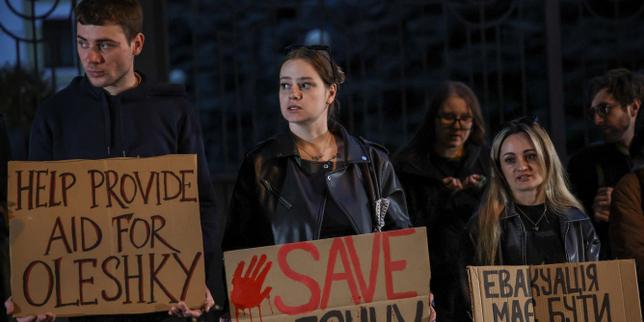
The Comfort of Despair Narratives
Headlines love a tragedy because tragedy sells subscriptions. Pick up any mainstream wire service report concerning the occupied left bank of the Kherson region, specifically the municipality of Oleschky, and you will find a predictable script. The narrative always features desperate civilians trapped in sub-human conditions, isolated from civilization, waiting passively for a dramatic rescue by exterior forces. It is a clean, emotionally resonant script that appeals to our worst anxieties and our deepest savior complexes.
It is also profoundly wrong.
When international journalists rely on secondhand accounts filtered through Telegram channels and filtered communications, they miss the gritty, highly adaptive mechanics of how actual occupied populations survive, adapt, and occasionally outmaneuver their occupiers. The lazy consensus says Oleschky is a static ghost town of pure misery. The reality on the ground is a complex, underground gray economy, a masterclass in decentralized resilience, and a silent war of economic and social attrition that standard reporting completely ignores.
Let us dismantle the mythology piece by piece.
The Myth of Complete Isolation
The primary falsehood peddled by standard coverage is the idea of total information and physical blockade. We are led to believe that once a settlement falls behind the contact line, it drops off the edge of the earth into a 1984-style blackout.
Logistics never stop for a border, especially not a fluid military one. Long before the current geopolitical flashpoints, the geography of the Dnipro delta made smuggling and informal trade an art form. Today, that informal trade has scaled into an essential lifeline that bypasses official military checkpoints entirely. Cash still flows, digital currencies change hands via encrypted nodes, and supply chains for medicine, fuel, and foodstuffs operate through a sprawling network of local operators who know every dirt track and river inlet.
To claim that residents are entirely cut off from the outside world is to misunderstand modern gray-zone survival. People are not sitting in dark cellars waiting for bread rations; they are running parallel distribution networks that would make supply chain executives in Fortune 500 companies sweat.
The Economics of Occupation
We need to talk about money because money dictates survival, not ideological speeches. Mainstream pieces treat occupied zones as economic voids where currency has lost all meaning.
In Oleschky, a brutal multi-currency reality exists. Rubles, hryvnias, and digital assets coexist in a volatile ecosystem of arbitrage. Local merchants and entrepreneurs who stayed behind—often dismissed unfairly by distant commentators as collaborators—are actually the shock absorbers keeping communities alive. They navigate administrative nightmares, pay protection fees to various military elements, and import goods at exorbitant risk to keep shelves stocked.
I have spoken with logistics fixers who operate across these gray zones. They do not care about geopolitical rhetoric; they care about margins, risk mitigation, and keeping their extended families fed. When a media outlet paints everyone remaining in an occupied zone with a broad brush of either victimhood or betrayal, it erases the pragmatic middle ground where actual human life persists. Surviving an occupation requires an ironclad stomach, zero illusions about morality, and a keen sense of market dynamics.
The Information Underground
Another favorite trope of the mainstream press is that occupation leads to total psychological subjugation through propaganda. The assumption is that without free media, the local population swallows the narrative broadcast on state television hook, line, and sinker.
Human beings are naturally resistant to obvious lies, especially when those lies contradict the smoking ruins outside their window. What actually happens is a sophisticated cognitive compartmentalization. Residents develop an acute filter. They nod along when necessary to survive administrative hurdles while maintaining entirely separate internal and digital networks of truth.
Virtual private networks, encrypted chat groups, and old-fashioned word-of-mouth create an informational bubble that is remarkably resilient. People know what is happening three streets over long before any official report is published. They calculate risks based on direct observation, not broadcast media. To underestimate the cognitive autonomy of people living under occupation is an insult to their intelligence. They are not brainwashed; they are calculating.
Why the Despair Narrative Serves No One
Why do reporters cling so tightly to the story of total despair? Because it demands nothing of the reader except pity. Pity is a cheap emotion. Pity allows people thousands of miles away to click a link, feel a pang of sadness, share the article on social media, and then go back to their morning coffee without changing a single action.
The despair narrative strips agency away from the occupied. It turns them into props in a geopolitical tragedy rather than active agents navigating an impossible hand. When you reduce a community of thousands of distinct individuals to a monolith of suffering, you miss the friction, the internal politics, the local power struggles, and the quiet acts of resistance that matter far more than symbolic gestures.
Real resilience is ugly, messy, and rarely photogenic. It involves compromises that make comfortable observers uncomfortable. It involves black markets, currency juggling, tactical silence, and sometimes playing two sides against each other just to ensure grandmother gets her heart medication.
Stop looking at Oleschky as a graveyard. Look at it for what it actually is: a brutal, functioning microcosm of human adaptability under extreme pressure. Until we learn to respect the complexity of survival over the comfort of simple tragedy, our analysis will remain as hollow as the headlines we consume.