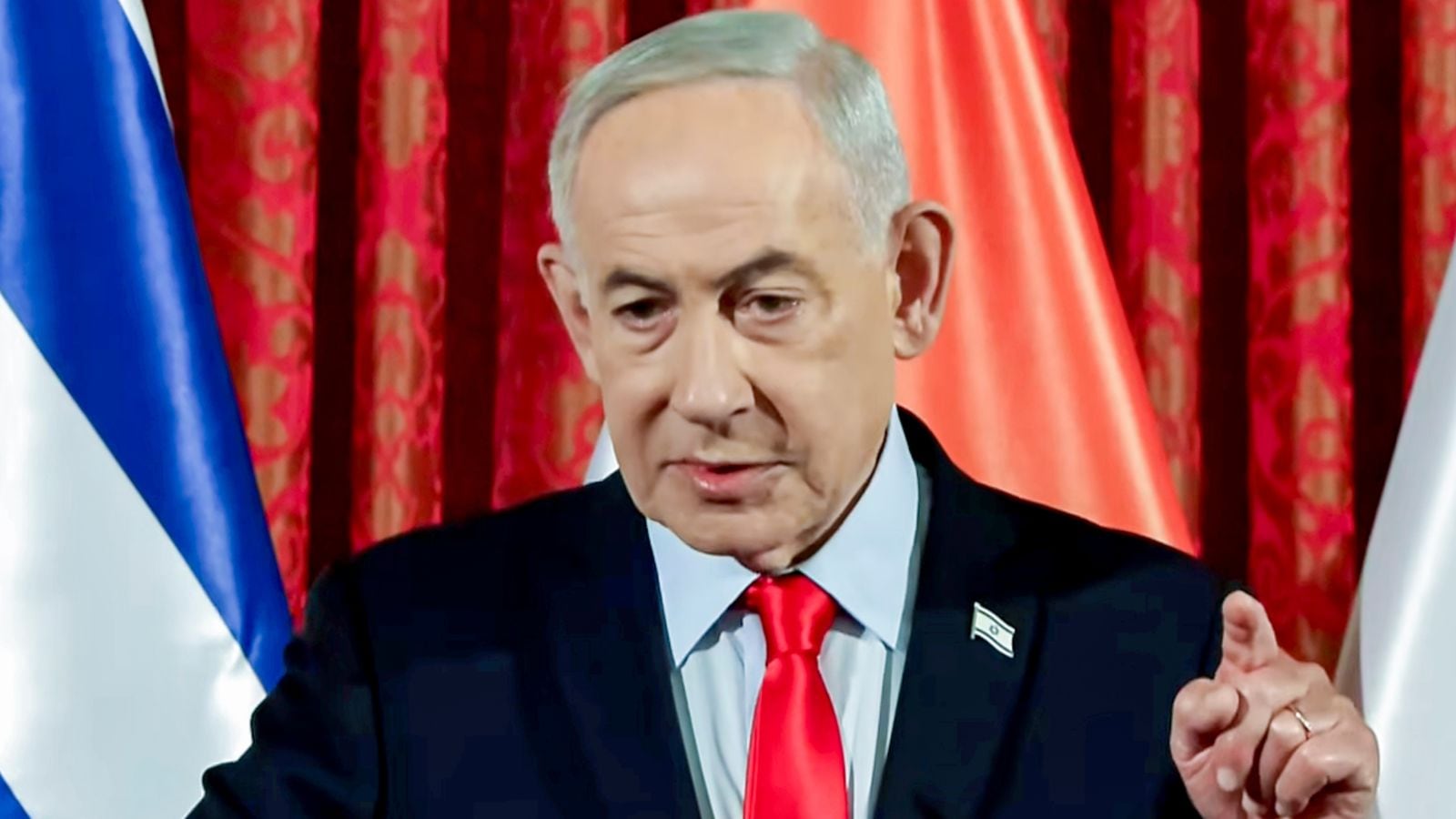
The glow of a smartphone screen is often the only light in a Tehran bedroom after midnight. For a young woman we will call Roya—a student who remembers the taste of tear gas from the 2022 protests—the internet is a battlefield of bypasses, VPNs, and flickering hope. She scrolls through a digital world that her government tells her does not exist. Then, a video appears. It is not a viral dance or a cooking tutorial. It is a man speaking from a polished desk in Jerusalem, addressing her directly in a language of shared history and impending fire.
Benjamin Netanyahu did not just issue a military briefing this week. He issued an invitation to a revolution.
The Israeli Prime Minister looked into the camera and told the Iranian people that their leaders—the men in the grey robes and the black turbans—are more afraid of their own citizens than they are of any F-35 fighter jet. He spoke of a "countdown" that has already begun. He spoke of striking thousands of targets. But the most potent weapon he brandished wasn't a missile. It was the suggestion that the Persian people are living in a temporary occupation, waiting for the moment the walls finally crumble.
Consider the sheer weight of that psychological gamble. While the world watches the flight paths of drones and the coordinates of nuclear enrichment sites, a different kind of war is being fought over the dinner tables of Isfahan and the cafes of Tabriz. The Israeli strategy has shifted. It is no longer just about degrading a military capability; it is about delegitimizing a regime by whispering to the people it oppresses.
The facts of the escalation are cold and jagged. Following a massive Iranian ballistic missile barrage, Israel has signaled that its response will be "lethal, precise, and especially surprising." We aren't talking about a symbolic gesture. We are talking about the systematic dismantling of an entire infrastructure. Yet, Netanyahu’s speech suggests that the kinetic strikes are merely the percussion for a much larger symphony. He wants the Iranian public to see every explosion as a crack in the regime’s foundation, rather than an attack on the Iranian nation itself.
It is a distinction that is notoriously difficult to maintain once the sirens start wailing.
History is littered with leaders who thought they could separate a people from their government with a few well-placed bombs and a stirring speech. Usually, the opposite happens. External threats tend to act like a forge, hammering a fractured population into a single, defiant blade. But the Israeli gamble rests on the belief that Iran is different. They are betting on the idea that the "Woman, Life, Freedom" movement didn't die; it just went underground to wait for a catalyst.
The tension in the region is now a physical thing. You can feel it in the fluctuations of the rial, Iran’s plummeting currency, and you can see it in the frantic diplomatic shuttles across the Middle East. For the average Iranian, the stakes are not academic. If Israel strikes the oil refineries, the economy—already gasping for air—might finally suffocate. If they strike the power grid, the darkness will be literal.
Netanyahu’s message to the Iranians was clear: This doesn't have to be your war.
He painted a picture of a future where the two nations, heirs to ancient civilizations, are partners in technology, medicine, and peace. It is a seductive vision. It is also one that requires the Iranian people to take a risk that has cost thousands of their children their lives in the streets of Tehran. The Prime Minister is asking them to be the anvil while he provides the hammer.
But the real problem lies elsewhere. Within the halls of power in Tehran, the rhetoric is just as absolute. The Supreme Leader and his generals view any Israeli communication as a violation of sovereignty, a psychological operation designed to mask "Zionist aggression." They counter Netanyahu’s videos with footage of their own underground missile cities, vast honeycombs of concrete and steel tucked away in the mountains, meant to show that the regime is unshakeable.
They are wrong. Everything shakes eventually.
The question is what happens when the first "surprising" strike occurs. If Israel hits the IRGC headquarters or the leadership bunkers, does the Iranian public cheer in the shadows, or do they recoil in nationalistic pride? There is no data point for this. No algorithm can predict the soul of a nation under duress.
We often talk about "targets" as if they are points on a map. They are also workplaces. They are neighbors. When Netanyahu says he will strike thousands of targets, he is describing a campaign that would be the largest aerial operation in the region’s modern history. The logistical tail of such an event is staggering. It involves refueling tankers circling over neutral countries, electronic warfare suites jamming entire frequencies, and search-and-rescue teams on high alert for the possibility of a pilot being downed in enemy territory.
The complexity of the mission is why the rhetoric has become so heated. When the physical risks are this high, the psychological preparation must be absolute. By telling the Iranians to "overthrow the regime now," Netanyahu is attempting to create a second front—an internal one. He is trying to force the Iranian security forces to look behind them at their own people, even as they look up at the sky for the arrival of the IAF.
Roya, sitting in her room in Tehran, hears these words and feels a terrifying blend of hope and dread. She knows that the "liberation" Netanyahu promises could come at a cost that her neighborhood might not survive. She knows that when giants fight, it is the earth that suffers. Yet, she also knows the name of every friend who disappeared into the Evin prison.
The invisible stakes are the lives of millions of people who have been trapped in a forty-year cold war that is suddenly turning white-hot.
Logic suggests that the Iranian regime will not simply fold because of a video message. They have spent decades building a domestic security apparatus designed specifically to survive a popular uprising. They have "Basij" militias on every corner and cameras with facial recognition in every metro station. They are experts in the art of staying in power through fear.
But fear is a brittle thing. It works perfectly until, one day, it doesn't work at all.
As the Israeli cabinet meets and the flight crews receive their final briefings, the world waits for the sound of the first explosion. We analyze the range of the Jericho missiles and the payload capacity of the F-15I Ra'am. We debate the "proportionality" of the coming strike. But we should be looking at the faces of the people in the videos.
Netanyahu has laid down a marker. He has staked his reputation and his country's security on the gamble that the Iranian people are ready to trade their rulers for their future. It is a play for the history books, a move that transcends mere military strategy and enters the realm of epic drama.
Consider what happens next: a flash in the night, a roar of engines, and the sudden, violent realization that the status quo has evaporated forever. Whether that leads to the "freedom" promised in the speech or a cycle of regional chaos that swallows another generation remains the great, terrifying unknown.
The message has been sent. The targets have been selected. The planes are fueled. And somewhere in Tehran, a young woman turns off her phone, stares into the darkness, and wonders if this is the end of her world, or the beginning of a new one.
The silence before the storm is never truly silent; it is filled with the heartbeat of a million people waiting to see if the sky will fall or open up.