The sound is what stays with you. It isn't the ethereal hum of a cooling fan or the silent, frantic pulse of electrons moving through silicon. Instead, it is a rhythmic, metallic clatter—the sound of teeth meeting, of springs tensioning, and of bolts sliding home. It sounds like a clockmaker’s workshop on the verge of an epiphany.
This is the heartbeat of a computer that doesn't need a single drop of electricity to think.
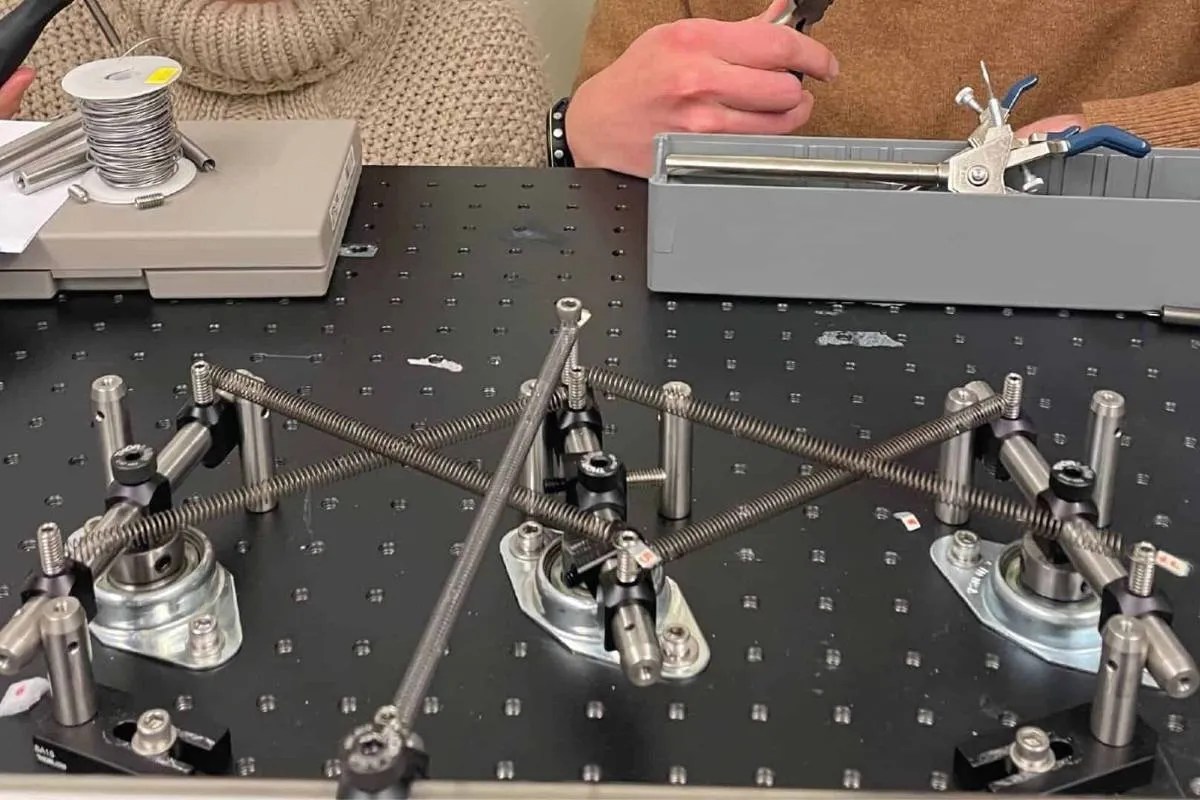
In a laboratory at North Carolina State University, a team of researchers led by Jie Yin has done something that feels like a step backward into a Victorian fever dream, yet it carries the weight of our digital future. They have built a functional computer out of plastic cubes, springs, and moving plates. No chips. No wires. No batteries. Just the cold, hard logic of geometry and physical force.
We have spent the last seventy years convincing ourselves that "computing" is synonymous with "electricity." We equate intelligence with the movement of subatomic particles through etched pathways so small they defy the naked eye. But this reliance has made our most advanced tools fragile. Take away the power grid, and our civilization’s collective memory vanishes. Expose a microchip to a solar flare or a high-heat environment, and it fries.
The mechanical computer reminds us that logic is not a ghost in the machine. Logic is a physical property of the universe.
The Anatomy of a Click
To understand how a handful of 3D-printed cubes can perform math, you have to stop thinking about code and start thinking about space.
Imagine a single translucent cube. Inside this cube sits a flexible plastic structure that can be pushed up or pulled down. This isn't just a toy; it is a bit. In your smartphone, a bit is a transistor holding an electrical charge. Here, a bit is a physical state. If the internal structure is pushed up, it represents a 1. If it is pulled down, it represents a 0.
When you connect these cubes, you aren't soldering wires. You are linking physical movements. When you pull on one side of the structure, the movement triggers a chain reaction. One cube shifts, which forces the next to snap into place, which causes a third to rotate. This is a "universal logic gate." By simply changing how these blocks are arranged, the researchers can force the system to perform addition, subtraction, or even complex encryption.
The researchers call it "Physical Complexity." I call it a return to the tactile.
There is a specific kind of satisfaction in watching this machine solve a problem. In a digital interface, the "answer" appears instantly, disconnected from the process. In this mechanical system, you see the struggle. You see the tension building in the springs as the "input" is introduced. You watch the ripple effect as the cubes communicate through sheer physical contact. Then, with a final, resonant clack, the system settles into its final configuration. The answer isn't a glow on a screen; it is a physical shape.
The Stakes of a Silent World
Why would anyone spend years of their life building a computer that is slower than a 1980s calculator and made of plastic?
The answer lies in the places where we cannot go.
Consider a deep-sea probe exploring the crushing depths of the Mariana Trench, or a sensor tucked inside the hellish, pressurized environment of a geothermal vent. In these places, electronics fail. Heat melts the delicate connections within a chip. Pressure crushes the tiny air pockets required for traditional hardware to function.
But a mechanical computer doesn't care about heat. It doesn't care about electromagnetic pulses that would wipe a hard drive clean. It is a survivalist.
The researchers discovered that by using these bistable "clippable" units, they could create a system that stores memory without needing power to maintain it. If you set a mechanical computer to "5" and walk away for a hundred years, it will still be "5" when you return, even if the world has ended in the meantime. It is permanent. It is stubborn.
The Ghost of Charles Babbage
There is a historical haunting at play here. In the mid-1800s, Charles Babbage obsessed over his Difference Engine and later his Analytical Engine. He envisioned vast, steam-powered forests of brass gears that could calculate logarithms. He died before he could see it fully realized, largely because the manufacturing precision of his era couldn't keep up with the complexity of his mind.
We moved on. We discovered the vacuum tube, then the transistor, and we left the dream of the mechanical mind in the dust of the industrial revolution.
Yet, here we are, 150 years later, realizing that Babbage was right. There is a specific kind of reliability that only physical mechanisms can provide. The North Carolina State team isn't just playing with blocks; they are refining Babbage’s ghost for a world that has become too dependent on the flicker of a light switch.
They have moved beyond simple gears. By using "reconfigurable" modules, they’ve created a system that can be reprogrammed without changing the parts. You don't rewrite the code; you rearrange the architecture. It is a computer that is its own hardware and its own software, intertwined in a dance of plastic and tension.
The Weight of the Invisible
We often feel like technology is something that happens to us, a series of invisible miracles we don't understand and can't control. When your computer crashes, you are helpless. You can't see what's wrong. You can't touch the broken bit.
But with Jie Yin’s cubes, the mystery is stripped away. If the computer fails to add two numbers, you can look at the cubes and see exactly where the movement stopped. You can see the spring that didn't catch or the block that was misaligned. It restores a sense of agency to the user. It makes the abstract tangible.
There is a profound beauty in the vulnerability of this work. The researchers admit that these systems are currently slow. They aren't going to replace the CPU in your laptop tomorrow. But they aren't trying to. They are building a backup for reality.
They are creating a way for logic to survive in the dark, in the heat, and in the silence of space. They are proving that even if we lost every power plant on Earth, the fundamental laws of mathematics could still be harnessed by something as simple as a well-placed bolt and a sturdy spring.
As the sun sets over the laboratory, the researchers prepare another test. They pull a trigger. The air fills with that distinctive, rhythmic clatter. It is the sound of a machine thinking for itself, powered by nothing but the intent of the person who touched it. It is a reminder that even in an age of AI and quantum bits, the most reliable things in this world are the ones you can hold in your hand.
The machine finishes its task. The springs go still. The logic is set in stone, or rather, in plastic. It sits there, silent and certain, waiting for the next physical push to bring its metallic mind back to life.