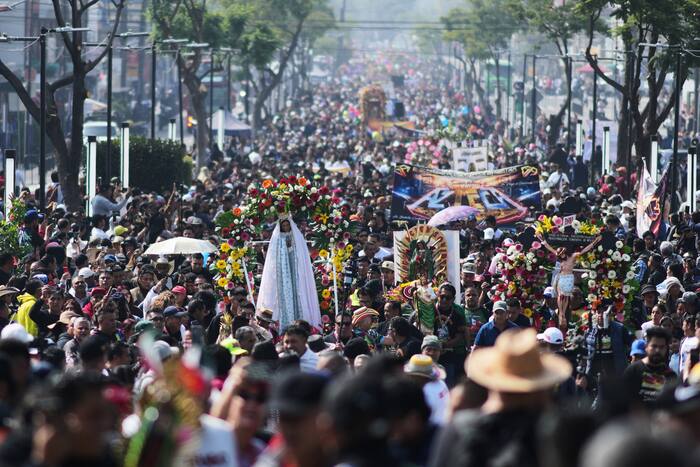
Walk down the Calzada de Guadalupe in Mexico City on the night of December 11, and your chest will rattle before you ever see the church. The bass hits first. It isn't coming from a nightclub or an underground rave, though it sounds just like one. It's pouring out of towering stacks of speakers strapped to flatbed trucks, accompanied by strobes, fog machines, and thousands of exhausted walkers suddenly dancing in the street.
Most outsiders picture a Catholic pilgrimage as quiet, somber, and strictly traditional. They expect whispered rosaries, solemn hymns, and heads bowed in silence. And while you'll definitely find plenty of quiet devotion among the millions of people marching toward the Basilica of Our Lady of Guadalupe, you'll also find sonideros—Mexico's legendary street DJs—turning the entire route into an open-air block party. For a different perspective, see: this related article.
If you don't understand Mexican popular culture, this mashup looks like a contradiction. How do heavy cumbia basslines, flashing neon lights, and shout-outs over a microphone fit into one of the largest religious gatherings on the planet? Honestly, once you see it in person, it makes total sense. Devotion in Mexico doesn't sit quietly in a pew. It spills onto the pavement, plugs into a generator, and turns up the volume.
What Is the Basilica of Guadalupe Pilgrimage?
Every year around December 12, millions of Catholics travel from every corner of Mexico—and plenty of other countries—to the Basilica of Our Lady of Guadalupe in northern Mexico City. The date marks the Feast of Our Lady of Guadalupe, commemorating the 1531 apparitions of the Virgin Mary to Saint Juan Diego on Tepeyac Hill. Similar coverage on this trend has been shared by BBC News.
The scale is hard to wrap your head around until you're stuck in the crowd. Depending on the year, municipal authorities in Mexico City regularly record anywhere from 10 million to over 12 million visitors arriving at the Basilica during the mid-December window. Many walk for days along major highways from neighboring states like Puebla, Estado de México, Querétaro, and Tlaxcala. Some crawl the final stretch on their knees as part of a manda—a personal vow made in exchange for a miracle, a healed relative, or safe passage through a hard year.
Because millions of people are moving on foot through the cold December night, the pilgrimage has always relied on community support along the route. Neighbors set up tables handing out free coffee, tamales, oranges, and bottled water. Mechanics offer free tire patches for support vehicles. And right alongside the food stalls and first-aid tents, you'll find the sound systems.
How Sonidero Culture Took Over the Pilgrimage Route
To understand why there are DJs blasting music for pilgrims, you have to understand sonideros. The sonidero movement started decades ago in working-class neighborhoods of Mexico City like Tepito and Peñón de los Baños. At its core, a sonidero isn't just a DJ playing tracks off a laptop. It's a mobile sound-system culture built around massive custom speaker walls, vinyl and digital cumbia, salsa, and guaracha records, and a charismatic announcer on the mic.
The defining feature of a sonidero set is the saludo—live shout-outs spoken directly over the music, often drenched in heavy reverb and echo effects. A sonidero reads out names of families, neighborhoods, markets, and friends, weaving the crowd directly into the soundtrack.
When working-class neighborhoods organize their annual peregrinación to the Basilica, bringing their local sonidero isn't an add-on. It's the centerpiece of the neighborhood's presence. Many sound-system operators are devout Catholics themselves. Setting up their rig along the Calzada de Guadalupe or marching behind a truck loaded with speakers is their own manda—their way of thanking the Virgin of Guadalupe for a year of steady gigs, safe travels on the road, and family health.
Instead of charging their usual booking fees, these DJs burn their own diesel, haul tons of audio gear, and play through the night for free.
What Happens When the Beat Drops on Calzada de Guadalupe
Around midnight on December 11, the atmosphere along the avenues leading to Tepeyac Hill shifts into high gear. After hours of walking in chilly weather—Mexico City December nights regularly dip into the single digits Celsius—fatigue sets in fast. Muscles cramp. Feet blister. People wrap themselves in thermal blankets and carry framed statues of the Virgin strapped to their backs.
Then they hit a block where a sonidero has parked a flatbed rig.
Suddenly, a classic Colombian or Mexican cumbia rebajada (slowed-down cumbia) echoes off the concrete buildings. The DJ grabs the mic and booms out a greeting to the crew arriving from Iztapalapa, or Ecatepec, or Nezahualcóyotl. Exhausted pilgrims drop their backpacks, form a circle on the asphalt, and start dancing. For ten or fifteen minutes, the physical pain of a 40-kilometer walk disappears into the rhythm.
It isn't just cumbia, either. Depending on who's running the booth, you'll hear:
- Traditional and slowed-down cumbia: The backbone of sonidero culture, heavy on accordion, guacharaca, and sub-bass that carries down the boulevard.
- Salsa and guaracha: Fast, percussive tracks that wake up tired legs around 3:00 AM when the temperature hits its lowest point.
- Traditional mañanitas remixes: As midnight strikes and December 12 officially begins, speakers switch over to "Las Mañanitas"—Mexico's traditional birthday song—sung in honor of the Virgin, often blending mariachi vocals with electronic basslines.
- Live microphone blessings: DJs pausing the beat to ask the Virgin for protection over the neighborhood's youth, truck drivers, or sick relatives.
Why Critics Misunderstand the Music and Lights
Whenever videos of flashing lights, fog machines, and dancing crowds go viral during the Guadalupe pilgrimage, a predictable debate pops up online. Outsiders—and even some conservative commentators—question whether turning a sacred walk into a street dance disrespects the religious nature of the event.
That argument misses how Mexican Catholicism actually functions on the ground.
Catholicism in Mexico has never been a sterile, quiet affair. From the syncretic traditions blending Indigenous Nahua rituals with Spanish Catholicism in the 16th century to modern patron-saint festivals (fiestas patronales) in tiny rural towns, celebration and devotion have always occupied the same space. Fireworks, brass bands (bandas), costumed conchero dancers wearing feathered headdresses, and loud music aren't distractions from faith. They're expressions of joy and gratitude.
As Mexican cultural anthropologists and chroniclers of urban life have long pointed out, the street is where working-class communities claim ownership of their faith. Inside the Basilica itself, clergy maintain traditional liturgical order—masses run back-to-back, priests bless crowds with holy water, and security keeps foot traffic moving smoothly past the famous tilma of Juan Diego. Outside on the avenues, the people run the show in their own language. And in Mexico City's working-class barrios, that language is bass and cumbia.
Inside the Logistics of a Mobile Pilgrimage Sound System
Pulling off a street set during the pilgrimage takes serious work. You can't just roll up with a Bluetooth speaker and expect to be heard over millions of voices, marching bands, firecrackers, and ambulance sirens.
Experienced sonideros treat December 11 like their biggest production of the year. Crews spend days prepping amplifiers, checking wiring, and loading heavy wooden speaker cabinets—often custom-built bass bins—onto trucks. Because municipal power outlets aren't sitting on street corners waiting for DJs, every mobile setup runs on industrial gas or diesel generators strapped to the truck bed.
Noise ordinances and crowd-control rules also play a role. Mexico City's Secretariat of Citizen Security (SSC) and the Gustavo A. Madero borough authorities deploy thousands of officers, paramedics, and civil protection workers around the Basilica perimeter every December. Sound systems generally have to stay in designated zones along approach routes rather than blocking the immediate plaza gates, where crowd density can become dangerous. Smart operators coordinate with local neighborhood committees so their trucks don't choke off emergency lanes for ambulances.
What You Need to Know If You Plan to Witness It
If you're visiting Mexico City in December and want to experience the pilgrimage firsthand, don't just show up at noon on December 12 expecting to stroll into the church. You'll get stuck in a wall-to-wall bottleneck and miss the real energy of the event.
Here is how to actually experience it safely and respectfully:
- Go on the night of December 11: The peak energy happens between 9:00 PM on December 11 and 3:00 AM on December 12. That's when the neighborhood processions arrive, the sonideros are in full swing, and the countdown to Las Mañanitas builds up.
- Walk the approach routes, not just the atrium: Start a couple of kilometers south along Calzada de Guadalupe or Calzada de los Misterios and walk north with the crowd. That's where the street DJs, food stalls, and neighborhood banners live.
- Leave bulky bags and valuables at your hotel: Pickpockets work dense crowds every year. Carry only cash in a front pocket, your phone, a portable charger, and a light jacket—it gets cold once you stop walking.
- Take the Metro, not a rideshare: Streets around La Villa are closed to private vehicles for blocks. Take Metro Line 3 or Line 6 to stations near the perimeter (keep in mind the closest stations sometimes close temporarily at peak hours, so check local transit alerts that evening and walk the final stretch).
- Respect the space: You're welcome to watch, dance when invited, and soak in the atmosphere, just remember you're standing in the middle of deeply personal vows. Don't shove cameras into the faces of people crawling on their knees or praying in tears.
The beauty of the Guadalupe pilgrimage lies in how effortlessly it holds two extremes at once. Ten meters away from a grandmother whispering a tearful prayer with a candle in her hand, a teenager in a custom airbrushed hoodie is two-stepping to a reverb-heavy cumbia track blasting off a flatbed truck. Neither cancels the other out. In Mexico City, faith doesn't ask you to stay quiet—it asks you to show up, bring what you have, and make some noise for the Virgin.