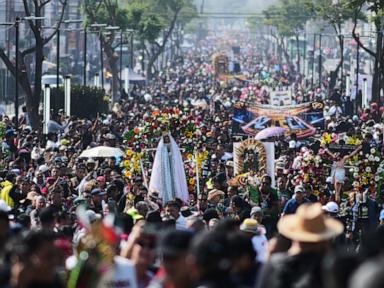
Walk down Calzada de Guadalupe in Mexico City on the night of December 11, and your chest will rattle before you ever spot the Basilica. It's not church bells shaking your ribs. It's a wall of subwoofers strapped to the back of a flatbed truck, blasting cumbia rebajada and high-energy guaracha while thousands of exhausted pilgrims dance in the middle of the avenue.
For outsiders, the visual is jarring. You expect solemnity, hushed prayers, and maybe a brass band playing traditional hymns. Instead, you get strobe lights, fog machines, and sonideros—Mexico's legendary street DJs—turning one of the largest Catholic pilgrimages on earth into an all-night block party.
Most coverage of Mexico's Catholic street DJs treats this phenomenon like a quirky contradiction. That misses the point entirely. If you've spent any time in working-class neighborhoods across central Mexico, you know that sonidero culture and devotion to the Virgin of Guadalupe aren't competing forces. They grew up on the exact same streets, sustained by the exact same families.
What Actually Happens on the Road to Tepeyac
Every December, millions of Catholics travel to the Basilica of Our Lady of Guadalupe at the foot of Tepeyac Hill in northern Mexico City. According to official figures from the Mexico City government and the Basilica itself, attendance regularly tops 10 to 12 million people over the course of a few days, peaking around December 12—the Feast Day of the Virgin of Guadalupe.
Many of these pilgrims don't take a bus or a flight. They walk. Some trek for days from neighboring states like Puebla, Tlaxcala, Hidalgo, and the State of Mexico. Others ride bicycles in massive neighborhood convoys, carrying framed statues of the Virgin strapped to their handlebars or mounted on custom-built altars.
And right behind those altars roll the sound systems.
Neighborhood groups—often called peregrinaciones—pool their money all year long to fund their trip to the Basilica. Along with buying matching jackets, fireworks, and floral arrangements, they hire local sonideros to escort them. A pickup truck or flatbed hauls stacks of speaker cabinets, amplifiers, and generators. As the procession inches forward through gridlocked traffic, the DJ spins tracks and grabs the microphone to shout out greetings—known as saludos—to the neighborhoods, families, and local businesses marching alongside the rig.
It looks like a street rave. It functions like a rolling town square.
Why Sonidero Culture Belongs at a Catholic Pilgrimage
To understand why a DJ booth fits naturally next to a statue of the Virgin Mary, you have to understand what a sonidero actually does in Mexican urban life.
Emerging in the mid-20th century in working-class barrios like Tepito and Peñón de los Baños in Mexico City, sonideros started out playing imported Colombian cumbia records at neighborhood street parties because families couldn't afford live orchestras. Over decades, the DJs stopped just playing music and became community broadcasters. Using heavy reverb and echo effects on their microphones, they read aloud messages passed up to the booth on scraps of paper—connecting relatives in Mexico City with family members working in Los Angeles, Chicago, or New York.
In 2023, the Mexico City government officially declared sonidero culture an Intangible Cultural Heritage of the city, recognizing its role in building social cohesion in marginalized neighborhoods.
That community glue is the exact same force driving the December 12 pilgrimage. You don't find many wealthy corporate executives hiking 40 miles in worn sneakers to Tepeyac. You find factory workers, market vendors, mechanics, and entire extended families from tight-knit barrios. When they organize a pilgrimage, they bring their whole culture with them. Leaving the sonidero at home would feel like leaving half the neighborhood behind.
Music as Fuel for Exhausted Walkers
There's also a purely practical reason the bass drops get louder around midnight. Walking on concrete for 12 hours straight hurts.
Pilgrims arriving from places like Toluca have to cross the freezing mountain pass at La Marquesa, where overnight temperatures routinely drop near freezing in December. By the time they hit the sprawling urban avenues of Mexico City, blisters have popped, knees are locking up, and sleep deprivation is setting in.
Quiet contemplation doesn't keep tired legs moving at 3:00 AM. Heavy percussion does.
When a sonidero drops a slowed-down cumbia or a driving electronic beat, the energy in the crowd shifts immediately. People who were limping five minutes earlier start bouncing in step. Young guys hoist heavy plaster statues onto their shoulders and dance in circles while older relatives clap along from the curb. The music turns physical endurance into collective euphoria.
How Mexican Catholicism Embraces Noise and Celebration
If you grew up attending quiet, structured church services in the United States or Northern Europe, a street DJ outside a major basilica might look borderline sacrilegious. Inside Mexican popular Catholicism, though, silence is rarely the default setting for devotion.
Long before Spanish colonization, indigenous Mesoamerican religious festivals relied heavily on communal dancing, drumming, processions, and sensory overload to honor deities. When Catholicism took root in New Spain—particularly around the story of the Virgin of Guadalupe appearing to Saint Juan Diego on Tepeyac Hill in 1531—those traditions didn't vanish. They merged.
You see this across Mexico all year round:
- Patron saint festivals in small towns routinely feature brass bands (bandas), carnival rides, and exploding fireworks (cohetes) starting at dawn right outside the parish doors.
- Danzantes—traditional Aztec-style dancers wearing feathered headdresses and ankle rattles—perform for hours on the Basilica plaza while priests celebrate Mass inside.
- Mariachi groups serenade the Virgin with Las Mañanitas at midnight on December 12, broadcasted nationwide on major television networks.
Against that backdrop, a sonidero isn't breaking tradition. They're just updating the instrumentation. Instead of a teponaztli drum or a tuba, they're using an 18-inch subwoofer and a mixer.
The Tension Between Street Party and Sacred Space
That doesn't mean everyone loves the decibel levels. Every year, friction pops up around how loud and chaotic the celebration gets.
Local residents living near Calzada de Guadalupe and the surrounding Gustavo A. Madero borough deal with days of blocked streets, roaring generators, and litter. City authorities regularly step in to set boundaries—banning alcohol sales near the Basilica perimeter, confiscating oversized fireworks, and directing heavy sound trucks away from the immediate atrium so liturgical services inside aren't drowned out.
Even within the Catholic community, opinions split. Older or more traditional churchgoers sometimes grumble that the party atmosphere overshadows prayer and repentance. Meanwhile, younger pilgrims argue that joyful celebration is the purest form of gratitude they can offer.
Church officials at the Basilica largely take a pragmatic approach. Rather than trying to police the musical tastes of millions of working-class devotees, clergy focus on welcoming pilgrims at the doors, offering continuous Masses, and blessing the statues and banners brought in from the street—regardless of whether those statues arrived to the sound of acoustic guitars or high-wattage cumbia remixes.
What to Know If You Want to Experience It Yourself
Seeing the Guadalupe pilgrimage in person is one of the most intense cultural experiences in North America, but showing up unprepared is a mistake.
If you plan to witness the sonidero processions in Mexico City, skip the daytime tourist rush and head toward the northern avenues leading to the Basilica on the evening of December 11. Metro stations closest to the shrine—like La Villa-Basílica—close due to overcrowding, so you'll need to get off several stops early and walk with the flow of the crowd.
Wear broken-in shoes, leave flashy jewelry or bulky camera gear at your hotel, and bring layers for the sharp drop in temperature after midnight. Stand near the edge of the avenue rather than blocking the center lanes where heavy bike convoys and flatbed sound trucks are moving through. Most importantly, remember that while the music sounds like a club, you're standing in the middle of a deeply personal religious vow for the people around you—ask before shoving a phone camera in someone's face, and let the neighborhood crews have the dance floor.