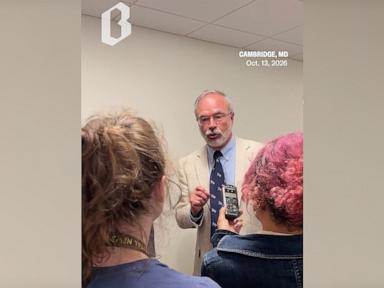
Click.
A tiny sound in a crowded hallway can make an elected official stiffen like a cornered animal, yet that exact click is often the only thing standing between a voter and a half-truth spun into gold. When a politician warns a reporter about potential criminal charges for recording a conversation, the exchange rarely stays small. It echoes down marble corridors, through newsrooms already stretched thin, and into the living rooms of people trying to figure out who actually works for whom in public life.
Cold headlines love tidy labels. Rep. Andy Harris threatens reporter with potential criminal charges for recording him. Five seconds of scrolling, one raised eyebrow, maybe a quick comment in a group chat. Done. Yet behind that bare sentence sits a collision that happens over and over in American politics: a public figure asserting control over how his words are captured, and a journalist trying to preserve the raw record before memory or spin reshapes it.
To keep our footing strictly on verifiable ground, let us separate what is established from what is imagined. A headline alone does not hand us every transcript, timestamp, or legal citation from a single encounter, and I will not invent quotes or pretend to hold a courtroom docket I do not have in front of me. What we do know from public reporting and settled legal principles is that clashes between lawmakers and reporters over audio or video recording are recurring flashpoints in modern press-government relations, especially when state wiretap laws, consent rules, and public-space norms meet on the fly. When I sketch a scene or a character in this essay, I will tell you plainly that it is a hypothetical illustration built to show how these moments feel in real time.
The Hallway Standoff
Picture a fluorescent-lit corridor outside a hearing room or a town hall exit. Let us use a hypothetical scenario—purely illustrative, not a claim about any specific meeting—to see how tension builds in thirty seconds. Maya has worked the beat long enough to know the rhythm of capitol hallways: the hurried footsteps, the aides hovering like goalies, the brief window between committee business and the next camera hit. She holds up her phone or digital recorder, asks a straightforward question about a policy vote or a constituent impact, and keeps the microphone aimed steady.
The lawmaker stops. Instead of answering the substance, the conversation pivots to the device. You do not have permission to record this. Do that again and you could be looking at criminal charges.
Fear.
That is the immediate emotion in the room, and it does not belong only to the reporter. A junior journalist without a seasoned media lawyer on speed dial feels a sudden knot in the stomach—not because she is plotting a crime, but because nobody wants a badge, a mugshot, or a subpoena over doing her job. At the same time, the politician who issues that warning is often feeling a different kind of pressure: the dread of an unedited clip going viral out of context, a half-formed thought frozen forever on a screen, a loss of narrative control.
Both impulses are human. One is not a crime; the other is not a constitutional right to silence the press.
I have stood in rooms where power shifted in a heartbeat over who controlled the record. Years ago, covering local government and civic disputes, I learned that the most consequential sentences are rarely spoken at a podium with a teleprompter glowing beneath them. They happen in doorways, in parking lots, in the five seconds after a speaker thinks the official moment has ended. When a public official invokes criminal liability over recording, the chill spreads faster than the legal analysis. A reporter hesitates. A source clams up. A reader never hears the exact cadence, tone, or evasion in a voice.
Think of a public record like a glass of clear tap water. If a press secretary summarizes a meeting later, that is like pouring the water into a colored cup—maybe still drinkable, maybe tinted by convenience. A straight recording is the clear glass. Threatening criminal charges is like trying to knock the glass out of someone's hand before anyone else can see what is inside. That is a metaphor, of course, because words are not glassware and laws are not hands, yet the feeling of watching a clear record get knocked aside is unmistakable.
Laws, Consent, and Gray Zones
Why do threats of criminal charges even enter the room when someone hits record? Because recording laws in the United States are a patchwork, and people—including officials and journalists—frequently conflate different rules.
At the federal level, 18 U.S.C. § 2511 generally allows a person to record an oral communication if they are a party to the conversation or have consent from one party, provided there is no criminal or tortious intent. States split into one-party consent and all-party (or two-party) consent regimes, with nuances depending on whether there is a reasonable expectation of privacy. Maryland, which Rep. Harris represents in Congress, is well known for strict statutory rules on wiretapping and electronic surveillance, alongside case law examining expectations of privacy and public settings.
Here is where confusion thrives: a reasonable expectation of privacy is not the same thing in a private living room as it is in a public hallway or an open civic event. Courts across the country have repeatedly wrestled with how surveillance statutes apply to public officials carrying out public duties, as well as how First Amendment principles protect gathering news on matters of public concern. Still, statutes on the books can be intimidating, and prosecutors—not politicians—decide whether criminal charges are even pursued. A lawmaker warning of potential criminal charges is stating a threat or a legal opinion, not issuing an indictment.
Still, the threat works even when charges never materialize.
Why? Because legal defense is expensive, slow, and exhausting. Even a baseless accusation forces a reporter or newsroom to spend hours answering questions, consulting counsel, and explaining to editors why a story is stalled. Over time, those small frictions add up. In an era when local and beat newsrooms already operate with lean staffs, the mere prospect of legal jeopardy can nudge a reporter toward caution—and caution, stretched thin, can start to look like self-censorship.
Consider what happens next: once a confrontation like this hits social media or a rival outlet, the dispute itself becomes the story. Instead of debating the bill, the budget cut, or the constituent complaint that prompted the question in the first place, the public argues over wiretap statutes, manners, and bad faith. Sometimes that distraction is accidental. Sometimes it is remarkably convenient.
Why Voters Should Care About a Recorder
A reader who does not carry a press pass might shrug and ask why a spat between a congressman and a reporter matters on a Tuesday afternoon. Fair question. I will admit openly that legal arguments over consent statutes can feel dry, technical, and far removed from grocery bills or school board meetings. When lawyers start parsing statutory language and expectation-of-privacy tests, my own eyes have glazed over more than once.
Yet the stakes are personal. Accountability is not an abstract civic virtue; it is a practical tool citizens use to judge whether promises match actions.
Imagine another hypothetical scenario, just to test the logic. Suppose a council member or representative tells constituents one thing in a glossy newsletter and says the exact opposite in a tense exchange outside a meeting. Without an accurate record—whether audio, video, or rock-solid contemporaneous notes—the public is left with a he-said-she-said stalemate. Power naturally favors the person with the larger megaphone, the official title, and the institutional platform.
When an elected official threatens criminal charges over recording, it sends a message far beyond the journalist holding the phone. It tells every citizen watching: Do not assume you have a right to capture what I say in public. Do not expect unvarnished accountability. Even if the speaker insists they are merely protecting privacy or following the law, the power imbalance in that moment is hard to ignore.
At the same time, fairness requires looking honestly at the other side of the lens. Modern technology makes it effortless to snip ten seconds out of a twenty-minute talk and blast it across feeds stripped of context. Politicians complain—sometimes with real justification—that viral clips reward outrage over nuance. A speaker who feels ambushed or misquoted can react defensively, harshly, or rashly.
Understanding that defensiveness does not excuse using the shadow of criminal law to intimidate the press. Public office comes with scrutiny. If a politician dislikes how a question is framed or how a clip is used, the remedy in a free society is to answer clearly, provide the full context, or challenge the characterization—not to wave the threat of criminal prosecution at the person holding the recorder.
The Quiet Cost of Chilling the Record
Look closely at what happens inside a newsroom after an incident like this. Nobody announces a policy of cowardice. Instead, conversations grow slightly more guarded. An editor asks whether an audio clip is worth a legal review. A young reporter wonders whether stepping into a hallway with a phone running will spark another public blowup or a lawyer's letter.
History shows a clear behavioral pattern in democratic institutions: norms erode through small, normalized exceptions long before any grand law is repealed. When pushback against routine press scrutiny becomes standard operating procedure—whether through access limits, hostile rhetoric, or threats of legal action—the public's window into government narrows by degrees.
And when the window narrows, rumors fill the gap. Trust drops. People stop believing any account because every account sounds like warfare.
That is why stories like this deserve more than a quick glance and a snarky comment. They are stress tests of how openly our public servants are willing to be seen and heard. A reporter's job is not to flatter officials or play along with staged talking points; the job is to ask questions, verify answers, and keep a faithful record so citizens can make up their own minds.
Silence.
That is what an intimidating threat aims to produce—a brief, telling pause where the recorder goes down and the hard question goes unanswered.
A republic does not run on curated soundbites alone; it breathes through inconvenient questions asked out loud in the open air, with the tape still rolling.