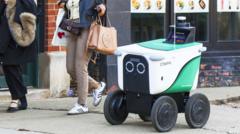
The sidewalk is the final unmonetized public commons in the modern urban topography, and it is currently undergoing a structural crisis. As autonomous delivery operators scale their fleets to solve the unit economics of the last mile, they are encountering a fierce socio-political barrier. The friction is not merely a cultural rejection of automation. It is a predictable resource conflict driven by the physical occupation of public infrastructure by private capital. When an 80-pound autonomous vehicle halts on a three-foot-wide urban walkway, it is executing an unpriced externality, transferring operational friction from the balance sheet of the logistics provider directly onto the pedestrian.
The public pushback across major urban hubs—ranging from operational moratoriums in Chicago and Glendale to outright sidewalk bans in Toronto—reveals a fundamental structural flaw in the deployment strategy of micro-mobility robotics. To understand why this friction occurs, we must move past casual observations of urban irritation and model the crisis through the precise frameworks of spatial economics, engineering bottlenecks, and legal liability.
The Three Pillars of Sidewalk Friction
The logistical failure of sidewalk delivery robots can be broken down into three distinct structural dimensions. When tech providers treat municipal walkways as empty, frictionless transit vectors, they ignore the physical and social dynamics that govern human infrastructure.
                  ┌─────────────────────────────────────────┐
                  │       SIDEWALK FRICTION MATRIX          │
                  └─────────────────────────────────────────┘
                                       │
         ┌─────────────────────────────┼─────────────────────────────┐
         ▼                             ▼                             ▼
┌─────────────────┐           ┌─────────────────┐           ┌─────────────────┐
│ Dynamic Spatial │           │ Structural Asymmetry│       │ Operational     │
│   Bottleneck    │           │ of the Commons  │       │ Arbitrage       │
└─────────────────┘           └─────────────────┘           └─────────────────┘
 Pedestrian density            Asymmetrical yield            Offloaded labor,
 scales non-linearly.          logic blocks human            tele-operations, &
 Multi-agent conflicts.        mobility (e.g. ADA).          system blockages.
1. The Dynamic Spatial Bottleneck
Sidewalks are non-uniform, dynamically constrained networks. Unlike roadways, which feature standardized lane widths and explicit traffic control mechanisms, urban walkways possess variable widths, unpredictable structural defects, and highly irregular pedestrian flows. Pedestrian density does not scale linearly; it clusters around transit nodes, retail entryways, and outdoor dining installations.
When a last-mile delivery unit enters a highly dense pedestrian corridor, it creates a multi-agent conflict. If the robot's perception system registers a human path cross, the default safety protocol dictates an immediate full stop. While this prevents a direct kinetic collision, it converts a moving vehicle into a static, physical obstruction. In narrow or highly trafficked environments, this reactive immobilization creates a immediate bottleneck, forcing human actors to alter their trajectories, step into vehicle lanes, or clear the path manually.
2. Structural Asymmetry of the Commons
The core conflict stems from an asymmetrical yield logic. In standard traffic networks, right-of-way is governed by explicit reciprocal rules. Sidewalk robotics operate on a parasitic optimization loop: they rely entirely on the intelligence, agility, and patience of human pedestrians to navigate around their operational limits.
This asymmetry becomes acute when interacting with vulnerable populations, particularly individuals utilizing wheelchairs or assistive mobility devices. A standard delivery vehicle that encounters an un-navigable obstacle or a tight corridor often lacks the mechanical or algorithmic capability to execute a rapid reverse or tight pivot. Instead, the unit remains stationary, blinking and emitting audio prompts, effectively demanding that the human actor negotiate a high-friction detour, such as stepping off a curb into active vehicular traffic.
3. Operational Arbitrage
Logistics firms are leveraging public infrastructure to offset capital expenditures. By utilizing public walkways instead of dedicated roadways or private distribution channels, operators avoid the tolls, licensing fees, and strict regulatory oversight applied to commercial vehicles. This operational arbitrage transfers the true cost of delivery from the platform and the end consumer onto the general public, who lose uninhibited access to public space.
The Cost Function of Last-Mile Robotics
To analyze why operators aggressively deploy these units despite the local backlash, we must examine the underlying cost function of last-mile logistics. The last mile represents up to 53% of total shipping costs. The primary driver of this cost is human labor—specifically the hourly wages, benefits, and operational inefficiencies associated with couriers parking, exiting vehicles, and physically walking to a doorstep.
Automation seeks to radically compress this variable cost structure. The theoretical economic model replaces a high variable labor cost ($C_L$) with a fixed capital expenditure ($C_{Cap}$) distributed over thousands of deliveries, supplemented by a minimal remote monitoring labor cost ($C_{Remote}$).
$$\text{Total Cost} = C_{Cap} + C_{Maintenance} + \sum (C_{Remote} \times T_{Intervention})$$
Where $T_{Intervention}$ represents the total time a human tele-operator must take control of a stuck or obstructed unit. The unit economics only break even when $T_{Intervention}$ approaches zero, implying a high ratio of autonomous miles to human-supervised miles.
However, the real-world operational environment introduces hidden cost variables that are currently breaking these financial models:
- The Tele-Operation Overhead: When a robot encounters complex urban geometry, adverse weather like snow or ice, or human interference, it drops out of autonomous mode and signals a remote operator. Many fleets are heavily reliant on remote workers located in lower-cost regions to manually drive these units out of tight spots. This requirement shifts the model from pure automation back to a distributed, low-wage tele-operation model, limiting the expected scalability.
- Asset Depreciation and Vandalism: Operating in an unmonetized, unsecured public space exposes the hardware to constant physical degradation. Units face structural damage from uneven pavement, collisions with infrastructure, and intentional tampering or vandalism. The acceleration of asset depreciation directly compresses the amortization window of the initial hardware investment.
- The Regulatory and Liability Premium: As cities transition from passive observation to active enforcement, operators face escalating compliance costs. Fines for obstructing public paths, licensing fees per device, and skyrocketing insurance premiums following high-profile pedestrian injuries—such as the severe fractures and concussions reported from sidewalk collisions—are transforming a low-cost testing environment into a highly litigious operational framework.
Technical and Algorithmic Vulnerabilities
The physical bottlenecks observed on urban streets are direct manifestations of underlying technical and data limitations. While operators frequently claim their platforms utilize advanced machine learning models, the actual deployment architecture reveals deep vulnerabilities in semantic understanding and edge-case execution.
Semantic Mapping vs. Real-Time Reality
Many delivery fleets do not navigate purely via real-time spatial reasoning. They rely heavily on pre-mapped, high-definition 3D environments. These spatial maps are frequently trained on massive public datasets—including crowdsourced geographic imagery.
While these maps provide accurate structural boundaries for static objects like walls and curbs, they fail to account for the dynamic variance of urban life. A sudden construction barrier, a temporary outdoor seating arrangement, or a gathering of pedestrians completely invalidates the pre-computed routing matrix. When the real-world inputs deviate significantly from the training data, the onboard navigation stack encounters a high-uncertainty state, defaulting to an operational shutdown.
The Limits of Computer Vision Edge-Case Classification
Onboard computer vision systems are highly proficient at identifying standard objects: a walking pedestrian, a passing car, or a traffic light. However, urban environments present an infinite array of non-standard edge cases that standard convolutional neural networks struggle to classify accurately.
┌────────────────────────────────────────────────────────┐
│               THE EDGE-CASE COGNITIVE GAP              │
├───────────────────────────┬────────────────────────────┤
│  Standard Classification  │    The Edge-Case Blindspot │
│   (High System Confidence)│   (System Uncertainty/Halt)│
├───────────────────────────┼────────────────────────────┤
│ * Standard Pedestrian     │ * Toddler in a Costume     │
│ * Parked Automobile       │ * Puddle Reflecting Neon   │
│ * Concrete Curb           │ * Low-Lying Chain Barrier  │
│ * Active Bicycle          │ * Discarded E-Scooter      │
└───────────────────────────┴────────────────────────────┘
When confronted with these low-confidence inputs, the autonomous system cannot safely execute an avoidance maneuver because it cannot predict the object's behavioral physics. To avoid a collision liability, the machine halts. This conservative safety loop, designed to protect the firm from legal exposure, is precisely what creates the public obstruction that drives the localized backlash.
Strategic Playbook for Urban Fleet Optimization
The current trajectory of uncoordinated sidewalk deployment is hitting a regulatory ceiling. For micro-mobility and autonomous logistics operators to survive the transition from localized pilots to permanent infrastructure, they must completely overhaul their deployment frameworks. The following tactical changes outline the mandatory pivot for last-mile robotic operations.
Shift from Sidewalk Commons to the Biking Infrastructure
The sidewalk cannot sustain heavy commercial transport. Operators must actively lobby for and transition their fleets into the secondary micro-mobility layer: dedicated bike lanes and low-speed urban corridors.
- Velocity Matching: Robots operating at 5 to 10 miles per hour are dangerously fast for a pedestrian walkway but perfectly matched for a bicycle lane infrastructure.
- Reduced Dynamic Obstruction: Moving the units off the sidewalk eliminates the acute spatial conflict with pedestrians and aligns the vehicles with existing traffic flow patterns, dramatically lowering the rate of emergency halts.
Implement Dynamic Pricing Based on Infrastructure Density
Operators must abandon flat-rate delivery pricing models and implement an infrastructure-impact fee structure. This model scales delivery costs based on real-time pedestrian density and historic intervention rates along the requested route.
- Peak Demand Throttling: Delivering a high-volume package through a congested district on a weekend evening should incur a heavy premium to reflect the high probability of human obstruction and tele-operation delay.
- Route Optimization via Cost Functions: The routing algorithm must prioritize paths with lower pedestrian density scores over the shortest geographical path, actively steering fleets away from critical public walking corridors.
Universal Hardware Interoperability and Standardized Yield Logic
The industry must move away from proprietary, isolated operation models and implement a unified vehicle-to-everything communication protocol.
- Active Deceleration and Reversal: Autonomous units must be programmed to automatically yield the entire path and execute immediate reverse maneuvers when detecting a human user with an assistive mobility device, completely eliminating the static standoffs that violate accessibility mandates.
- Remote Off-Switch for Municipal Enforcement: Cities must be provided with a universal API capable of geofencing specific zones during public events or emergencies, instantly commanding all active units to exit the designated perimeter via alternative routes.
The era of treating urban sidewalks as a free, unregulated testing ground for corporate logistics is concluding. Operators that fail to integrate these structural adjustments into their core business models will find their fleets permanently regulated off the streets by municipal moratoria.
The economic and spatial realities of urban delivery automation are complex. For a deeper look into the logistical challenges and real-world friction occurring within major metropolitan centers, watch this detailed breakdown of Autonomous Delivery Robot Structural Bottlenecks, which highlights the growing field friction between municipal infrastructure and automated fleets in Southern California.