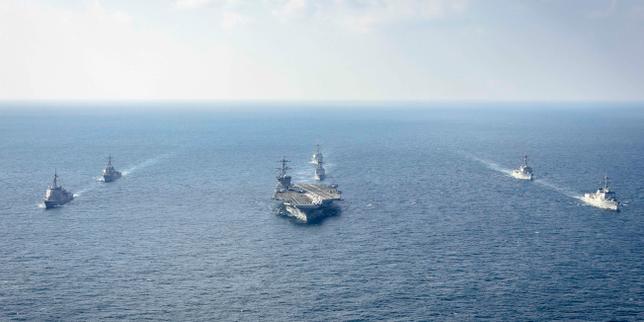
Every mainstream foreign policy column reads like a copy-pasted press release from a defense contractor's public relations department. When headlines cheer that South Korea, Japan, and the United States are pushing forward with joint military drills despite rumored budget pressures or executive cuts, the consensus view screams about unity, deterrence, and an ironclad alliance.
It is a comforting narrative. It is also dangerously wrong.
I have spent years watching governments burn billions of dollars on theater operations that soothe political egos while doing nothing to alter the hard realities of modern friction. The lazy consensus assumes that more carrier strike groups, synchronized jet formations, and chest-thumping amphibious landings translate directly into strategic safety. They do not.
The Misconception of Synchronized Posturing
Let us define terms immediately. Strategic deterrence is not a high school marching band contest where loud coordination wins trophies. Real security relies on asymmetric resilience, supply chain sovereignty, and electronic domain dominance. Yet, Washington, Seoul, and Tokyo remain obsessed with legacy metrics. They count aircraft sorties, troop headcounts, and tonnage moved as if it were 1944.
When budget constraints hit—whether driven by executive mandates or shifting legislative priorities—the automatic panic among pundits is that regional defense will crumble. This fear stems from a profound misunderstanding of how actual friction works in the twenty-first century.
Imagine a scenario where every single high-profile joint amphibious exercise scheduled for this quarter is abruptly canceled due to funding compression. Does regional stability collapse? Absolutely not. In fact, it might improve.
The Logistics Mirage Behind the Headlines
Big multilateral drills are bloated logistical nightmares. They require months of fuel burn, administrative drag, and diplomatic hand-holding just to produce glossy photo-ops for nightly news broadcasts. They test how well a US Navy admiral coordinates with a South Korean general over standardized radio frequencies, which sounds great until you realize that real-world conflicts do not wait for scheduled window slots or pre-approved rules of engagement.
Defense analysts love to point out that budget cuts force a scaling down of these operations. They wring their hands over perceived weakness. They ignore the foundational rule of modern logistics: administrative bloat is not readiness.
- Legacy hardware consumption: Drills chew up expensive flight hours on aging airframes that should be preserved for actual contingencies.
- Interoperability theater: True technical integration happens in software architecture and secure data links, not in fleet maneuvers that telegraph positions to every electronic intelligence gatherer within a thousand-mile radius.
- The deterrence trap: Adversaries do not calculate their risk assessments based on how many destroyers park off a coastline for a two-week photo shoot. They measure endurance, industrial base output, and cyber defense depth.
What the Media Misses About Funding Cuts
When funding gets tighter, military planners are forced to stop lying to themselves about what matters. Financial pressure acts as a brutal, necessary filter against institutional laziness.
Instead of funding massive, performative armada sail-bys, tighter budgets compel defense ministries to invest in things that actually alter the calculus of conflict: distributed missile defense nodes, autonomous surface vessels, hardened command-and-control networks, and stockpiled precision munitions.
The obsession with preserving every single joint drill is a symptom of political insecurity, not tactical necessity. Leaders want visible symbols of commitment because symbols are easy to explain to voters. Real preparation is quiet, expensive in unglamorous ways, and entirely unphotogenic.
How to Read Regional Defense News Without Getting Fooled
Stop looking at the frequency of joint exercises as a thermometer for geopolitical health. When you read about funding cuts or scaling back of large maneuvers, do not panic. Ask a different set of questions entirely.
- Are defense procurement dollars shifting away from legacy platforms toward scalable autonomous tech?
- Is command integration moving past bureaucratic joint headquarters down to tactical, decentralized units?
- Are supply chains for critical components decentralized within the tri-lateral partnership?
If the answers to those questions are yes, then budget cuts are doing their job by cutting the fat. The alliance does not need more theatrical maneuvers to prove its worth. It needs to abandon the vanity of pageantry and prepare for the quiet, unscripted reality of modern friction.