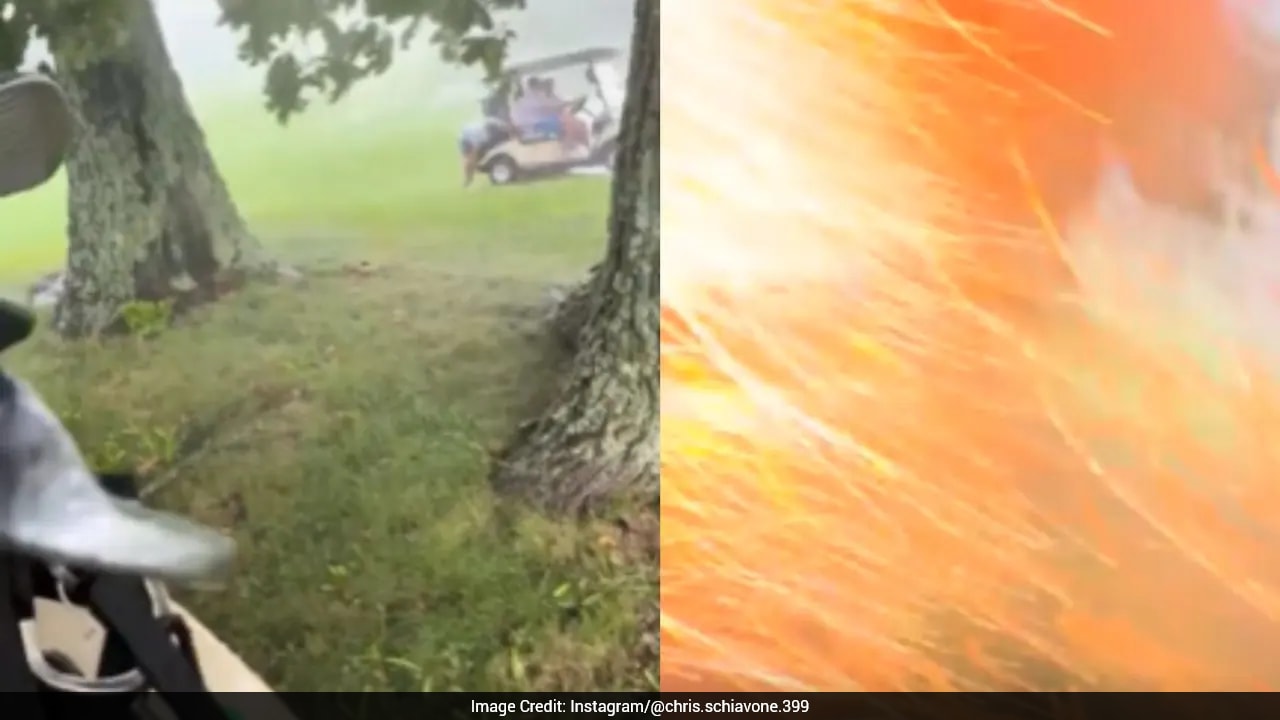
Every golf writer on the planet just lost their mind over a statistical anomaly wrapped in pure luck. A weekend golfer steps up, swings out of their shoes, catches a hurricane-force downwind, bounces a ball off a cart path, and watches it trickle into a cup 411 yards away. The internet gasps. Headlines shriek about miracles. Pundits talk about the magic of the game.
It is absolute garbage.
That freak shot is not a celebration of skill. It is an indictment of modern course architecture, equipment engineering, and an entire industry in total denial. When a par-4 measuring well over four hundred yards can be conquered by a single swing, the sport has fundamentally broken its own physics. We are cheering for a lottery win while the house burns down around us.
The Lazy Consensus Of Miracle Manufacturing
Open any mainstream golf publication right now and you will read the same tired narrative. They call it romance. They write glowing paragraphs about destiny, the unpredictability of nature, and how anyone can achieve greatness on any given Sunday.
This is the lazy consensus. It comforts weekend hackers by pretending that golf remains an egalitarian contest of craft where a miraculous stroke of fortune sits on equal footing with a decade of grinding on the range.
Let us look at the math instead of the poetry.
A 411-yard hole in one requires a combination of ball speeds exceeding 180 miles per hour, launch angles calibrated to the millimeter, and an ungodly amount of external assistance from terrain and weather. Yet, equipment manufacturers spend billions engineering titanium drivers and multi-layer polyurethane balls specifically designed to maximize distance at the expense of dispersion control. When modern technology stretches driving distances past 320 yards on the professional tour, standard courses built in the twentieth century become obsolete overnight.
When a 411-yard hole plays as driveable, the game's core defense mechanism—length—collapses.
The Physics They Ignore
To understand why a 411-yard ace is a symptom of structural decay, you have to look at how energy transfers from clubface to core.
Consider a scenario where a player swings a forty-five-inch driver at 125 miles per hour. The resulting smash factor pushes ball velocity to terrifying thresholds. Thirty years ago, that kinetic energy stayed manageable because equipment twist and high-spin rates forced balls to balloon and drop out of the air. Today's low-spin aerodynamics keep the ball riding an optimal lift vector much longer. Add a firm, baked-out summer fairway acting like a bowling alley, and physics turns a standard drive into a runaway freight train.
The industry calls this progress. I call it a design failure.
If a golf hole requires external environmental glitches—dry turf, concrete-hard cart paths, and tailwinds strong enough to ground a Cessna—just to make a single shot possible, the architectural design is fundamentally flawed. Courses should test shot-shaping, iron control, and strategic risk management. Instead, modern courses are forced to stretch yardages to absurd lengths, ruining walking accessibility and maintenance budgets, all because equipment companies refuse to roll back technology.
The Equipment Arms Race
I have watched equipment brands spend millions marketing distance gains to players who cannot break ninety. They sell the fantasy of thirty extra yards off the tee while ignoring the fact that those same players are now spraying balls into adjacent zip codes.
The governing bodies had a chance to fix this. The USAG and R&A introduced proposed Model Local Rules for rolled-back ball testing to rein in elite distances, and the entire manufacturing lobby threw a tantrum. Why? Because the entire business model depends on selling the illusion of effortless power.
When a viral video highlights a 411-yard hole in one, it acts as the ultimate marketing flyer for this broken paradigm. It normalizes absurdity. It tells the consumer that hitting a wedge into a green on a par-4 is normal, and that carrying a mountain is just standard course management.
What Actually Needs To Happen
Stop celebrating statistical anomalies. Start demanding better course design.
If you run a golf facility, stop lengthening your tees to chase an arms race you cannot win. Narrow your fairways. Bring back penal hazards that punish mishits instead of rewarding a wild pull that catches a downslope. Reward the player who hits a 240-yard cut into a tight window over the brute who hacks it 350 yards into the rough and catches a lucky bounce.
The next time you see a headline about a freakishly long ace, do not smile. Realize that you are looking at a symptom of a sport running away from its own identity.
The game does not need more miracles. It needs reality.