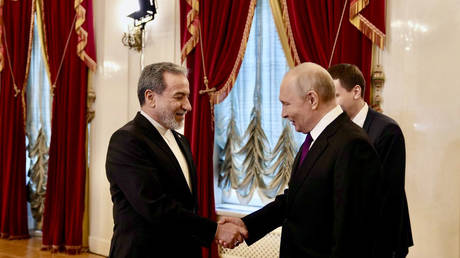
The foreign policy establishment is currently obsessed with a fiction. It’s a comfortable, academic fairy tale that suggests Moscow holds the keys to Middle East stability. You’ve read the reports. They claim that Tehran is pivoting toward Russia to secure a "strategic partnership" that will magically pacify the Levant and the Gulf.
It is nonsense.
What we are witnessing isn't a strategic alliance. It is a desperate, transactional barter system between two sanctioned outcasts who barely trust each other. To suggest Russia is "crucial for peace" ignores the fundamental reality of Kremlin biology: Russia does not export peace. It exports managed instability. Peace is a low-margin business. Chaos is where the profit lives.
The Myth of the Russian Arbiter
The prevailing argument—the lazy consensus—is that Russia serves as the only power capable of talking to everyone: Tehran, Tel Aviv, Riyadh, and Damascus. On paper, that looks like leverage. In practice, it’s a weakness.
When you try to be everyone's friend in the Middle East, you eventually become everyone’s disappointment. Moscow’s "balanced" approach is actually a series of hollow promises held together by aging S-300 batteries and vetoes at the UN Security Council.
I’ve watched diplomats waste years waiting for Russia to "restrain" Iran. They assume Putin has a dial he can turn to reduce IRGC activity in exchange for Western concessions. He doesn’t. Tehran knows exactly how much Russia needs Iranian drones for its own survival. The power dynamic has flipped. The junior partner is now the supplier. You cannot arbitrate a conflict when you are financially and militarily dependent on one of the combatants.
Transactional Survival is Not Strategy
Let’s define the "Tehran-Moscow Axis" for what it actually is: a mutual defense pact of the desperate.
- Iran wants advanced Su-35 fighter jets and air defense systems to deter a strike on its nuclear infrastructure.
- Russia wants Shahed-136 loitering munitions and ballistic missiles to keep its front lines from collapsing.
This is a grocery swap, not a grand strategy. Real strategic partnerships involve integrated economies, shared long-term visions, and cultural alignment. None of that exists here. The Russian elite still views Persians through a lens of imperial condescension; the Iranian leadership remembers centuries of Russian territorial theft.
When people ask, "Will Russia help broker a deal between Iran and the West?" they are asking the wrong question. Russia’s primary goal is to ensure the West remains bogged down in a multi-front crisis. Every Tomahawk missile fired in the Red Sea is one fewer missile available for Eastern Europe. Peace in the Middle East would be a disaster for Russian interests. It would lower oil prices and allow the Pentagon to refocus its full attention on the borders of NATO.
The Energy Trap
The most frequent "People Also Ask" query involves whether Russia and Iran will dominate global energy markets through a "Gas OPEC."
This is where the logic falls apart completely. Russia and Iran are direct competitors. They sell the same products to the same shrinking pool of shadow-market buyers. When Moscow discounts its Urals crude to entice Chinese refineries, it is literally stealing bread from Tehran’s table.
You don't build a lasting peace on a foundation of two hungry wolves fighting over the same scrap of meat. Any "cooperation" in the energy sector is a temporary truce designed to keep prices high enough to fund their respective wars. The moment one can undercut the other to secure a hard currency contract, the "partnership" dissolves.
The Syria Delusion
Look at Syria. For years, the "experts" told us Russia was the stabilizing force.
The reality? Syria is a fragmented narco-state. Russia controls the skies, Iran controls the ground, and neither can afford to rebuild what they helped destroy. I’ve seen the internal assessments—the "stability" provided by Moscow is a thin veneer covering a massive protection racket.
Russia doesn't prevent conflict between Israel and Iran in Syria; it simply manages the frequency. It allows Israeli strikes on Iranian assets as long as its own bases aren't hit. This isn't "peacekeeping." It's air traffic control for an ongoing war.
The High Cost of the Russian Illusion
The danger of believing Russia is "crucial for peace" is that it leads Western policymakers to offer concessions to a Kremlin that cannot deliver the goods. We’ve seen this movie before. We offer "carrots" to Moscow, hoping they will leash the "dogs of war" in the Middle East. They take the carrots, eat them, and then claim the dogs are too wild to control.
If you want to understand the Middle East, stop looking at Moscow.
The regional gravity is shifting toward local autonomy and middle-power hedging. The UAE, Saudi Arabia, and even Qatar are no longer looking for a "security guarantor" in the traditional sense. They are building their own industrial bases and choosing partners based on immediate utility. Russia, with its shrinking economy and its military hardware being exposed as underwhelming on the plains of Ukraine, is becoming less useful by the day.
Stop Asking for a Russian Solution
The premise that we need Russia to fix the Middle East is a relic of the Cold War. It assumes the world is still a bipolar or tripolar board where the "Big Powers" move the pieces.
The pieces are moving themselves now.
Tehran isn't turning to Moscow because Russia is "crucial." Tehran is turning to Moscow because it has nowhere else to go. It is an act of isolation, not an act of strength.
By treating Russia as an essential mediator, we provide them with the very relevance they are losing. We give them the "great power" status they crave but can no longer afford to maintain.
If the West wants to stabilize the Middle East, it needs to stop outsourcing its diplomacy to a regime that views global stability as a threat to its own survival.
The Kremlin isn't the fireman. It’s the guy selling matches.
Stop buying the matches.