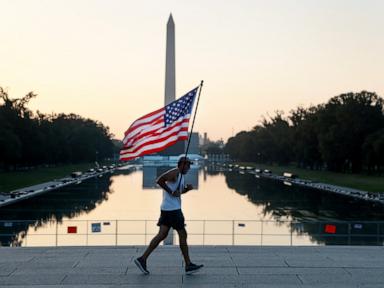
The Walt Disney Company has effectively captured the broadcast narrative for America’s 250th anniversary, turning a historic national milestone into a multi-platform corporate commercial. Through its flagship broadcast network ABC, the entertainment conglomerate has positioned itself as the primary curator of the Semiquincentennial. This isn't just a celebration of country. It is a masterclass in modern corporate consolidation, where public patriotism is seamlessly traded for private corporate equity. While competitors scramble for leftover advertising dollars, Disney has built a walled garden around July 4th, ensuring that every firework, musical performance, and historical retrospective drives traffic directly back to its streaming platforms and theme parks.
The Corporate Takeover of the Semiquincentennial
To understand how a single media entity took ownership of America's 250th birthday, you have to look at the multiyear planning that preceded the broadcast. Disney did not merely book a few pop stars and rent out a stage in Washington, D.C. They embedded their intellectual property into the very fabric of the national celebration.
The strategy relies on vertical integration. ABC handles the linear broadcast, capturing the millions of households still tuned into traditional television. Concurrently, Disney+ anchors the streaming distribution, offering exclusive behind-the-scenes content and interactive viewing options that appeal to younger demographics. This dual-threat approach isolates rivals like Comcast’s NBCUniversal and Paramount’s CBS, leaving them to broadcast standard, localized fireworks displays while Disney commands the definitive national feed.
This centralization of a public milestone raises significant questions about the commercialization of history. When a corporation controls the broadcast of a national anniversary, the history presented is invariably sanitized. It is designed to offend no one while maximizing broad-spectrum consumer appeal. The messy, complex, and often painful realities of a 250-year-old democracy are smoothed over, replaced by a highly produced, easily digestible spectacle that mirrors the curated perfection of a Main Street, U.S.A. parade.
The Financial Architecture Behind the Patriotism
National pride is highly profitable. Advertisers are willing to pay astronomical premiums to be associated with positive, unifying national events, especially in an era of hyper-partisan media fragmentation.
Disney capitalizes on this by bundling its ad inventory. Brands looking for a spot during the prime-time ABC live broadcast are forced to purchase ad space across the broader Disney ecosystem. This includes ESPN, Hulu, and even physical ad placements within Disney theme parks, which are hosting concurrent "America 250" events.
Consider the layout of the broadcast itself. The event is ostensibly a tribute to the American journey, yet the commercial breaks tell a different story. The transition from a historical tribute to a promotion for a new Disney cruise ship or an upcoming Marvel film is calculated. The patriotism serves as the hook; the corporate ecosystem is the destination.
The Ad Dollar Drain
By locking up major corporate sponsors months in advance through upfront presentations, Disney created an artificial scarcity in the marketplace. Competitors found themselves locked out of top-tier ad spend.
- Exclusive Sponsorship Packages: Disney offered tier-one sponsors category exclusivity, meaning no other automotive, telecom, or financial institution could buy time during the broadcast.
- Cross-Platform Multipliers: Advertisers were incentivized with data-tracking capabilities that linked television viewership to immediate digital purchasing options via the Disney shop app.
- The Park Pipeline: Viewers are bombarded with imagery of the celebrations happening at Walt Disney World and Disneyland, turning a television event into a direct-response marketing campaign for the company's domestic parks division.
The Myth of the Shared National Moment
Media executives love to talk about the return of the shared national moment. They point to high viewership numbers as proof that traditional broadcasting can still unite a fractured public. This is a mirage.
What Disney has constructed is not a town square. It is a theme park with an admission fee. While the basic broadcast on ABC is free over the air, the true, comprehensive celebration is locked behind subscription paywalls and premium experiences. Want to see the uncut musical performances? Subscribe to Disney+. Want to experience the physical celebration? Buy a park ticket, which has seen prices outpace inflation for over a decade.
This creates a tiered system of national celebration. The affluent experience the milestone in person or via premium, ad-free digital streams. The rest of the country watches a heavily commercialized, interrupted broadcast on linear television. The shared experience is fragmented by socioeconomic class, packaged and sold back to the public by a boardroom in Burbank.
The Production Bureaucracy
The sheer logistical scale of the broadcast reveals the corporate mechanics at play. Production insiders note that the coordination between ABC News, the entertainment division, and park operations required a centralized command structure usually reserved for military operations or political conventions.
The line between news and promotion is completely erased. ABC News anchors, tasked with maintaining journalistic objectivity, find themselves introducing pop stars and interviewing Disney executives about the "magic" of the anniversary. This compromise of editorial independence is the hidden cost of the modern media monopoly. When the news division is weaponized to support a corporate synergy initiative, the public loses a critical, independent lens through which to view national events.
Cultural Curation and the Erasure of Nuance
History is a battleground of interpretation. A 250th anniversary should provoke introspection, debate, and an assessment of where a nation has succeeded and where it has failed. But debate does not sell soap.
Disney’s curation of America’s 250th anniversary relies on nostalgia. It invokes a vague, idealized past that aligns perfectly with the company’s brand identity. By focusing heavily on generalized themes of innovation, imagination, and perseverance, the broadcast avoids the specific, contentious historical debates that define modern American discourse.
This corporate-approved version of history is dangerous because of its ubiquity. Because ABC possesses the distribution network to reach every corner of the country, its sanitized narrative becomes the default collective memory of the milestone. The rich, complicated tapestry of the American experiment is reduced to a series of high-definition video packages, scored to swelling orchestral music, designed to evoke emotion without stimulating critical thought.
The Technical Illusion
The broadcast relies on advanced augmented reality and synchronized drone shows across multiple cities, including Philadelphia, Washington, D.C., and Orlando. These technical achievements are impressive, but they serve a specific purpose. They distract from the lack of substantive content.
A dazzling display of light and sound over the National Mall looks spectacular on an OLED screen, but it offers nothing in the way of cultural substance. It is spectacle for the sake of spectacle, an expensive distraction designed to keep the viewer from changing the channel to a competitor or, worse, turning off the television entirely.
The Long-Term Cost of Event Monopolization
The precedent set by Disney’s Semiquincentennial broadcast will shape the media landscape for the next generation of major events. We are moving toward a future where significant cultural milestones are treated as corporate properties to be bid on, acquired, and monetized.
If a single media giant can patent a national anniversary, what stops the privatization of other public celebrations? The line between civic duty and corporate profit is not just blurred here; it has been entirely obliterated. The broadcast proves that with enough capital and a sufficiently vast distribution network, a corporation can buy its way into the center of the national consciousness, transforming a moment of public reflection into a permanent line item on a corporate balance sheet.
The credits roll, the fireworks fade, and the television screen prompts the viewer to log into an app to continue the experience. The celebration of America ends, but the monetization of the viewer never stops.