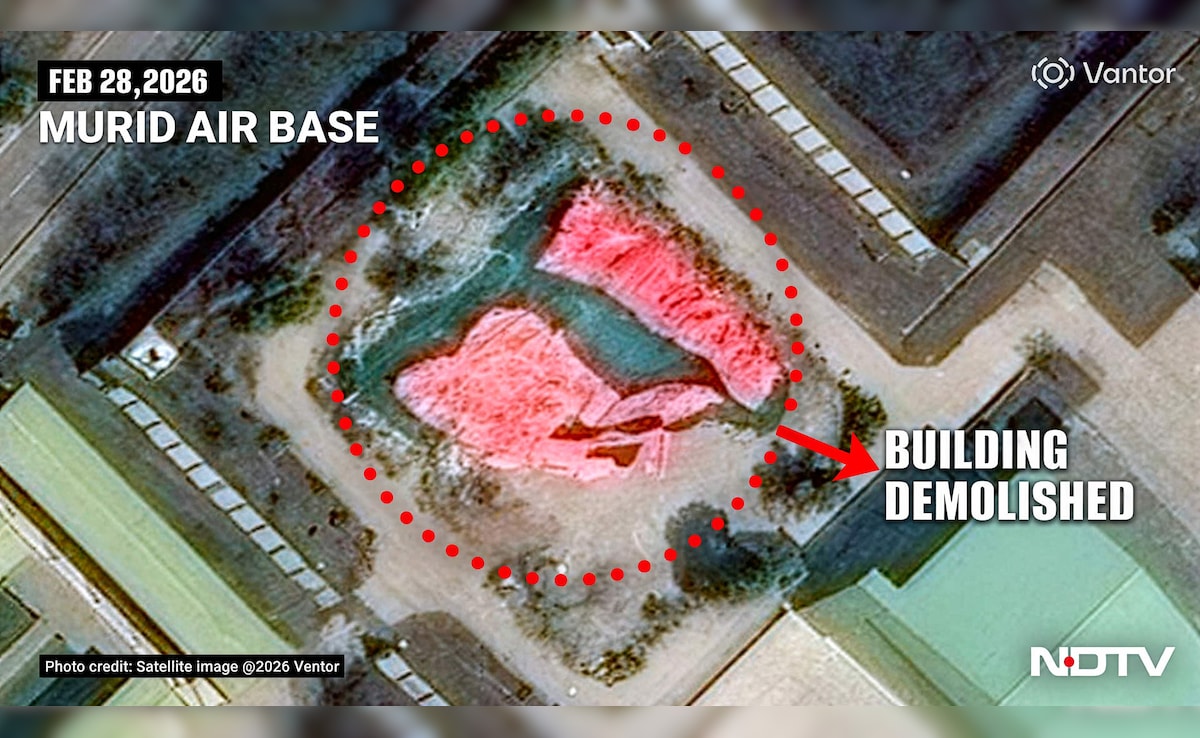
Pakistan has officially moved to demolish a key command structure at the Murid Air Base, an admission that the damage sustained during the high-stakes exchanges of Operation Sindoor was beyond the reach of conventional repair. While official narratives initially downplayed the precision of the strike, the arrival of heavy machinery and the systematic clearing of the site tell a different story. This is not just about clearing rubble. It is a calculated move to erase a visible reminder of a structural failure that occurred under the most intense operational pressure the base has seen in a decade.
The decision to raze the building rather than reinforce it reveals a harsh reality about modern kinetic warfare. When a facility is hit with the specific yield and trajectory used in this engagement, the internal integrity of the concrete and steel often shatters in ways that aren't visible to the naked eye. Engineers likely discovered that the foundational shifts made the structure a liability for the sensitive electronic equipment it was meant to house.
The Myth of Surface Level Damage
In the immediate aftermath of the strike, the narrative centered on operational continuity. We were told the base remained fully functional. While technically true—runways were cleared and sorties continued—the nerve center of the facility was hemorrhaging utility.
Modern military architecture relies on hardened shells designed to withstand pressure waves. However, the munitions used in Operation Sindoor appear to have exploited a specific resonance or penetration depth that compromised the load-bearing pillars of the Murid facility. You can patch a hole in a wall, but you cannot easily fix a cracked foundation that must support tons of signal-processing hardware.
The demolition serves as a silent confirmation that the "near miss" reported in some circles was, in fact, a direct hit on the facility's long-term viability. By leveling the site, the military is signaling a total reset. They are opting for a ground-up rebuild that incorporates lessons learned from the strike, likely moving toward deeper subterranean integration or more advanced kinetic energy dissipation materials.
Strategic Silences and Satellite Reality
You cannot hide a demolition of this scale from modern commercial synthetic aperture radar (SAR). Even when cloud cover or nightfall obscures the view, the metallic signatures of excavators and the changing elevation of the debris piles are visible to anyone with a subscription and the right coordinates.
The "why" behind this demolition is as much about psychological warfare as it is about civil engineering. Leaving a charred, non-functional husk at a primary air base is a gift to enemy intelligence. It provides a constant calibration point for future strikes, allowing analysts to measure exactly how their previous munitions performed against specific building materials.
By tearing it down, Pakistan is attempting to "reset the clock."
The Cost of Repair vs. Replacement
The economics of military infrastructure are brutal.
- Retrofitting: Attempting to shore up a compromised structure often costs 1.5 times the original construction price due to the specialized labor and testing required.
- Vulnerability: A repaired building often has "soft spots" where the old material meets the new, creating predictable failure points for future engagements.
- Technology Leap: A new build allows for the installation of modern fiber-optic shielding and EMP protection that was not standard when the original Murid buildings were erected.
The choice to demolish is the only logical one from a purely technical standpoint, even if it carries the sting of a public admission of loss.
Engineering a New Defensive Standard
What comes next at Murid will be a blueprint for the region's future defense posture. We should expect to see a shift toward decentralized command modules. Instead of one massive, vulnerable building that serves as a beacon for GPS-guided munitions, the new Murid will likely feature smaller, dispersed nodes connected by hardened underground conduits.
This transition mirrors a global shift in airbase design. The era of the "Grand Command Center" is ending. It is too easy to find, and as Operation Sindoor proved, too difficult to save once the first impact occurs. The demolition teams at Murid are not just clearing space for a new building; they are burying an outdated philosophy of static defense.
The ground at Murid is being prepared for a structure that assumes it will be hit. The next iteration will focus on modularity and rapid recovery, moving away from the rigid, brittle designs of the past. This isn't just a cleanup. It is an evolution forced by the uncompromising physics of modern conflict.
Review the satellite imagery over the next six months to see if the new foundation footprint remains in the same location or shifts toward the perimeter for better dispersal.