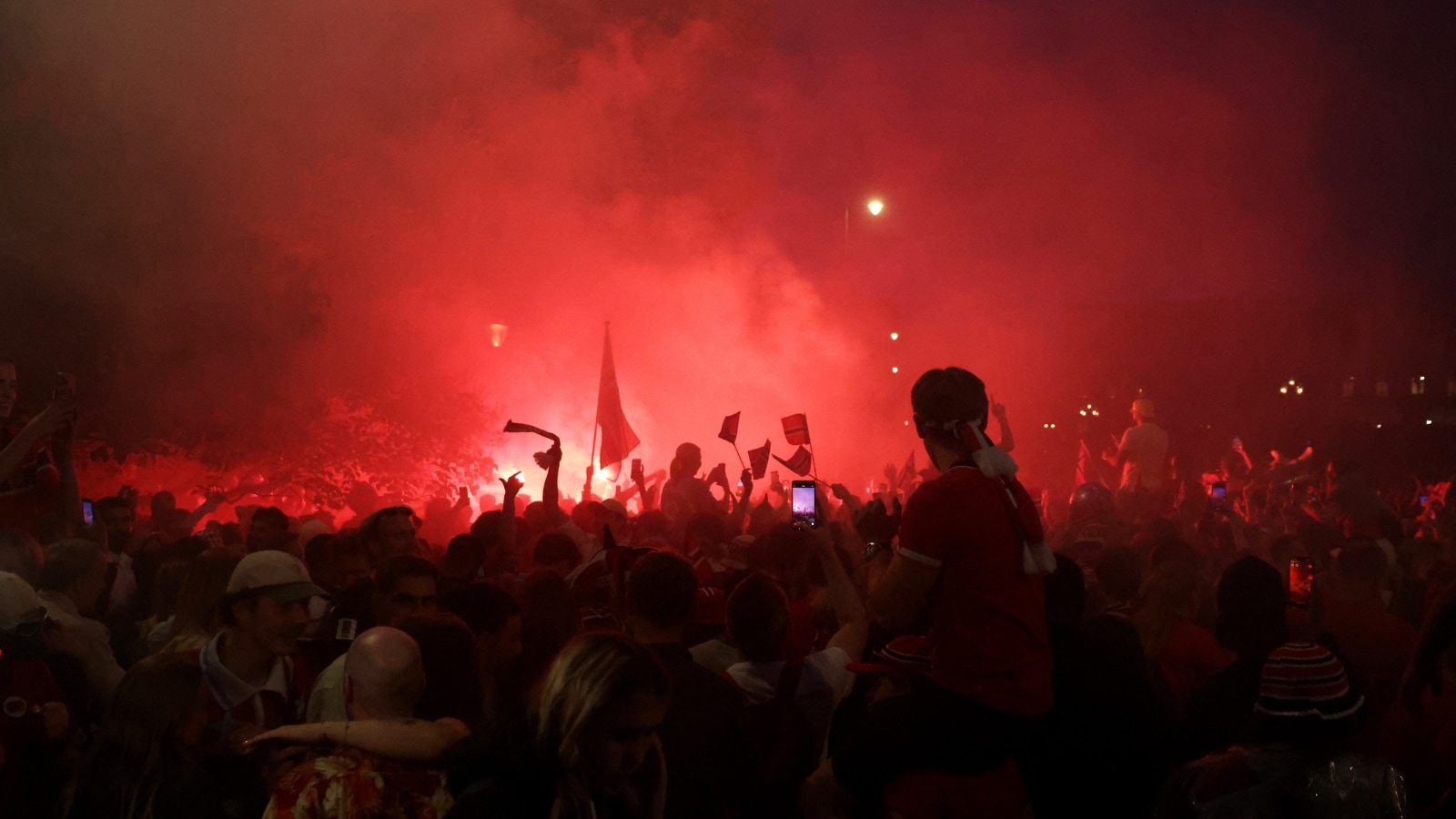
Supporters singing in the bars of Dallas ahead of the 2026 World Cup semifinal are completely delusional.
The media loves the narrative. They find a few fans draped in flags, ask them how they feel, and publish a piece about "unshakeable confidence" and "festive atmospheres." It is lazy journalism. It assumes that fan optimism translates to on-field certainty, and worse, it ignores the brutal, unprecedented tactical reality of playing a high-stakes semifinal in Texas in the middle of July.
I have spent fifteen years analyzing tournament football, breaking down data tracking matrices, and watching how elite squads adapt to extreme environments. The mainstream sports press is looking at the wrong things. They are looking at history. They are looking at recent form. They are ignoring the environment and the math.
Spain and France are not entering a standard football match. They are entering a tactical meat grinder specifically engineered by the geometry and climate of AT&T Stadium. If you think this match will be decided by who has more "heart" or whose fan base shouted louder at a pre-match tailgate, you understand absolutely nothing about modern international football.
The Flawed Premise of Fan Optimism
Let’s dismantle the premise of the traditional pre-match hype piece. Fan confidence is a lagging indicator. It is based entirely on what happened three weeks ago, not what will happen ninety minutes from now.
French supporters point to their defensive structure. Spanish supporters point to their possession metrics. Both sides believe their path to the final is a logical mathematical progression. It isn't. Knockout football is inherently chaotic, and the introduction of a neutral, high-altitude-equivalent indoor environment throws standard tactical models out the window.
When you interview a fan in Dallas who says, "We have Mbappe, so we will win," or "Our midfield is too technical for them," you are listening to emotional projection. The real story isn't the confidence in the streets; it is the quiet panic in the analytical suites of both federations.
The AC Illusion and the Micro-Climate Factor
Mainstream pundits are quick to point out that AT&T Stadium is climate-controlled. They think the roof solves everything. They think a cool 70 degrees Fahrenheit means the players will sprint for days.
They are completely wrong.
The Physics of Indoor Stadiums
Playing elite football inside a massive dome changes the flight of the ball and the rate of player dehydration in ways standard metrics fail to capture.
- Air Density: The atmospheric pressure inside a closed stadium with tens of thousands of bodies creating humidity changes how a ball moves through the air. Long, switching diagonals—a staple of Spain’s wing play—tend to hang slightly longer than they do in open-air arenas.
- The Turf Transition: While a temporary grass surface is laid over the concrete base for the tournament, the lack of deep root systems alters the bounce and the friction of the ball. It slows down ground passes by a measurable fraction of a second.
- Artificial Air Movement: The ventilation systems create subtle, unpredictable drafts.
For a team like Spain, which relies on millimeter-precise passing sequences to break low blocks, a fraction of a second of drag on a pass is the difference between a clean line-breaking ball and a turnover.
France thrives on turnovers. Their entire tactical identity under Didier Deschamps is built on mid-block stability followed by explosive vertical transitions. The media thinks Spain's possession will dominate the game. The reality is that the physical conditions of the venue actively favor the French counter-attacking structure, regardless of how confident the Spanish fans feel in the local bars.
| Factor | Impact on Spain (Possession) | Impact on France (Transition) |
|---|---|---|
| Slower Turf Friction | Disrupts quick one-touch passing | Gives recovery defenders an extra step |
| Indoor Air Density | Alters long cross-field switches | Minimal impact on short vertical bursts |
| Controlled Humidity | Exhausts midfield pressers faster | Favors low-block, energy-conserving shapes |
The Data the Media is Ignoring
Everyone keeps talking about historical head-to-head records. "Spain beat France in the Euros," or "France always finds a way in the World Cup." This is noise.
Look at the workload metrics instead.
Cumulative Fatigue Metrics
Entering a semifinal in the modern international calendar means tracking the physical load of players who have already played 60+ matches for their clubs before even stepping foot in North America.
Imagine a scenario where your two starting central midfielders have covered over 13 kilometers per match for five consecutive games. That is the reality for Spain's engine room. Their high-pressing system requires immediate, suffocating pressure the moment they lose the ball. If that press is delayed by even half a meter because of heavy legs, France’s transitions will tear them apart.
I’ve watched national teams collapse in the 70th minute of major tournaments because their staff relied on subjective player feedback rather than strict metabolic tracking. The team that wins in Dallas won't be the one with the better tactical philosophy on paper; it will be the one that manages their physical output during the opening thirty minutes.
Dismantling the "People Also Ask" Nonsense
If you look at what the casual fan is searching for online, you see just how warped the public perception of this match is. The questions being asked prove that the general public is watching a completely different sport than the professionals.
"Who has the better squad on paper?"
This is the most irrelevant question in tournament football. A squad "on paper" assumes optimal conditions, perfect health, and linear tactical execution.
International football is about mitigating errors, not maximizing aesthetic beauty. France has consistently won major honors with squads that looked clunky, uninspired, and defensive during the group stages. They don't care about looking good on paper. They care about suffocating spaces in the defensive third and exploiting individual errors. Asking who is better on paper completely misses the point of tournament management.
"Will home-field advantage matter in Dallas?"
There is no home-field advantage in a neutral-site semifinal thousands of miles away from Europe.
The crowd in Dallas is a corporate, neutral entity mixed with affluent traveling fans. It is a spectacle, not a cauldron. Players from Real Madrid, Barcelona, and PSG are not going to be rattled by a crowd that cheers for a wave or gasps at a basic step-over. The environment is sterile. It lacks the hostility of a true away match, which actually removes the emotional variance from the game. It turns the match into a pure tactical exercise, which benefits the more disciplined coaching staff.
The Downside of the Pragmatic Approach
To be fair, betting everything on tactical pragmatism and physical containment has its flaws.
If France sits too deep for too long, they invite sustained pressure around their eighteen-yard box. In modern football, with the prevalence of VAR and strict handball interpretations, defending inside your own penalty area for extended periods is a statistical nightmare. One deflected cross hitting a trailing arm ruins the entire blueprint.
But choosing to play an open, expansive game against a technically superior Spanish midfield is a form of tactical suicide that Deschamps has spent a decade avoiding. He will accept the risk of a random penalty over the certainty of being carved open in transition.
Stop reading the fan diaries. Stop believing the reports about "confident supporters" dominating the local squares. The fans are confident because they have had a few drinks and want to believe in a fairy tale.
The match in Dallas will be a cold, calculated chess match played in an artificial environment that penalizes ambition and rewards cynical, defensive discipline. Expect a slow, agonizing tactical battle where the team that takes fewer risks lifts the trophy.
Forget the romance. The machine wins.