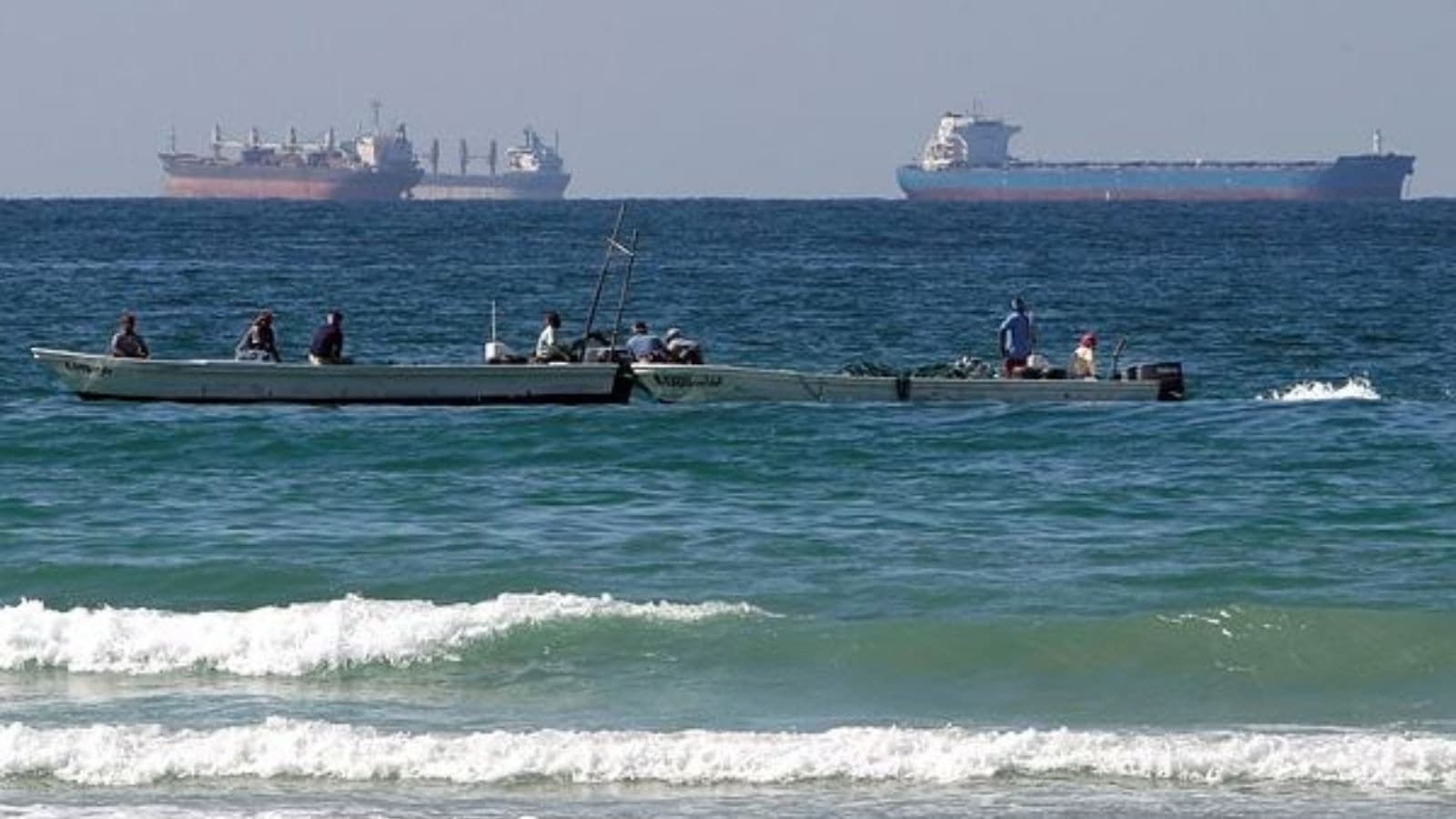
Military analysts love a good David vs. Goliath story. For two decades, the "Mosquito Fleet" has been the darling of naval war gaming. The narrative is seductive: Iran’s swarm of fast-attack craft (FACs), armed with C-802 missiles and suicide drones, will overwhelm a billion-dollar U.S. destroyer in the narrow confines of the Strait of Hormuz. We’ve been told that $30,000 boats will sink $2 billion ships. It sounds efficient. It sounds modern.
It is also a fundamental misunderstanding of how 21st-century sea denial actually works.
The "swarm" is not a masterstroke of asymmetric genius. It is a desperate response to a total lack of air superiority. While the media focuses on the visual of a hundred speedboats buzzing a carrier, they miss the tactical reality: in a high-intensity conflict, these boats are nothing more than floating target practice for an Integrated Air Defense System (IADS) and multi-domain sensors.
The Precision Fallacy
The "swarm" relies on the idea of saturation. If you send 50 targets, the ship can only shoot 40. The 10 that remain get through. This logic worked in the 1980s. It fails today.
Modern naval warfare is no longer about the platform; it is about the kill chain. The U.S. Navy’s Cooperative Engagement Capability (CEC) allows a sensor on one ship to guide a missile from another. When you factor in the MQ-4C Triton and the P-8 Poseidon’s radar capabilities, the "surprise" element of the mosquito fleet vanishes. You cannot swarm what is identified and neutralized 50 miles before it reaches its launch point.
The IRGC Navy (IRGCN) boats are loud, hot, and highly visible on radar. They lack the electronic warfare suites necessary to jam incoming Aegis-guided munitions. In every real-world engagement where fast boats met modern naval aviation—see Operation Praying Mantis in 1988 or the 1991 "Bubiyan Shelf" battle—the results were a massacre. In '91, the British Lynx helicopters alone gutted the Iraqi fast boat fleet using Sea Skua missiles. We haven't moved backward since then; the missiles have just gotten smarter.
The Hormuz Paradox
The common fear is that Iran will "close" the Strait of Hormuz. This is the ultimate "People Also Ask" bogeyman. But closing the Strait is not a military victory; it is economic suicide for the regime.
Eighty percent of Iran’s export revenue comes from oil, and much of that passes through that very channel. If they mine the Strait or sink tankers with their mosquito fleet, they aren't just locking the U.S. out—they are locking themselves in.
More importantly, the geography that favors the mosquito fleet—the jagged coastline and numerous islands like Abu Musa—is a double-edged sword. To be effective, the boats must stay close to shore for cover. The moment they venture into the deep-water shipping lanes to engage a target, they lose their only advantage: clutter. Without that clutter, they are just slow-moving targets in a high-def environment.
The Drone Obsession is a Distraction
Recently, the narrative shifted. Now, it’s not just speedboats; it’s "suicide boat drones" and the Shahed-136. Analysts claim these cheap assets render traditional naval power obsolete.
This is the "lazy consensus" at its peak. It ignores the physics of the ocean.
A drone boat (USV) moving at 40 knots in a choppy Persian Gulf is a different beast than a drone flying in the air. Sea state matters. Salt spray ruins optics. Continuous pounding destroys cheap electronics. While a Shahed drone is a legitimate threat to static land targets, hitting a moving warship equipped with Phalanx CIWS, RIM-116 Rolling Airframe Missiles, and directed energy weapons is a different tier of difficulty.
The IRGCN is essentially trying to fight a 19th-century "Jeune École" strategy with 21st-century toys. The Jeune École was a French naval theory that argued small, torpedo-armed vessels could defeat battleships. It didn't work then because the battleships evolved. It won't work now because the "battleships" are now networked computers that see everything from the stratosphere.
The Battle Scars of Reality
I have seen defense contractors pitch "swarm-busting" tech for years. They love the mosquito fleet because it’s a perfect excuse to sell more hardware. But the real-world data is grim for the swarm.
In the 2002 Millennium Challenge war game, the "Red Team" used a mosquito fleet to sink a U.S. fleet. People still cite this as proof of the swarm’s power. They forget two things:
- The war game was rigged with "magic" messaging that bypassed electronic warfare.
- The U.S. Navy spent the next 24 years specifically engineering the hardware to ensure that scenario could never happen.
The arrival of the Littoral Combat Ship (LCS), despite its criticized development, was specifically designed with the "Suave" module to wipe out swarms. Combined with the Hellfire Longbow missiles now integrated onto naval platforms, a single Seahawk helicopter can neutralize half a dozen IRGCN boats before the pilots even break a sweat.
Why Iran Keeps Building Them
If the mosquito fleet is a tactical dead end, why does Iran spend millions on it?
It’s about internal signaling and low-intensity harassment. The mosquito fleet is perfect for seizing a commercial tanker or harassing a merchant vessel. It is a tool for "Gray Zone" warfare—actions that stay below the threshold of open conflict. It makes for great propaganda videos for the domestic audience.
But in a shooting war? The mosquito fleet is a one-way trip.
The real threat from Iran isn't the boat you see on the news. It's the coastal defense cruise missiles (CDCMs) hidden in reinforced mountainside bunkers. It's the Ghadir-class midget submarines that sit silent on the sandy bottom, waiting for a thermal signature. These are the assets that require respect. The boats are just noise.
The Counter-Intuitive Truth
The obsession with the "Mosquito Fleet" has actually made the U.S. Navy stronger. By forcing the Pentagon to obsess over "small boat threats," it accelerated the development of high-speed, high-capacity targeting systems.
The swarm is no longer a threat; it is a catalyst for the very technology that has made it obsolete.
We need to stop asking "How do we stop the swarm?" and start asking "Why are we still pretending the swarm is the primary threat?" When you focus on the speedboats, you miss the cyber-disruption of GPS signals, the undersea cable cutting, and the long-range ballistic missiles that can hit a carrier from 1,000 miles away.
The IRGCN mosquito fleet is a psychological weapon, not a kinetic one. It survives on the fear of what might happen if we "underestimate" them. But the greatest danger in military intelligence isn't underestimating your enemy; it's overestimating a tactic that has already been solved.
The next time you see a grainy video of Iranian boats circling a U.S. carrier, don't look at the boats. Look at the horizon. The real war is happening in the electromagnetic spectrum and the deep sea, where the mosquitoes can’t fly and the speedboats can’t reach.
The swarm is dead. It just hasn't realized it yet.
Stop preparing for the 2002 version of the Persian Gulf. The ocean has become transparent, and in a transparent ocean, there is no place for a swarm to hide.


