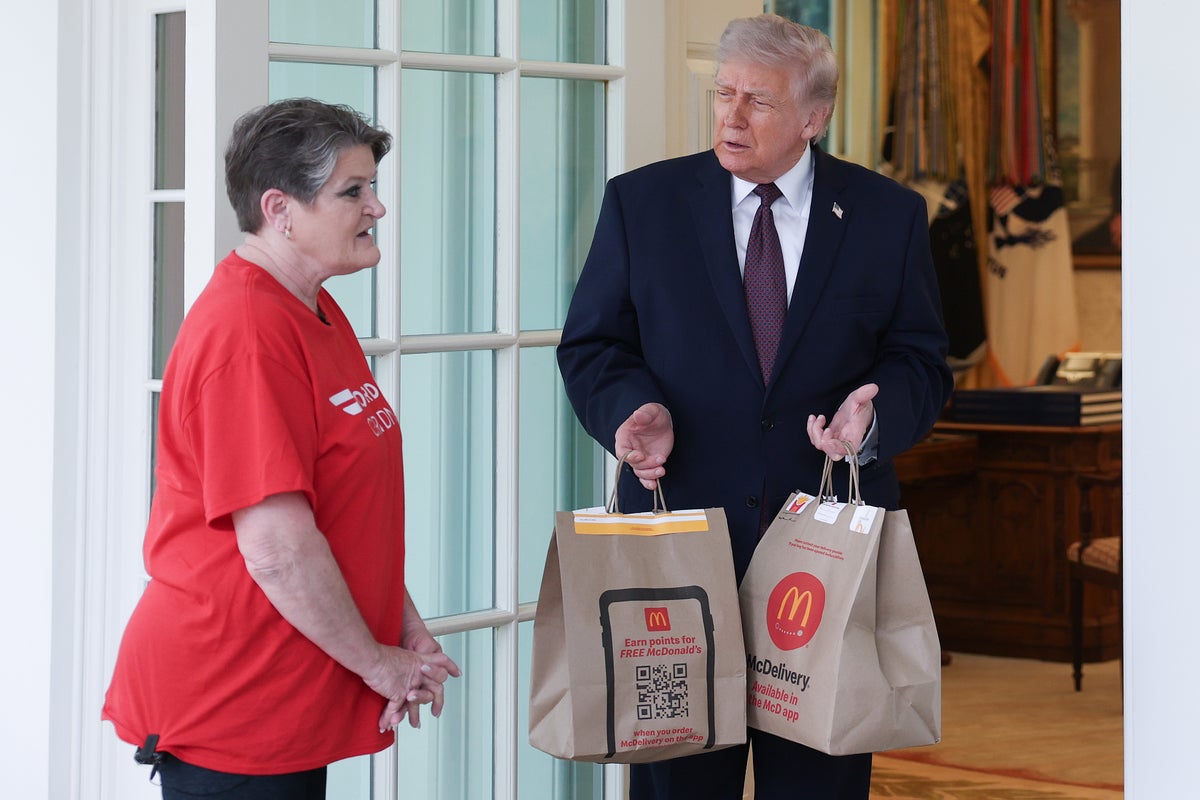
Donald Trump’s digital presence has always functioned as a high-velocity feedback loop, but a recent sequence involving the removal of AI-generated religious imagery followed by a highly visible fast-food stop reveals more than just eccentric behavior. It highlights a specific friction between experimental campaign technology and the rigid expectations of a traditional base. When a bizarre, AI-rendered image of a "white-robed figure" appeared and then vanished from his social feed, replaced shortly after by a viral stop for Chicken McNuggets, the media focused on the absurdity. They missed the mechanics of the pivot. This was not a random glitch but a collision of two distinct branding strategies: the unregulated frontier of generative media and the battle-tested reliability of the "everyman" populist aesthetic.
The Short Life of the Synthetic Prophet
Generative AI offers political campaigns a tempting shortcut to emotional resonance. It allows for the instant creation of iconography that would take a photography team weeks to stage. In this instance, the image depicted a stylized, ethereal figure—often interpreted by followers as a messianic representation—engaging with the former president. The problem with synthetic media in a political vacuum is its inherent lack of soul and, more importantly, its lack of deniability.
Unlike a photo-op with a real constituent, AI imagery feels hollow to the skeptical and "weird" to the undecided. Internal campaign metrics likely showed that while the fringe found the "AI Jesus" imagery moving, the broader electorate viewed it as a descent into the uncanny valley. The deletion was a silent admission of a tactical error. You cannot build a movement on hallucinations when your opponent is already accusing you of losing your grip on reality.
Why the Uncanny Valley Kills Campaigns
The "uncanny valley" is a well-documented phenomenon where an image looks almost human but lacks the subtle cues of life, triggering an instinctive revulsion in the viewer. For a politician who relies on a "tough guy" or "real talk" persona, appearing next to a shimmering, multi-fingered AI specter undermines the core brand of authenticity.
When the image was scrubbed, it left a void in the news cycle that needed immediate filling with something tangible. Something greasy. Something that couldn't be faked by a midjourney prompt.
McNuggets as a Tactical Reset
The shift from the ethereal to the deep-fried was a calculated return to the "Common Man" playbook. By showing up at a McDonald's to order McNuggets, Trump engaged in a form of retail politics that has served him for decades. It is the ultimate grounded counterweight to the ethereal weirdness of AI.
Fast food is a universal language in the American electorate. It suggests a lack of pretension. It signals that despite the private jets and gold-plated towers, the candidate shares the same metabolic struggles and culinary guilty pleasures as a shift worker in Ohio. This wasn't about hunger; it was about re-establishing a physical presence in a world that was starting to look too much like a computer simulation.
The Logistics of the High Calorie Photo Op
A presidential-level fast food stop is never "random." It involves Secret Service sweeps, advance teams coordinating with franchise owners, and a specific choreography for the cameras.
- The Interaction: The candidate must appear to handle the transaction himself, even if an aide actually holds the cash.
- The Order: It must be relatable. Ordering a kale salad would be political suicide; ordering McNuggets is a signal of consistency.
- The Distribution: The food is often handed out to supporters or the press, transforming a selfish act of eating into a communal act of "providing."
This sequence effectively neutralized the "AI Jesus" story by replacing a controversial, intangible digital artifact with a physical, relatable human moment. The media, distracted by the spectacle of a billionaire at a drive-thru, stopped asking why a messianic AI image was posted in the first place.
The Risk of the Digital Frankenstein
This episode uncovers a growing tension in modern political communication. Staffers are increasingly using generative tools to "vibe check" the internet, throwing content at the wall to see what sticks. But these tools are volatile. An AI doesn't understand the nuance of religious sacrilege or the subtle line between "inspiring" and "creepy."
When a campaign lets the algorithm lead, it risks alienating the very people it seeks to inspire. The religious right, a cornerstone of the Trump coalition, is not a monolith. While some find comfort in the digital exaltation of their leader, others find the use of synthetic religious figures to be borderline blasphemous or, at the very least, deeply tacky.
The Reliability of the Physical Brand
Trump’s long-term survival in the public consciousness is tied to his physicality—the hair, the suit, the specific cadence of his speech. AI threatens this because it makes the unique common. If anyone can generate a high-definition video of Trump saying or doing anything, the "real" Trump loses his monopoly on his own image.
By pivoting back to the McDonald's counter, he reclaims his physical monopoly. A computer can’t smell like french fry oil. It can’t shake a hand with the precise pressure of a man who spent forty years on construction sites and in boardrooms. This is the "Brutal Truth" of the 2024-2026 era: the more digital we become, the more political power resides in the tactile.
The End of the Experimental Phase
We are witnessing the messy puberty of AI in politics. We saw it with the deepfake videos used in the primary ads and we see it now with the "deleted" posts that haunt the archives of internet researchers. These are not just gaffes; they are data points in a massive, real-time experiment on the American psyche.
The deletion of the AI image suggests that even the most aggressive digital teams recognize there are limits. You can't replace a handshake with a prompt. You can't replace a Big Mac with a pixel. The campaign realized that for every voter impressed by a digital miracle, ten were confused by the lack of a human touch.
Moving forward, expect to see a more disciplined approach to synthetic media. The "Wild West" era of posting whatever the latest model spits out is ending because the cost of "looking weird" is becoming too high. In a high-stakes environment, the risk of a digital hallucination outweighs the reward of a viral moment.
The McNugget order was the pallet cleanser. It was the reset button. It was a reminder to the base that the candidate is still made of flesh, blood, and processed poultry, rather than code and weights. In the battle between the algorithm and the appetite, the appetite still wins every single time.
The strategy is clear: use the AI to grab the attention, but use the grease to hold the ground. If you find yourself wondering why a major political figure is acting "weird" on the internet, look for the physical stunt that follows. It is almost always a frantic attempt to prove they still exist in the three-dimensional world.