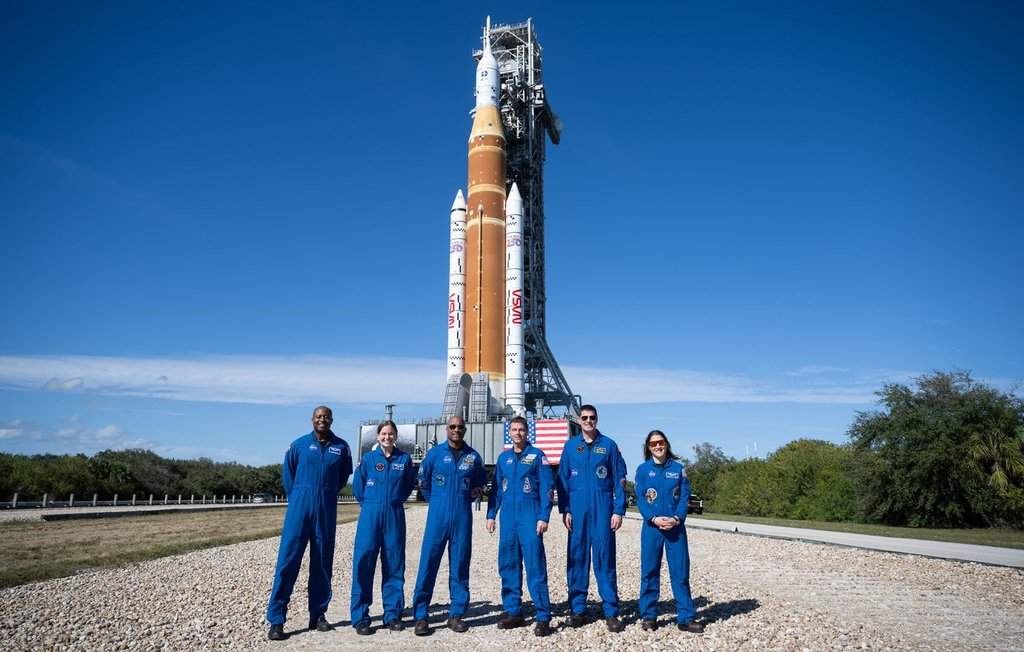
The countdown clock at Kennedy Space Center is no longer a theoretical exercise. After decades of false starts, shifting political mandates, and a budget that has ballooned to roughly $93 billion, NASA is finally poised to send humans back to the vicinity of the Moon. On April 1, 2026, the Space Launch System (SLS) rocket is scheduled to ignite, carrying the Orion capsule and four astronauts—Reid Wiseman, Victor Glover, Christina Koch, and Jeremy Hansen—on a high-stakes trajectory that will take them further into the deep-space void than any human in history.
But beneath the patriotic sheen of "returning to the Moon" lies a more complex, uncomfortable reality. This is not just a mission of discovery; it is a desperate validation of a legacy hardware system that has been teetering on the edge of obsolescence since its inception. While the public celebrates the diversity of a crew that includes the first woman and the first person of color to leave Earth’s orbit, the engineers in the trenches are holding their breath over a heat shield that nearly failed its last test and a life-support system that has never been stressed by human lungs in deep space.
The Heat Shield Problem NASA Can’t Ignore
When the uncrewed Artemis I mission returned to Earth in late 2022, the Orion capsule’s heat shield did not behave as the simulations predicted. Instead of a smooth ablation—the process where the outer layer burns away to carry heat from the spacecraft—the Avcoat material suffered from "spalling." In plain English, chunks of the shield broke off.
This left unexpected divots and gouges in the thermal protection system. For over a year, the agency’s Office of Inspector General (OIG) raised alarms, noting that these voids could lead to localized "hot spots" during the 25,000 mph reentry. If the heat penetrates the underlying structure, the result is a catastrophic breakup of the vehicle.
NASA spent much of 2024 and 2025 investigating the root cause. They eventually pointed to "char permeability" issues, where trapped gases under the surface caused the material to pop like popcorn. The agency has cleared the Artemis II hardware for flight, but it is a calculated risk. They are betting that the specific trajectory of this crewed mission will mitigate the spalling seen on the more aggressive Artemis I reentry. It is a "fly as is" decision that highlights the immense pressure to launch before the program loses its remaining political capital.
A Legacy Rocket in a New Space Age
The SLS is a beast of a machine, standing 322 feet tall and generating 8.8 million pounds of thrust. Yet, to many industry analysts, it represents the "Old Space" way of doing business. Unlike the reusable rockets being perfected just a few miles away at SpaceX’s facilities, every SLS is a "single-use" multi-billion dollar expendable.
- Cost Per Launch: Estimates peg the cost of a single Artemis launch at over $4 billion.
- The Heritage Problem: The SLS uses modified RS-25 engines that originally flew on the Space Shuttle. We are essentially burning priceless museum pieces to push 1970s-derived technology into the 2020s.
- The China Factor: While NASA navigates internal audits, China’s lunar program is moving with a speed that has the Pentagon nervous. Artemis II is no longer just a scientific milestone; it is a geopolitical necessity to maintain "space superiority."
This mission uses a free-return trajectory. This means that once the crew performs the Trans-Lunar Injection (TLI) burn, physics will naturally pull them around the Moon and sling them back to Earth. It is a safety-first flight profile, similar to the "lifeboat" return used by the crippled Apollo 13. If the Orion’s main engine fails once they are on that path, the crew still comes home. It is a sober admission that, despite 50 years of progress, deep space remains a place where we prioritize survival over complexity.
Testing the Invisible Limits
The ten-day mission will be a grueling test of the Orion’s Environmental Control and Life Support System (ECLSS). In low Earth orbit, if a CO2 scrubber fails, the International Space Station is only hours away from a potential evacuation. On Artemis II, once the crew leaves high Earth orbit, they are days away from help.
The crew will spend the first 24 hours in a high Earth orbit, reaching an altitude of nearly 45,000 miles. This is a deliberate "test porch." Before they commit to the three-day trek to the Moon, they must ensure the capsule can maintain a breathable atmosphere, manage waste, and shield them from the increased radiation levels of the Van Allen belts.
There is also the matter of the proximity operations demonstration. The crew will use the spent upper stage of the SLS as a target, maneuvering the Orion capsule manually to test its handling characteristics. This isn't just for show; it is the foundational skill needed for Artemis III, where astronauts will have to dock with a lunar lander in high lunar orbit.
The Distance Record Nobody Wanted to Break
If all goes according to plan, the Artemis II crew will travel approximately 4,600 miles beyond the far side of the Moon. This will break the record for the farthest humans have ever been from Earth, a title held since 1970 by the Apollo 13 crew.
Breaking this record is a bittersweet milestone. It highlights how long the human species has remained tethered to the "backyard" of low Earth orbit. The view from the far side—the "Earthrise" over the lunar horizon—will be broadcast in high definition for the first time, but the emotional weight for the crew will be different. They are the bridge between the analog heroics of the 20th century and the commercialized, roboticized reality of the 21st.
The mission is an expensive, dangerous, and technically fraught endeavor. It relies on a heat shield with a known "spalling" history and a rocket that costs as much as a small country's GDP. But in the cold math of aerospace engineering, there is no such thing as zero risk. There is only the point where the cost of waiting exceeds the danger of flying. NASA has decided we have reached that point.
The four individuals sitting atop that 32-story pillar of fire are not just testing a spacecraft. They are testing whether the United States still has the institutional will to be a spacefaring nation. The success of Artemis II won't just be measured by a safe splashdown in the Pacific; it will be measured by whether it can justify the existence of the program itself in an era of cheaper, faster alternatives. We are about to find out if the gamble pays off.
The engines are ready. The crew is in quarantine. The moon is waiting. Let’s see if the hardware holds.