The introduction of passenger rail services across the United Arab Emirates represents a fundamental restructuring of domestic mobility economics. For decades, inter-emirate transit relied almost entirely on rubber-tired highway transport, a model characterized by high externalized congestion costs, constant road maintenance expenditure, and linear scaling of individual vehicle emissions. The activation of the Etihad Rail passenger network shifts this paradigm from decentralized highway congestion toward concentrated, fixed-guideway transport corridors. Understanding the implications of this network requires deconstructing its underlying economic, operational, and geographic variables.
Highway transport systems suffer from diminishing marginal efficiency as traffic volume approaches capacity thresholds. Every additional passenger vehicle on the E11 or E311 highway adds non-linear friction, manifesting as slowdowns, micro-accidents, and escalating fuel consumption per passenger-kilometer. Rail infrastructure internalizes these variables by decoupling throughput from individual driver behavior. A single passenger train operating at maximum capacity replaces hundreds of private automobiles or multiple heavy buses, stripping variable road friction out of the inter-emirate transit equation.
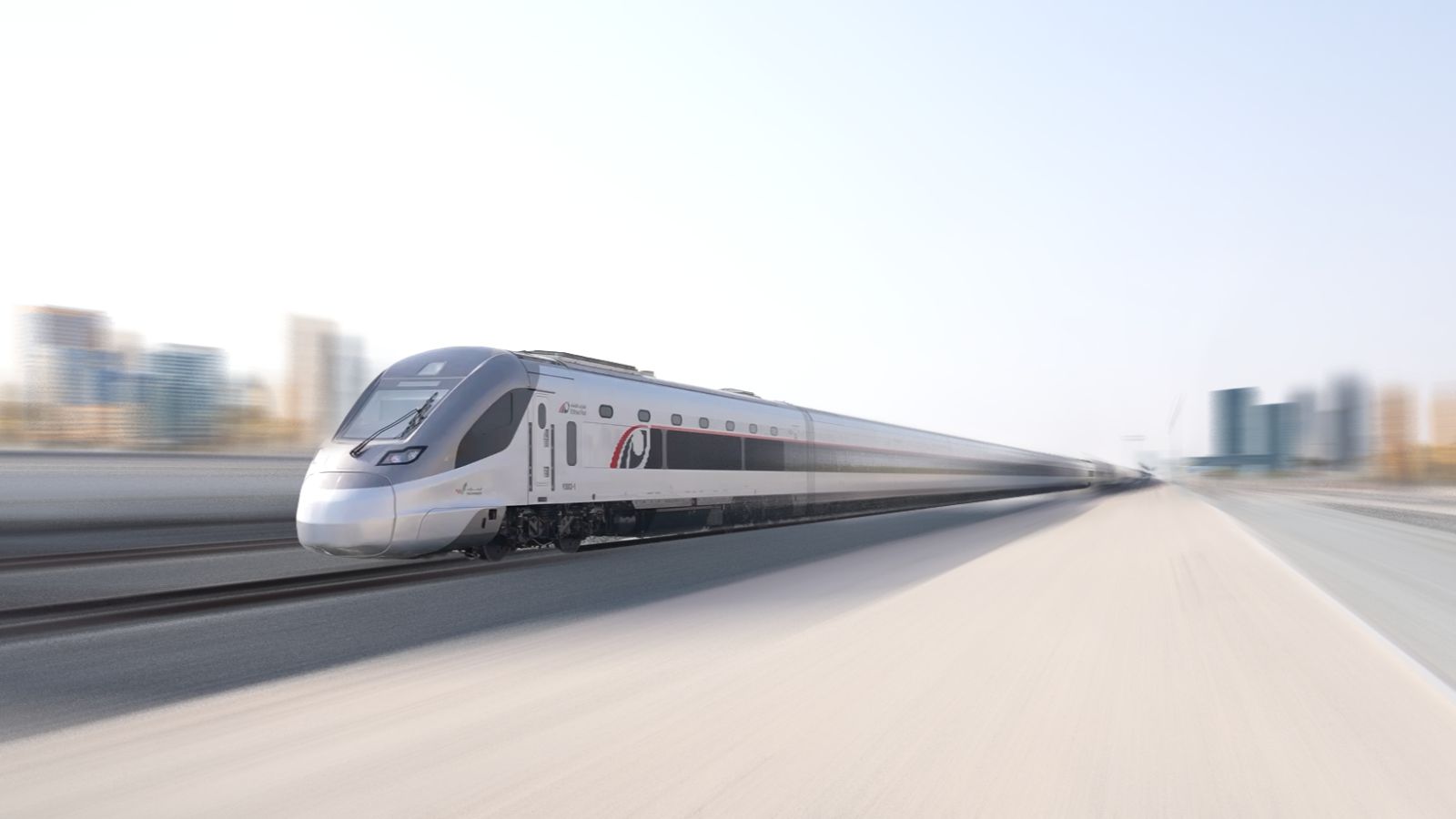
The initial operational phase connects Abu Dhabi and Fujairah, with subsequent expansions incorporating Dubai, Sharjah, and Al Dhaid. This routing strategy reflects an intentional prioritization of connecting high-density urban nodes with peripheral industrial and logistical hubs. The engineering parameters dictate a maximum operating speed of up to 200 kilometers per hour for the regional fleet manufactured by CAF. While this speed does not match ultra-high-speed bullet trains found in other global markets, it optimizes energy consumption and structural wear relative to the distance spans involved.
Time-distance compression is the primary economic benefit delivered by fixed-rail systems. Distance is no longer measured strictly in linear kilometers or variable driving hours dictated by peak-period congestion bottlenecks. The scheduled 105-minute journey time between Abu Dhabi and Fujairah, alongside the 57-minute transit window between Abu Dhabi and Dubai, introduces predictable time-value calculations for business and leisure commuters. When travel time becomes a fixed, non-variable constant, labor productivity calculations shift. Commuters can utilize transit periods for uninterrupted work or rest, converting dead travel time into productive or restorative hours.
Fare architecture plays a critical steering function in managing network demand. Ticket pricing begins at AED 55 for Comfort Class on long-haul routes like Abu Dhabi to Fujairah, scaling up to AED 120 for Premium Class, while shorter segments such as Dubai to Abu Dhabi start at AED 39 for Comfort Class and AED 109 for Premium Class. This tiered pricing structure establishes clear economic stratification among passengers. Budget-conscious travelers, students, and regular commuters occupy Comfort Class tiers, while corporate travelers and those seeking enhanced workspace or privacy self-select into Premium Class.
To manage inventory and seat yield, the operator implements a three-tiered ticketing taxonomy consisting of Saver, Value, and Flex tariffs. The Saver tier imposes strict cancellation and modification restrictions while stripping away advance seat selection, functioning as a yield-management tool to fill unreserved capacity on off-peak runs. The Value tier introduces complimentary seat selection and moderate ticket modification rights, while the Flex tier provides full refundability and rescheduling autonomy. This economic segmentation mirrors modern aviation revenue management, allowing the rail operator to optimize seat utilization and maximize asset yield across varying demand cycles.
Network scheduling reveals a deliberate tactical approach to service frequency. Initial operational schedules deploy five daily round-trip services between Dubai and Abu Dhabi, matched with lower frequencies on peripheral lines like the single daily run connecting Dubai and Fujairah. This asymmetry reflects initial capacity management and demand-testing protocols. Rather than flooding the network with surplus capacity from day one, the operator matches rolling stock deployment to empirically verified passenger flow data. As ridership density increases, frequency adjustments will follow baseline utilization rates.
The physical architecture of the rolling stock fleet consists of thirteen dedicated passenger trains, each engineered with a maximum capacity of approximately four hundred passengers. These units are fitted with onboard Wi-Fi, standardized power adapters at every seat, dedicated luggage storage, and accessibility features for passengers with reduced mobility. This interior layout addresses the specific friction points of long-distance regional transit. In contrast to public buses, which often lack integrated workspace ergonomics or luggage capacity, these passenger rail cars are designed to capture mid-to-high-tier commuters accustomed to digital connectivity and spatial comfort.
A critical determinant of any rail network success is the efficiency of first-and-last-mile connections. Inter-emirate train stations do not exist in a vacuum; their utility is bounded by how easily a passenger can transition from the station platform to their ultimate urban destination. In Dubai, integration with the existing transit network is anchored by positioning stations near established high-density zones, such as the station at Jumeirah Golf Estates, and partnering with local transit authorities to allow payment compatibility via existing transit card infrastructure like the Nol card. This reduces friction at transfer nodes, lowering the psychological and financial barrier to switching from private cars to rail.
In Abu Dhabi, the primary station in Mohammed Bin Zayed City serves as the southern anchor of the core passenger corridor. Similar structural considerations apply to regional stations in Sharjah and Al Dhaid, where proximity to university complexes, commercial free zones, and residential hubs dictates actual passenger capture rates. Where stations are isolated from dense pedestrian catchments, shuttle bus services, parking availability, and car rental partnerships become mandatory support infrastructure. Without these integrated access vectors, even a fast train suffers from low terminal efficiency.
The freight operations of Etihad Rail predate and subsidize the passenger service rollout. Operating heavy freight locomotives carrying industrial materials across the UAE network establishes baseline track maintenance funding and operational familiarity. Passenger trains must share or coordinate track access windows with freight traffic, though the physical separation of signaling and scheduling prevents major operational conflicts. This dual-use rail model maximizes the capital expenditure efficiency of the entire ninety-kilometer national network, amortizing infrastructure costs across both industrial logistics and consumer mobility.
Looking at regional spillover effects, the integration with international projects like Hafeet Rail extends the economic geography beyond UAE borders. Connecting Abu Dhabi to Sohar Port in Oman creates a cross-border rail corridor that alters freight and future passenger logistics across the southern Arabian Peninsula. While the immediate focus remains domestic inter-emirate connectivity, the underlying track topology is built for regional interoperability.
The limitations of the current rollout must be acknowledged. The initial train speeds and daily frequencies mean that rail cannot yet replace the absolute flexibility of the private automobile for every traveler. A commuter whose schedule changes unpredictably cannot rely on a fixed schedule with limited daily departures. Furthermore, capital expenditure recovery on mega-scale rail infrastructure requires multi-decade horizons, meaning that short-term profitability metrics are secondary to long-term macroeconomic gains such as reduced highway pavement degradation, lower carbon emissions per capita, and enhanced regional labor market liquidity.
To maximize structural absorption of passenger rail into daily transit habits, regional planning authorities must enforce transit-oriented development around station hubs. Municipalities should restrict low-density urban sprawl near terminal zones, replacing surface parking lots with high-density commercial and residential complexes that feed commuters directly into station concourses. Simultaneously, dynamic pricing algorithms should be refined to smooth peak-hour congestion spikes by incentivizing off-peak travel through aggressive fare discounting on under-utilized midday runs.