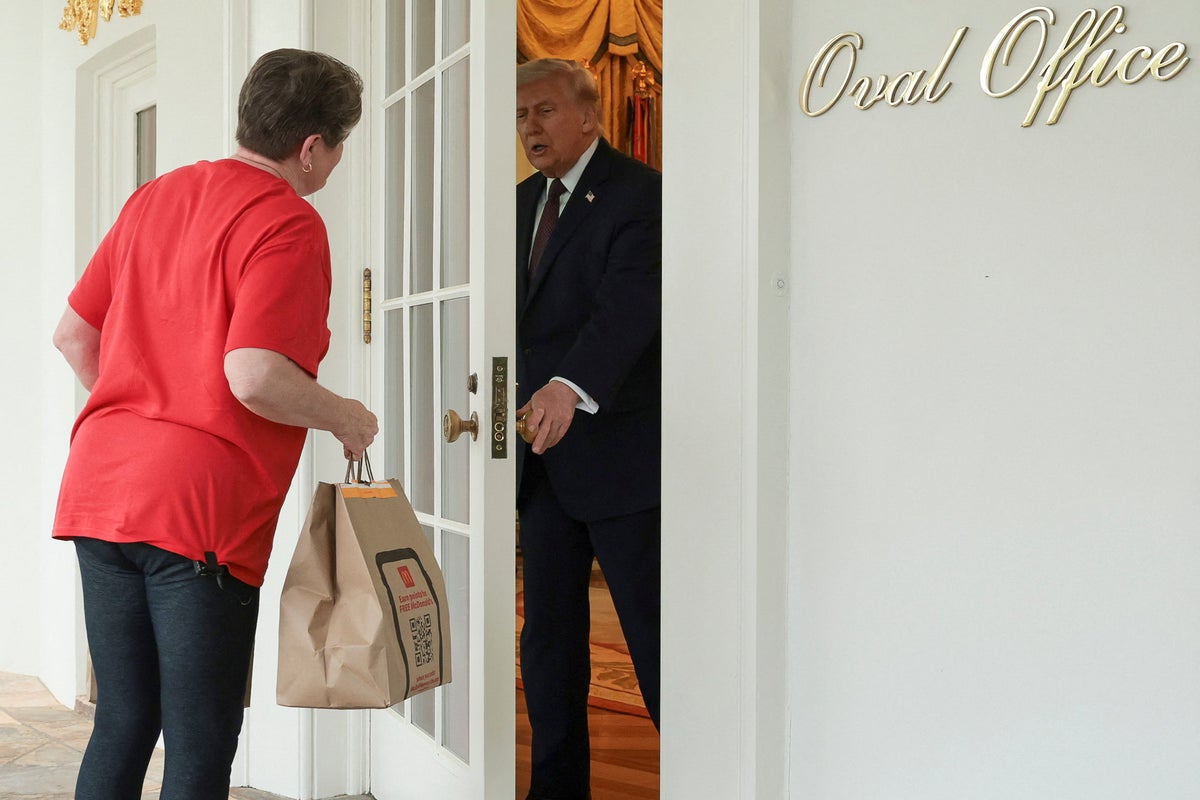
The sight of a gig worker standing in the driveway of the most heavily fortified residence on earth is not just a lapse in decorum. It is a catastrophic failure of operational security. When Donald Trump reportedly ordered McDonald’s via DoorDash to the White House and proceeded to field questions about a potential conflict with Iran while the delivery driver stood within earshot, he did more than break a diet. He punctured the "bubble" that keeps the executive branch safe from espionage, digital tracking, and physical compromise.
In the world of high-stakes intelligence, we talk about the "attack surface." This is the sum of all points where an unauthorized user can try to enter data or extract it. By introducing a third-party, unvetted civilian into the West Wing’s immediate orbit, the administration turned a secure fortress into a drive-thru. This isn't about a love for Big Macs. It is about the terrifying ease with which modern convenience apps can be weaponized against the highest levels of government.
The Digital Breadcrumbs of a Big Mac
Every DoorDash order carries a payload of metadata that would make a foreign intelligence officer drool. When that order is placed, a signal bounces from a personal device to a corporate server, then to a restaurant, and finally to a driver’s smartphone.
Consider the trail. The driver’s phone uses high-precision GPS to navigate. In a standard civilian setting, this is helpful. In the context of the White House, it provides a real-time ping of exactly where a high-value target is located. If the driver’s phone is compromised—a simple task for state-level actors using "zero-click" exploits—the delivery app becomes a beacon.
It reveals more than just a location. It provides a timeline of activity. It shows when the President is awake, when he is hungry, and, by extension, when he is distracted. For a hostile actor, knowing the precise moment a leader is preoccupied with a Quarter Pounder is the ultimate window for a coordinated strike or a cyberattack. The convenience of the app is the very thing that makes it a liability.
The Human Intelligence Goldmine
Journalists focused on the spectacle of the driver standing there during war talk. They missed the broader implication of "HUMINT" or human intelligence.
Standard White House protocol involves the Secret Service vetting every individual who enters the complex. They check backgrounds, scan for recording devices, and monitor every movement. When a delivery driver bypasses the standard mess hall procurement system, they represent an unvetted variable.
What did that driver see? What did they hear? Even a casual observer can pick up on "atmospherics." They see who is in the room, the level of tension on faces, and the documents sitting on a coffee table. If that driver is later approached by a "talent spotter" from a foreign embassy, that twenty-minute delivery window becomes a debriefing session.
The Illusion of Privacy in the Gig Economy
We have been conditioned to see gig workers as invisible. We treat them like furniture. This psychological blind spot is exactly what an operative exploits. A person wearing a bright thermal bag is "hiding in plain sight."
The Secret Service is trained to look for assassins, not the guy bringing the fries. But in a world of miniaturized technology, the driver doesn't need to be a spy. Their phone, tucked into a pocket, can be recording high-fidelity audio. The war room discussions regarding Iran—tactics, troop movements, or diplomatic leverage—could be uploaded to a cloud server before the driver even clears the final security gate.
Breaking the Chain of Custody
Food safety is usually a matter of health. At the presidential level, it is a matter of succession. The White House has a dedicated kitchen staff and a rigorous supply chain specifically to prevent the poisoning or incapacitation of the Commander-in-Chief.
By using a public delivery service, the President effectively outsourced his life support to a random restaurant and a random driver. There is no "chain of custody" for a DoorDash order. The food is prepared in a kitchen that hasn't been swept. It is handled by a driver whose vehicle hasn't been inspected for chemical agents.
The risk isn't just a disgruntled employee at a fast-food chain. It’s the possibility of an adversary intercepting the delivery. If an intelligence agency knows the President’s habits—which are now documented in a commercial database—they can predict when and where he will order. Intercepting a delivery vehicle and swapping a meal is a low-tech, high-impact operation that bypasses millions of dollars in electronic security.
The Policy of Convenience Over Caution
This incident highlights a growing trend of "consumerization" in government. Leaders are increasingly using personal devices and commercial apps because they are faster and more intuitive than the clunky, secure systems provided by the state.
But government systems are clunky for a reason. They are designed to be friction-filled to prevent accidental leaks. When a leader chooses the "seamless" experience of a consumer app, they are choosing to remove the guardrails that prevent disaster.
The Iranian war questions were the headline, but the delivery person was the real story. Their presence proved that the most sensitive conversations in the world are now subject to the terms and conditions of a Silicon Valley startup.
The Secret Service needs to treat delivery apps with the same hostility they show to unauthorized drones. If a device or a person enters the proximity of the President without a full security scrub, the perimeter is broken. It doesn't matter if they are carrying a bomb or a burger; the breach is the same.
The true danger isn't that the President likes fast food. It's that he has forgotten that in the modern world, there is no such thing as a private meal when a smartphone is invited to the table. Every order is a data point. Every driver is a witness. Every delivery is a vulnerability waiting to be exploited by anyone with the patience to watch the app.