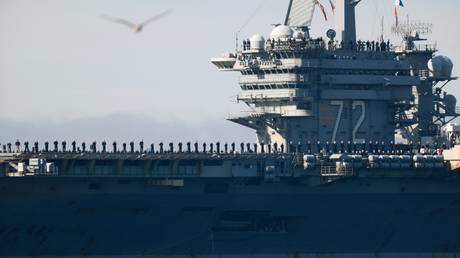
The headlines following the recent reports about United States aircraft carrier sailors near the Middle East trying to jump overboard read like a predictable script. Mainstream outlets pointed their fingers at the usual suspects. They screamed about operational tempo, exhaustion, hostile environments, and a systemic failure of leadership. They painted a picture of broken human beings ground down by the merciless gears of geopolitical projection.
It is a tidy narrative. It makes people angry. It generates clicks. And it is fundamentally wrong.
The lazy consensus in defense journalism treats a carrier flight deck like a sweatshop on water, assuming that if you just give sailors more downtime, better Wi-Fi, and extra ice cream socials, the psychological bleeding will stop. That analysis ignores the mechanical reality of naval combat engineering and the psychological profile of the people who volunteer to stand watch in the Persian Gulf.
I have spent decades watching military bureaucracies try to fix human problems with administrative band-aids. The truth nobody in the press corps wants to admit is that burnout on a supercarrier is rarely a product of working too many hours. It is a symptom of a profound disconnect between individual purpose and institutional friction.
The Myth Of The Overworked Sailor
Let us look at the data the mainstream media ignores. The modern Nimitz or Ford-class aircraft carrier is a floating city of roughly five thousand souls. Within that floating city, the work is brutally hard. It always has been. Steam pipes burst. Jet blast deflectors jam. Corrosion eats steel faster than paint can cover it.
When civilian reporters look at a ninety-hour workweek on a carrier, they hyperventilate. They assume a human brain simply short-circuits under that kind of physical load. But anyone who has actually worn the dungarees knows that humans do not break down merely because they are tired. They break down when they feel helpless.
Exhaustion is manageable when you believe in the mission, when your chain of command is competent, and when every person standing next to you is pulling their weight. The real crisis on those decks is not physical fatigue. It is institutional paralysis.
When sailors are forced to spend half their watch-standing hours checking bureaucratic boxes, filling out digital compliance forms, and navigating risk-mitigation theater that has nothing to do with keeping aircraft in the air, their spirits rot. They are treated like liabilities rather than operators. That is what drives a human being to the edge of the fantail. Not the sixty-hour workweek. The administrative indignity.
The Psychological Profile Of The Volunteer Force
Another uncomfortable truth the narrative glosses over is self-selection. People do not accidentally end up on an aircraft carrier. They sign a contract. They volunteer for a floating airport bristling with ordnance operating in one of the most volatile regions on Earth.
They expect danger. They expect hardship. What they do not expect is bureaucratic gaslighting.
When an organization tries to solve every complex emotional challenge with mandatory resilience training modules and QR codes for mental health apps, it signals to the crew that leadership is entirely out of touch. Imagine a scenario where a young aviation ordnanceman is running on four hours of sleep, trying to troubleshoot a weapon release system while a safety observer stands ten feet away with a clipboard checking off irrelevant safety metrics. That friction point destroys morale faster than any deployment extension ever could.
The Navy does not need more sensitivity seminars. It needs to strip away the mountain of administrative bureaucracy that turns skilled technicians into paper-pushers in uniform.
[Traditional Media Diagnosis] ---> Burnout from Long Hours ---> More Downtime & Wellness Apps
[The Ground Reality]           ---> Bureaucratic Friction   ---> Strip Compliance Theater & Empower Chiefs
Why The Standard Fixes Fail Every Single Time
Every time a crisis hits the fleet, the response follows a predictable choreography. An admiral holds an all-hands call. A task force is formed. A new instruction is published. None of it works because it attacks the symptom while feeding the disease.
Compliance culture has infiltrated the military. In an attempt to eliminate risk on a platform designed entirely around violence and risk, headquarters staff have wrapped every process in red tape. Sailors feel trapped not by the enemy across the water, but by the safety officers behind them.
When you remove autonomy from professionals, you strip them of their agency. When a sailor feels they have zero control over their daily environment, despair sets in. The act of trying to jump overboard is the ultimate, tragic expression of a desire to reclaim control when all other avenues have been sealed off by bureaucracy.
The Unspoken Downside Of Fixing The Real Problem
If we actually want to solve this, we have to embrace a deeply unpopular reality. Fixing the fleet requires accepting higher operational risk in other areas.
To give sailors their agency back, senior leadership has to stop micromanaging every movement from desks in Norfolk or Bahrain. They have to trust the chain of command on the deck plates. That means letting junior officers and senior enlisted make mistakes, own them, and fix them without an immediate inspector general investigation.
Most admirals are terrified of that level of decentralization. They prefer a miserable, compliant sailor who fills out his digital logs on time over a fulfilled, slightly chaotic operator who bends a rule to get the mission done efficiently.
Until the Pentagon stops valuing zero-defect bureaucracy over operational competence, the psychological pressure on the fleet will only mount.
Stop writing profiles about tired sailors. Start investigating the bloated staff structures that keep them awake doing useless paperwork.