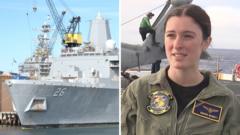
The media wants you to believe that the U.S. Navy’s involvement in the Artemis II recovery is a masterclass in modern logistics. They show you glossy videos of the USS San Diego, divers jumping from helicopters, and specialized winches pulling a high-tech capsule into a well deck. It looks like progress. It feels like the future.
It isn’t. Recently making news recently: Arbitrage by Infrastructure: The Corporate Geometry Behind Transnational AI Exploitation.
What you are actually witnessing is a multi-billion-dollar dependency on a recovery architecture designed in 1961. While SpaceX lands boosters on autonomous drone ships with centimeter-level precision, NASA is still betting the lives of four astronauts and the success of a $4 billion launch on the hope that the Pacific Ocean stays calm enough for a slow-moving amphibious transport dock to play "catch the capsule."
We are pretending that splashdowns are the gold standard of reentry. They aren't. They are a liability we’ve dressed up in a dress white uniform. Additional information into this topic are covered by Wired.
The Myth of the Gentle Splashdown
The competitor narrative suggests that water is a "soft" landing spot. This is a fundamental misunderstanding of fluid dynamics at high velocity. When the Orion capsule hits the water at roughly 25 miles per hour, that surface doesn't feel like a swimming pool; it feels like concrete.
Orion uses a system of five airbags to right itself in the water, but the true danger isn't the hit—it’s the wait. The moment that capsule touches the ocean, it stops being a spacecraft and starts being a very expensive, very cramped boat.
In a world where we can guide a needle through a haystack from orbit, why are we still leaving our best pilots bobbing in the swells like a piece of driftage? The Navy’s "Underway Recovery Capability" is a massive, bloated solution to a problem we should have solved with landing legs and retro-propulsion decades ago.
The Hidden Cost of the "Free" Navy
The public assumes this recovery is a fringe benefit of having a global fleet. "The Navy is out there anyway," the logic goes.
That is a fiscal fantasy.
Deploying a San Antonio-class amphibious transport dock costs taxpayers hundreds of thousands of dollars per day in operational expenses alone. Add in the specialized training for the Helicopter Sea Combat Squadrons, the EOD (Explosive Ordnance Disposal) technicians, and the specialized dive teams, and you realize we are spending millions to recover a single-use bucket.
I’ve seen government projects hemorrhage cash under the guise of "inter-agency cooperation." This is the ultimate example. We are using a sledgehammer to crack a nut. The Navy is forced to divert assets from actual defense missions to act as a glorified towing service for a space agency that refuses to iterate on its landing tech.
Logistics of the 20th Century
The current plan for Artemis II involves a "stable" recovery window. If the weather in the primary recovery zone turns, the mission is in jeopardy.
Compare this to the Dream Chaser or even the retired Space Shuttle. Runway landings provide immediate access to medical facilities, zero risk of drowning, and a controlled environment for the hardware. Instead, NASA has doubled down on the Apollo-era "sink or swim" method.
The Problem with the Well Deck
The Navy uses the "Well Deck" method. The ship ballasts down, lowering its stern into the water so the capsule can be winched inside.
This sounds controlled until you account for the "Relative Motion" problem. You have two massive objects—the ship and the capsule—moving independently in three dimensions (pitch, roll, and yaw) driven by ocean currents. If the timing is off by a fraction of a second, the capsule slams into the steel walls of the ship.
We are risking the integrity of the heat shield and the safety of the crew on a mechanical process that relies more on seamanship than aerospace engineering. It is an unnecessary variable in a mission already packed with high-stakes risks.
The Toxic Reality of Post-Landing
The articles you read won't mention the hypergolic propellants.
Orion uses monomethylhydrazine (MMH) and nitrogen tetroxide (NTO). These chemicals are incredibly efficient and incredibly lethal. If there is a leak upon impact, the recovery divers are swimming in a toxic soup. The Navy personnel have to approach the capsule in full hazmat gear to "sniff" for leaks before the astronauts can even think about breathing fresh air.
This isn't a "seamless" recovery. It is a high-stakes hazardous materials operation conducted in the middle of a restless ocean. By choosing a water landing, NASA forces a complex decontamination phase onto a crew that has just spent ten days in microgravity and is likely suffering from significant vestibular disorientation and nausea.
Imagine being sea-sick, space-sick, and trapped in a small tin can smelling like rocket fuel while waiting for a giant ship to catch you. That is the reality of Artemis II.
Why We Aren't Landing on Solid Ground
The standard excuse is weight. Landing legs, parachutes for land, and crushable structures add mass. In the "Old Space" mindset, every gram of weight used for landing is a gram taken away from the payload.
But this is a failure of imagination.
By refusing to invest in land-landing technology for Orion, NASA has tied its fate to the Navy's schedule and the Pacific's weather. If the goal is a "sustainable" presence on the moon, we cannot rely on an entire carrier strike group to pick up the pieces every time someone comes home.
The industry insiders won't tell you that land-landing was on the table early in the Constellation program. It was killed by budget cuts and the "safe" choice to stick with what worked in 1969. We are literally regressing in our recovery capabilities while claiming to be "boldly going."
The Actionable Truth for the Industry
If you are an engineer or an investor looking at the next twenty years of spaceflight, stop looking at the Navy.
The Navy recovery of Artemis II is a dead end. It is a legacy requirement for a legacy vehicle. The future belongs to companies and agencies that treat the landing as part of the flight profile, not a maritime salvage operation.
We need to stop celebrating the "heroic" recovery efforts of the Navy and start asking why they are necessary in the first place. Every time a diver jumps into the water to attach a line to an Orion capsule, it’s a confession that our aerospace tech hasn't evolved past the Nixon administration.
Stop calling it a "successful recovery" and start calling it what it is: a tactical retreat to the ocean because we were too afraid to build a ship that could land itself.
The next time you see that video of the capsule being pulled into the ship, don't marvel at the coordination. Ask yourself why we're still using a boat to catch a spaceship.
Logistics is not a victory; it’s a cost. And right now, the cost of our nostalgia is far too high.