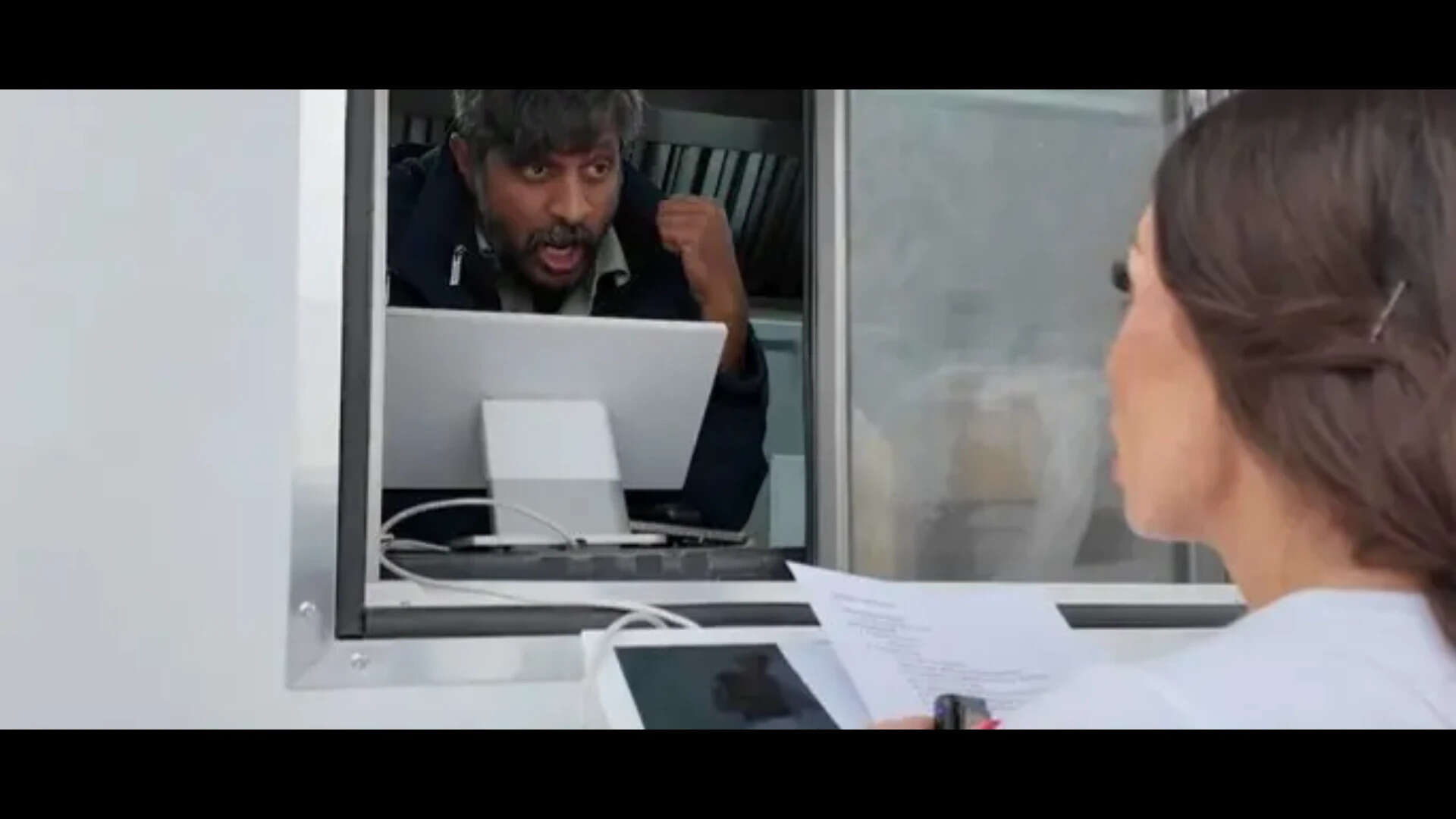
The humidity in Frisco, Texas, has a way of sticking to your skin like a second layer of anxiety. On a Tuesday night under the harsh artificial hum of a parking lot’s overhead lights, the air smells of diesel exhaust and toasted cumin. It is the kind of evening where most people are looking for a quick bite and a short drive home. But for two men standing outside a brightly painted food truck, the stakes had suddenly shifted from a simple transaction to a high-stakes interrogation about the American Dream.
One man held a phone, his thumb hovering over the record button. He wasn’t there for the tacos. He was there to hunt for a violation. The other man, an Indian tech worker on an H-1B visa, stood his ground behind the counter. He didn’t look like a man hiding in the shadows. He looked like someone tired of being told where his body is allowed to be.
"I know my H-1B rules," the tech worker shouted, his voice cutting through the suburban quiet.
It was a confrontation caught on video that would soon rack up millions of views, sparking a firestorm of debate about labor, immigration, and the invisible cages built by federal paperwork. At first glance, it looked like a petty squabble. To the whistleblower, it was about protecting American jobs from "illegal" labor. To the tech worker, it was a defense of his humanity.
But beneath the shouting lies a complex, often misunderstood reality of how the United States manages its high-skilled workforce.
The Invisible Perimeter
To understand why a man would risk his entire career to argue over a food truck counter, you have to understand the H-1B visa. It is often described as a golden ticket. In reality, it is more of a tether.
Imagine you are a world-class marathon runner, but you are only allowed to run on one specific track. If you step an inch onto the grass, you lose your shoes. If you try to run for a different stadium, you have to ask the government for permission months in advance, and they might say no. Most importantly, you are strictly forbidden from doing anything else—no swimming, no cycling, no selling lemonade on the side—to supplement your income or explore a passion.
The H-1B program is designed for "specialty occupations." It allows U.S. companies to hire foreign workers in fields like technology, engineering, and medicine. However, the law is rigid. The visa is tied to a specific employer and a specific role.
When the whistleblower in Texas pointed his camera, he was banking on a technicality: H-1B holders are generally prohibited from "unauthorized employment." In the eyes of a strict constructionist, a software engineer flipping a paratha or taking an order at a food truck is a violation of the terms of their stay. It doesn't matter if they own the truck as an investment or if they are just helping a friend. The mere act of "work" can trigger a deportation sequence.
The Whistleblower and the Camera
The man behind the camera represented a growing movement of "visa watchdogs." These are individuals who believe that the H-1B system is being abused to depress wages and displace American citizens. To them, seeing a tech worker at a food truck isn't just a quirky career pivot; it’s evidence of a "scam."
The logic follows a cold, mathematical path. If a worker is here to code, they should be coding. If they are found at a food truck, they must be taking a job from a local teenager or a struggling immigrant with the "right" paperwork. The whistleblower wasn't just recording a video; he was performing a citizen’s arrest of a perceived economic threat.
"You're not supposed to be working here," the man behind the lens insisted.
He wasn't just citing a rule. He was asserting a hierarchy. He was reminding the worker that his presence in Texas was conditional. It was a moment of profound vulnerability captured in 4K resolution. The tech worker’s defiance—his insistence that he knew the rules—was a desperate attempt to reclaim agency in a system that often treats people like interchangeable units of productivity.
Passive Income or Active Violation
The confusion often stems from the murky line between "investment" and "labor."
According to U.S. Citizenship and Immigration Services (USCIS) guidelines, an H-1B holder can legally own a business. They can be an investor. They can even sit on a board. What they cannot do is provide "productive labor" for that business.
Consider the hypothetical case of Arjun. Arjun is a Senior Cloud Architect at a major firm in Austin. He pays his taxes, he has a mortgage, and his children have Texas accents. Because he loves the food of his childhood, he invests his savings into a food truck. He hires a manager and three employees. This is perfectly legal.
But one Saturday, the manager gets a flat tire. The line of hungry customers grows. Arjun steps into the truck to help hand out napkins or take an order.
In that moment, Arjun has crossed a legal Rubicon. By handing over a napkin, he has performed labor. By performing labor, he has technically violated his status. The penalty isn't a fine. It isn't a slap on the wrist. It is the potential revocation of his visa, the loss of his home, and the forced relocation of his family.
The Texas confrontation turned viral because it put a face on this absurdity. The worker in the video claimed he was not "working" in the sense of earning a wage from the truck, but rather overseeing his interest or helping out. But to the whistleblower, any movement behind the counter was a "gotcha" moment.
The Psychological Toll of the Tether
Living on a visa is a form of low-grade, constant trauma. It is the feeling of building a house on a foundation made of shifting sand. Every time you pass through customs, every time a new policy is tweeted from Washington, and every time a stranger points a camera at you, the sand moves.
The Indian tech community in the U.S. is particularly caught in this vice. Because of per-country caps on Green Cards, many Indian workers face a wait time for permanent residency that is measured in decades, not years.
This means an entire generation of high-skilled professionals is living in a state of "permanent transience." They are the backbone of the Silicon Prairie, yet they live with the knowledge that a single disgruntled neighbor or an overzealous whistleblower can collapse their entire lives.
The viral fight in Frisco wasn't really about a food truck. It was about the resentment that builds when one group of people feels "replaced" and another group feels "hunted."
The whistleblower saw an interloper. The tech worker saw a bully.
The High Cost of Small Rules
Critics of the whistleblower argue that these "stings" do nothing to protect the American economy. They point out that a software engineer helping at a food truck isn't the reason for stagnant wages in the service industry. Instead, they argue, this kind of harassment fosters a culture of fear that drives talent away from the U.S. and toward more welcoming hubs like Toronto or Berlin.
On the other side, the "America First" advocates argue that rules mean nothing if they aren't enforced. If we allow H-1B workers to moonshine in other industries, they say, the entire integrity of the immigration system collapses.
But the reality on the ground is never that binary. It is messy. It is human.
It is a man in a parking lot, his heart hammering against his ribs, wondering if the life he spent ten years building is about to vanish because he stood on the wrong side of a stainless-steel counter.
The Echoes of the Parking Lot
The video eventually ends, but the tension it tapped into remains. The tech worker survived that night, but the digital record of the confrontation lives on, a permanent stain in the Google search results of his name.
We often talk about immigration in terms of statistics: 85,000 visas a year, 11 million undocumented, 20% growth in tech sectors. But those numbers are just a way to avoid looking at the people.
The story of the Texas food truck is a story about the limits of the law. It’s about what happens when we prioritize the "terms and conditions" over the human impulse to build, to help, and to belong.
The next time you see a food truck, look past the menu. Think about the layers of permissions, the years of waiting, and the fragile papers that allow the person behind the window to be there.
Safety is an illusion provided by a piece of plastic and a government stamp. And in a Texas parking lot, under the watchful eye of a smartphone camera, that illusion can shatter in seconds.
The hum of the generator continues. The cumin still smells of home. But for some, the price of a meal is much higher than the number on the chalkboard. It is everything they have ever worked for.
Sometimes, the most dangerous thing you can do in America is simply try to be helpful while holding the wrong passport.