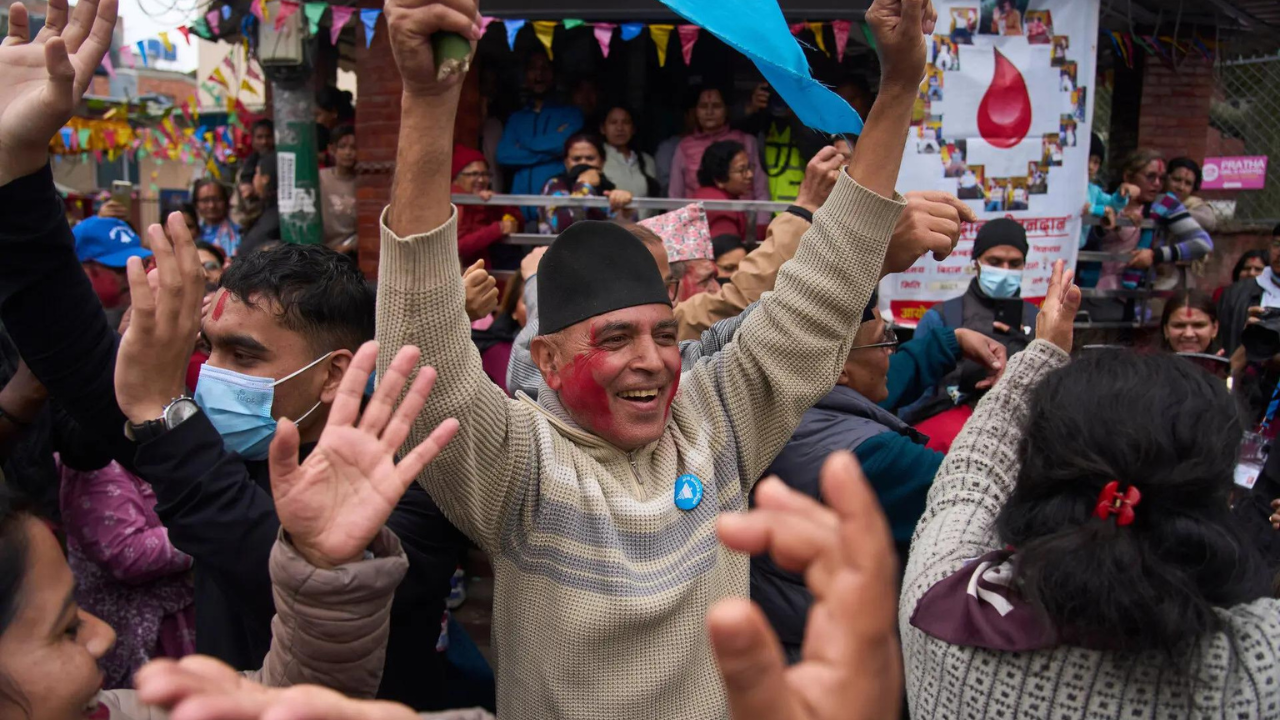
The ground in Kathmandu didn’t just shake; it opened up and swallowed the old guard whole. As of Saturday, March 7, 2026, the Rastriya Swatantra Party (RSP) is not merely leading; it is executing a clinical dismantling of the political machinery that has stalled Nepal for two decades. With Balen Shah at the helm, the RSP has secured or maintains a crushing lead in over 115 of the 165 directly elected seats. This isn't a typical shift in power. It is a total eviction.
For years, the "Big Three"—the Nepali Congress, the CPN-UML, and the Maoists—operated like a rotating chairmanship of a failing firm. They shared the spoils, traded the Prime Minister's chair like a used car, and assumed the public would eventually settle for the least-worst option. They were wrong. The results pouring in from the Election Commission show a nation that has moved past "settling." In Jhapa-5, the ultimate symbol of the old era, former Prime Minister KP Sharma Oli, didn't just lose; he was routed. Balen Shah secured 68,348 votes against Oli’s 18,734. A margin of nearly 50,000 votes in a former stronghold is a political obituary written in neon lights.
The Gen Z Uprising and the Digital Siege
To understand why the RSP is currently on track for a potential supermajority, you have to look back at September 2025. The previous government’s decision to ban dozens of social media platforms was the spark, but the fuel was years of stagnant wages and a "revolving door" leadership that felt more like an oligarchy than a democracy. When the youth took to the streets, the old guard responded with the only tool they understood: force. Seventy-seven lives were lost.
The established parties treated the internet as a nuisance to be managed. Balen Shah and the RSP treated it as the new public square. While traditional candidates were still organizing bus-in rallies and printing paper manifestos, the RSP was running a data-driven campaign that bypassed the gatekeepers entirely. They didn't just promise change; they used the 2025 protests to prove the old system was physically incapable of listening. The current election is the final act of that revolt.
Economics of the New Guard
The RSP’s "Citizen Contract 202" is the most aggressive economic document in modern Nepali history. It promises to double the per capita income to $3,000 and swell the GDP to $100 billion within five years. Critics, mostly from the shell-shocked camps of the Nepali Congress and UML, call it fantasy. They point to the country's reliance on remittances and a crumbling infrastructure as proof that such growth is impossible.
However, the RSP is betting on a massive reversal of the brain drain. For thirty years, Nepal’s greatest export has been its young people, who flee to the Gulf or Europe to send home barely enough to survive. Shah’s platform centers on creating 1.2 million domestic jobs, specifically targeting the digital and service sectors. It’s a high-stakes gamble. If the RSP wins the projected 120+ seats across both direct and proportional systems, they will have the legislative muscle to rewrite the investment laws that have historically scared off foreign capital.
A Breakdown of the Landslide
| Party | Won/Leading (Direct) | Proportional Vote Share (Estimate) | Status |
|---|---|---|---|
| RSP | 121 | 53% | Incoming Government |
| Nepali Congress | 18 | 16% | Major Losses |
| CPN-UML | 11 | 13% | Total Collapse |
| Others | 15 | 18% | Marginalized |
The data above tells a story of geographic dominance. The RSP didn't just sweep the Kathmandu Valley—where it took 13 out of 15 seats—it penetrated the Madhesh province and the rural hills, areas the "Big Three" thought were locked down by patronage networks.
The Geopolitical Tightrope
New Delhi and Beijing are watching these results with visible anxiety. For decades, Nepal's foreign policy was a predictable, if messy, dance between its two giant neighbors. Balen Shah represents something different: a fierce, almost abrasive nationalism. His 2023 decision to hang a "Greater Nepal" map in his mayoral office as a retort to India’s "Akhand Bharat" mural wasn't just theater. It was a signal that the next generation of Nepali leadership would not be "pro-India" or "pro-China," but strictly "pro-Nepal."
This creates a massive diplomatic headache. India’s Ministry of External Affairs has already issued a polite statement welcoming the polls, but the reality is more complex. Shah’s stance on border disputes in Kalapani and Lipulekh is non-negotiable. He views these not as talking points, but as sovereign violations. At the same time, he is a structural engineer who studied in India. He understands the pragmatism of trade. He won't burn bridges, but he will likely demand they be rebuilt on his terms.
The Danger of the Supermajority
History is a cruel teacher in Kathmandu. Every time a party has gained significant power in Nepal, it has succumbed to internal rot or the arrogance of the mandate. The RSP is a young party, built on the charisma of two men: Balen Shah and Rabi Lamichhane. While Shah has the cleaner record, Lamichhane’s past—including allegations of financial mismanagement and his controversial stint as Home Minister—remains a vulnerability.
The "Balen Effect" has brought thousands of professionals, doctors, and engineers into the political fold. But governing is not the same as protesting. When the honeymoon ends and the RSP has to make hard choices about the national budget, or when they have to negotiate with a civil service still loyal to the old parties, the cracks will show. A two-thirds majority is a dangerous weapon. It allows for constitutional amendments, but it also removes any excuses for failure.
The traditional parties are currently in a state of paralysis. Gagan Thapa of the Nepali Congress, once seen as the bright hope of the middle ground, is trailing significantly in Sarlahi-4. The communist factions are splintered and searching for a narrative that doesn't sound like a relic of the 1990s. They didn't lose because of a bad campaign; they lost because the demographic they were talking to no longer exists. Nepal is now a country where the median age is roughly 25. Those voters do not care about the "People’s War" or the 1990 revolution. They care about high-speed internet, health insurance, and the ability to find a job in Kathmandu rather than Doha.
The RSP has promised a "New Nepal" for years. With nearly 100 seats already in the bag and more coming every hour, they no longer have the luxury of being the opposition. They are the state. The rapper-turned-mayor is about to become the rapper-turned-Prime Minister. The music has stopped, and now the work begins.