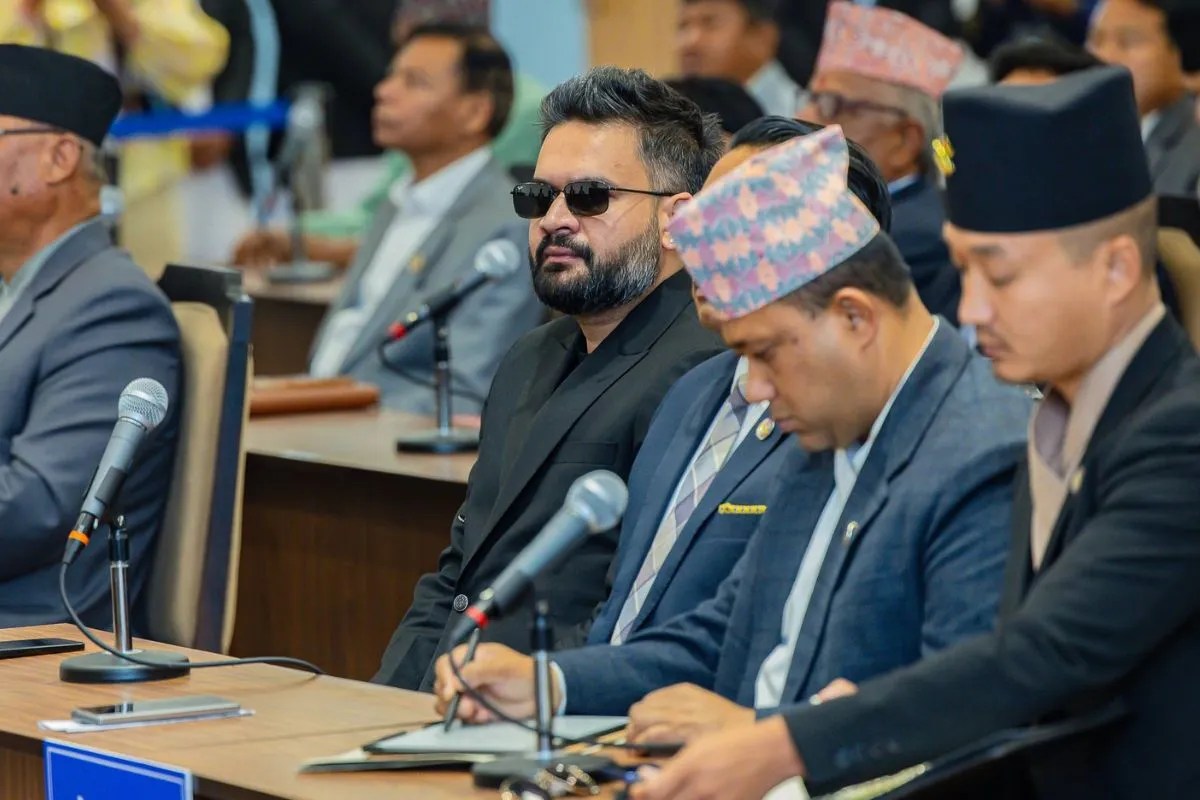
The opening session of Nepal's Parliament did not just witness a routine political disagreement; it became a battlefield for the soul of the country's fragile democracy. Lawmakers from the opposition and ruling benches engaged in a shouting match that effectively paralyzed the legislative process, with the potential arrest of former Prime Minister KP Sharma Oli serving as the flashpoint. This confrontation signals a dangerous shift in Kathmandu, where the pursuit of political accountability is being interpreted—or perhaps weaponized—as a tool for personal vendetta.
At the heart of the friction lies a series of high-profile corruption investigations that have crept closer to the upper echelons of power. While the immediate uproar centered on the rumored or impending moves against Oli, the underlying tension involves a web of scandals including the Bhutanese refugee scam and various land grab allegations. The session was meant to address economic stability and legislative backlogs. Instead, it exposed a government and an opposition that are no longer on speaking terms, leaving the governance of the nation in a state of suspended animation.
The Weaponization of Accountability
Political stability in Nepal has always been a rare commodity. However, the current strategy of using anti-corruption agencies to target political rivals has reached a fever pitch. The opposition, led by Oli’s CPN-UML, views the recent investigative fervor not as a genuine cleanup but as a surgical strike intended to decapitate their leadership. They argue that the timing of these inquiries, coinciding with parliamentary shifts, is too convenient to be coincidental.
This is not a simple case of "guilty or innocent." It is about the perception of justice. When the state moves against a former head of government, the burden of proof must be absolute to avoid the charge of political persecution. In the halls of Parliament, that burden of proof was replaced by vitriol. The ruling coalition maintains that no one is above the law, yet the selective nature of these investigations fuels the fire of the opposition's rage. If the government targets a former Prime Minister without a watertight case, it risks turning a political figure into a martyr, further polarizing an already fractured electorate.
Why This Standoff is Different
Historically, Nepali politics has been defined by backroom deals and shifting alliances. We have seen these parties break and reform with dizzying frequency. But the current animosity suggests that the "gentleman’s agreements" that used to keep the peace have evaporated.
The primary reason for this escalation is the narrowing path to power. With the rise of newer, smaller parties that are capturing the frustration of the youth, the traditional heavyweights—the Nepali Congress, the CPN-UML, and the Maoist Center—are fighting over a shrinking pie. They are desperate. And desperate politicians do not play by the old rules. They resort to the nuclear option: the threat of imprisonment for their predecessors.
The disruption in Parliament is a physical manifestation of this desperation. When lawmakers jump into the well of the house and scream over the Speaker, they are not just protesting a policy. They are signaling to their base that the current system is broken and that only their brand of "resistance" can fix it. This performative outrage serves a dual purpose: it stalls any legislation that might be unfavorable to them and keeps their supporters in a state of constant mobilization.
Economic Costs of Legislative Paralysis
While the politicians argue over who belongs in a jail cell, the Nepali economy is gasping for air. The country faces a looming crisis characterized by dwindling foreign exchange reserves, high inflation, and a stagnant job market that is forcing thousands of young Nepalis to migrate every single day. Parliament is the only body capable of passing the structural reforms needed to attract investment and stabilize the currency.
Every hour spent in a shouting match is an hour lost for economic recovery.
- Budgetary Delays: Essential funding for infrastructure projects remains tied up in committees that cannot meet because the main chamber is in turmoil.
- Policy Uncertainty: Foreign investors look for predictability. A country where the former Prime Minister might be arrested on a weekly basis does not scream "safe haven."
- Institutional Decay: The more the Parliament is used as a theater for brawling, the less respect the general public has for the institution. This cynicism is the breeding ground for populism and authoritarianism.
The data on Nepal’s trade deficit is alarming, yet the legislative priority has shifted entirely toward survival and retaliation. This is the brutal truth: the political class is currently more interested in winning a domestic skirmish than in preventing a national economic collapse.
The Role of Investigative Agencies
The Commission for the Investigation of Abuse of Authority (CIAA) finds itself in an impossible position. If they investigate high-ranking officials, they are accused of being the government's "puppets." If they remain silent, they are seen as complicit in the status quo. To break this cycle, Nepal needs an anti-corruption framework that is truly independent of the Prime Minister’s Office.
Current laws allow for significant executive influence over who gets investigated and when. This structural flaw ensures that every corruption probe will be viewed through a partisan lens. Until the appointment process for these agencies is insulated from political horse-trading, their work will always be contested in the streets and in the Parliament.
International Eyes on Kathmandu
Nepal’s internal chaos does not happen in a vacuum. Its neighbors, India and China, are watching closely. Both regional powers prefer a stable, predictable government in Kathmandu to protect their respective security and economic interests. A volatile Parliament and a government focused on internal purges make Nepal a wildcard in regional geopolitics.
There is a growing concern among the diplomatic community that the persistent instability will hinder the implementation of major international projects. When the legislative body is non-functional, international treaties and aid agreements sit gathering dust. The deadlock over Oli's potential arrest is not just a local news story; it is a signal to the world that Nepal is currently unable to govern itself effectively.
The Breakdown of Consensus
In the past, the "12-point agreement" and the peace process showed that Nepali leaders could find common ground even after a decade of civil war. That spirit of compromise is gone. The current leaders seem to have forgotten that democracy requires a minimum level of mutual recognition between the majority and the minority.
If the ruling coalition continues to push for arrests without transparent, irrefutable evidence, they will find that a cornered opposition is a dangerous one. Conversely, if the opposition continues to block the Parliament every time an investigation touches one of their own, they are effectively declaring themselves above the law. Both sides are walking toward a cliff, and they are taking the country's democratic institutions with them.
Breaking the Cycle of Retaliation
The only way out of this impasse is a return to procedural regularities. This means the government must allow the judiciary and the CIAA to function without public grandstanding or interference. It also means the opposition must allow the Parliament to function, bringing their grievances to the floor through debate rather than disruption.
Transparency is the only antidote to the accusations of vendetta. If there is evidence against KP Sharma Oli or any other leader, it should be presented in a court of law, not leaked to the press to gauge political reactions. The theatrics in Parliament suggest that the parties involved are more interested in the optics of the fight than the outcome of the justice system.
The citizens of Nepal are watching their representatives with increasing exhaustion. They did not vote for a circus; they voted for a government that could provide basic services, stable prices, and a future within their own borders. The current standoff is a betrayal of that mandate. Every moment the Speaker's gavel is ignored is a moment the needs of the people are sidelined.
The confrontation over the former Prime Minister is merely the symptom of a much deeper rot. The real crisis is the total collapse of trust between those who lead. Until that trust is rebuilt—or until a new generation of leaders replaces the current guard—the Parliament will remain a theater of the absurd, and the country will continue to drift. The cost of this political ego trip is being paid by the common man, and that bill is becoming due.
The path forward requires an immediate cessation of legislative hostage-taking. If the government wants to prove its commitment to the law, it must ensure that every investigation is bipartisan in its scope and transparent in its process. If the opposition wants to prove its commitment to the nation, it must stop treating the Parliament like a personal shield. Anything less is an admission that the current leadership has no interest in governing, only in surviving.
The scenes from the first day of the session were not just a "row" or a "brawl." They were a warning. Nepal’s democracy is being hollowed out from the inside by a political class that has lost its sense of purpose. The noise in the chamber was loud, but it could not mask the silence of a government that has forgotten how to function.



