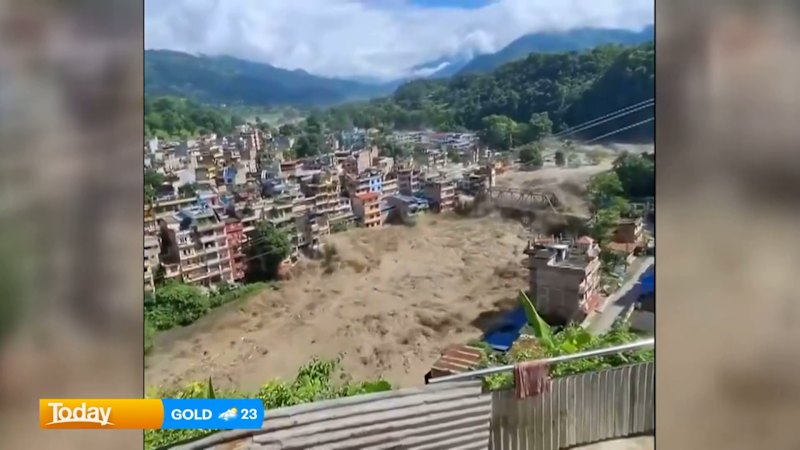
Rescue teams at the epicenter of the catastrophic Nepal-Tibet border disaster faced a sudden and dangerous order to stand down. Chinese authorities paused all search operations after an unstable natural lake, formed by massive piles of debris, began overflowing. When a massive glacier collapsed earlier in the week, it sent an unstoppable wall of ice, mud, and rock tearing through the Himalayan terrain. That initial surge wiped out roads, bridges, and the vital border hub of Gyirong Port.
Now, the sheer volume of trapped water threatens to trigger a secondary disaster. State broadcaster CCTV confirmed that emergency teams operating near the frontline were ordered to withdraw at least one kilometer to safety.
Understanding the Growing Threat at the Epicenter
The danger isn't just past destruction. It's what's currently pooling behind millions of tons of rubble. Hours of relentless rain have swelled the debris-blocked river basin, creating a volatile artificial barrier. Water levels are projected to climb continuously, pushing hydrologists and disaster management teams to the absolute limit.
When an engineered blockage like this starts spilling over, a catastrophic breach becomes a ticking clock. That reality forced officials to pull back search units who were actively scanning the wreckage using drone-based 3D modeling and thermal imaging. You simply cannot send human rescuers into a zone when a wall of water is actively threatening to break loose above them.
The human toll across the region continues to climb at a staggering rate. On the Nepalese side, particularly within districts like Rasuwa, local authorities and military personnel have registered hundreds of fatalities alongside thousands of missing individuals. Meanwhile, the Tibetan side accounts for hundreds more missing persons, including a significant number of international travelers and pilgrims journeying toward Mount Kailash.
The Cascading Crisis Across International Borders
Disasters in the Hindu Kush Himalaya region rarely respect political lines. The flash flood didn't stay put in the remote mountains. It cascaded downstream, trapping workers in infrastructure tunnels—such as roughly 100 people stranded inside the Trishuli 3A hydropower project in Nepal—while military helicopter teams fought treacherous conditions to pull them out.
Communication lines are shattered. Nearly forty kilometers of vital roadways are severely damaged or entirely washed away. This isolation turns every hour into a frantic race against dehydration, injuries, and hypothermia for anyone lucky enough to survive the initial wall of water. International aid mechanisms, including emergency funding allocations from United Nations agencies, are mobilizing to rush medical supplies, clean water, and temporary shelter to the hardest-hit zones.
Scientists studying the catastrophe point to a combination of extreme geographic vulnerability and accelerating climate shifts in the high-altitude ranges. While attributing a single weather event entirely to global temperature shifts is complex, researchers note that warming trends destabilize glaciers at an unprecedented frequency. When a massive section of ice breaks away unexpectedly, valleys that have stood undisturbed for centuries are instantly rewritten by raw geologic power.
For now, the immediate priority remains sheer survival. Engineering teams are monitoring the overflowing debris lake minute by minute, waiting for water levels to stabilize before recovery crews can safely step back onto the frontline. Until that risk subsides, the search for the missing remains paused, leaving families and rescue coordinators in an agonizing holding pattern.