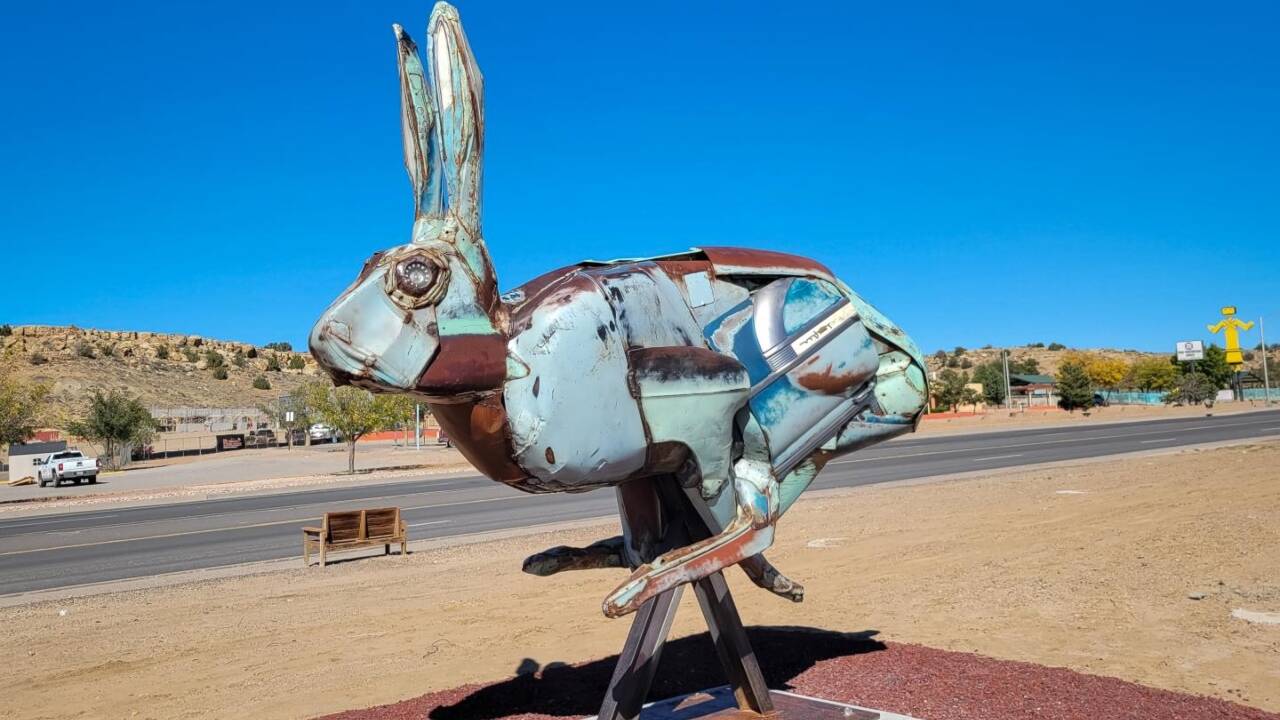
In the high desert of New Mexico, a 1953 Chevrolet Bel Air no longer cruises down asphalt; it sits perched on its haunches as a massive, sheet-metal jackrabbit. Created by a local sculptor using salvaged automotive steel, the installation transforms an icon of mid-century American manufacturing into an emblem of Southwestern ecology. Rather than rotting in a junkyard or undergoing an expensive, purist restoration, the car’s curved fenders, chrome trim, and heavy-gauge hood were cut, hammered, and welded to mimic the tense anatomy of a desert hare, highlighting a growing movement in adaptive reuse and roadside public art across the American Southwest.
Most people look at a rusted 1950s sedan and see either scrap weight or a money pit. Classic car enthusiasts spend tens of thousands of dollars hunting down original factory parts, matching paint codes, and obsessing over stock carburetors. They treat mid-century Detroit iron as sacred relics that must be preserved in amber.
Artists working in the desert southwest see something entirely different. They see raw material that has already survived seventy years of harsh sun and thermal expansion. By stripping the 1953 Bel Air down to its structural bones and reconfiguring its signature curves into the oversized ears and muscular hind legs of a jackrabbit, the sculptor bypassed the traditional restoration market altogether. This approach turns automotive nostalgia on its head, asking why we value a machine only when it performs its original, fossil-fuel-burning function.
The Anatomy of a 1953 Bel Air Makes It Ideal for Organic Sculpture
To understand why this specific vehicle works as a giant desert hare, you have to look at how General Motors built cars in the early 1950s. Modern vehicles are constructed from thin, high-strength steel and stamped aluminum designed to crumple on impact. If you try to cut and re-weld a modern fender, the metal warps instantly under the heat of a torch, leaving behind a wavy, unusable mess.
The 1953 Chevy Bel Air belongs to a completely different era of metallurgy. It was built with heavy-gauge, mild steel that forgives aggressive manipulation.
- Compound Curves: The 1953 model year introduced a sleeker, more integrated fender line compared to the bulbous pontoon styles of the late 1940s. Those sweeping rear quarter panels naturally mirror the hunched, powerful haunches of a resting rabbit.
- Thick Sheet Metal: Because the steel is substantially thicker than contemporary automotive panels, a metalworker can English-wheel, hammer, and TIG-weld sections together without burning through the substrate.
- Chrome Accents: The Bel Air trim package was famous for its brightwork. Repurposing those stainless steel spears and bumper guards allows an artist to catch the blinding New Mexico sunlight, creating natural highlights along the sculpture's spine and ears.
When you strip away the chassis, the inline-six "Blue Flame" engine, and the interior upholstery, you are left with a collection of pre-shaped organic forms. The hood alone provides enough broad, gently domed steel to form the creature's torso. The front fenders, once detached and inverted, bear an uncanny resemblance to long, alert ears listening for coyotes.
Salvage Art Versus the Classic Car Restoration Purists
Turning a desirable classic car into a stationary animal sculpture inevitably triggers friction within the automotive community. To a traditional collector, cutting up a 1953 Bel Air—even a rusted, incomplete donor shell—borders on sacrilege. The 1953 model year was the first time the Bel Air became its own distinct series rather than just a hardtop trim option, making it a milestone in Chevrolet history.
Yet this criticism ignores the grim reality of desert salvage yards. Across New Mexico, Arizona, and West Texas, thousands of mid-century cars sit half-buried in caliche clay. Their frames are often twisted, their floors rusted through from decades of leaking window seals, and their drivetrains long since scavenged. Restoring one of these derelict shells to concours condition frequently costs more than double what the finished car would ever fetch at auction.
For a hypothetical collector facing a $65,000 restoration bill on a car worth $30,000, the math simply does not work. The vehicle remains untouched, slowly oxidizing into the dirt.
Sculptors step into this economic dead zone. By purchasing a non-viable hulk for scrap value, the artist rescues the steel from permanent decay. Instead of hiding the dents, surface rust, and weathered patina beneath layers of Bondo and two-stage urethane clear coat, desert metalworkers celebrate the wear. The sun-baked paint and oxidation become the fur of the jackrabbit. It is an honest preservation of history—one that acknowledges the passage of time rather than trying to erase it.
Why the Jackrabbit Resonates in New Mexico Roadside Culture
Choosing a jackrabbit rather than a coyote, roadrunner, or rattlesnake is a deliberate nod to Southwestern visual history. For decades, the jackrabbit has served as an unofficial mascot of Route 66 and the broader American West, immortalized in oversized fiberglass statues, vintage postcards, and tourist traps from Texas to California.
However, placing a steel jackrabbit in the New Mexico landscape carries deeper ecological weight than a fiberglass souvenir. Black-tailed jackrabbits are masters of desert survival. Their massive ears are not just for hearing predators; they are dense networks of blood vessels that radiate excess body heat, acting as biological air conditioners in 100-degree temperatures.
Building that specific animal out of a 1953 automobile creates a sharp visual irony. The mid-century American car was the ultimate symbol of human dominance over nature—a heavy, gas-guzzling machine built to conquer vast distances in air-conditioned comfort. By dismantling the car and reshaping it into a native desert lagomorph, the sculpture suggests that the landscape eventually reclaims everything introduced into it. The machine is forced to adapt to the environment, taking on the physical traits of the creatures that actually belong there.
The Brutal Mechanics of Welding Salvaged Automotive Steel
Working with seventy-year-old car bodies in an outdoor studio presents severe technical hurdles that rarely make it into puff-piece profiles. You cannot simply tack two fenders together and walk away. New Mexico’s climate is punishing, characterized by extreme diurnal temperature swings where daytime highs can drop forty degrees after sunset.
Metal expands and contracts constantly under these conditions. If a sculptor fails to account for thermal stress, welds will crack within a few seasons, and towering ears will sag under their own weight.
Stripping Contaminants and Lead
Before a single spark flies, the steel must be chemically and mechanically cleaned. Cars from 1953 did not use modern plastic body fillers; factory assembly lines used actual lead solder to smooth out seams between the roof panel and the quarter panels. Heating vintage bodywork with a cutting torch without identifying those factory lead seams releases toxic fumes. Experienced metal artists have to grind back old paint layers to expose the bare substrate, mapping out where factory solder sits so it can be safely removed before welding begins.
Internal Armature Engineering
A giant jackrabbit sculpture acts like a massive sail during spring windstorms in the Rio Grande Valley, where gusts regularly exceed sixty miles per hour. The sheet metal skin of a Bel Air cannot support itself against that kind of lateral wind load. Inside the hollow cavity of the Chevy body panels, the artist must fabricate an internal skeleton made from heavy-walled structural steel tubing or repurposed rebar. Every exterior fender and hood section is anchored to this internal spine, transferring wind shear down into a concrete foundation pad buried beneath the frost line.
Managing Galvanic Corrosion
When pairing salvaged steel with stainless steel trim—like the iconic Bel Air side spears—artists have to watch out for galvanic corrosion. Even in an arid climate, morning dew and monsoon rains can create an electrolyte bridge between dissimilar metals, causing the mild steel to rust rapidly around the stainless fasteners. Isolating those contact points with rubber grommets or marine-grade sealants is the difference between a sculpture that lasts five years and one that stands for fifty.
The Economics of Monumental Salvage Art
Creating a large-scale automotive sculpture is rarely a lucrative commercial enterprise, which explains why so few artists attempt it at this scale. While a restored 1953 Chevy Bel Air has an established market value dictated by auction houses and collector guides, a monumental jackrabbit made from car parts exists in a niche market of private collectors, municipal art commissions, and eccentric roadside attractions.
Material costs are deceptively high. Even if the donor car is acquired cheaply, the consumables required to transform it add up quickly:
- Shielding Gas and Welding Wire: Miles of MIG and TIG welds require dozens of cylinders of argon-CO2 mix and spools of specialized wire capable of bridging gaps in uneven, pitted metal.
- Abrasives: Grinding discs, flap wheels, and plasma cutter consumables wear out rapidly when chewing through decades of baked-on enamel, undercoating, and surface scale.
- Heavy Equipment: Lifting an engine block out of a donor chassis or hoisting a twelve-foot steel ear into position requires gantries, forklifts, or crane rentals.
Artists who pursue these projects are usually driven by compulsion rather than profit margins. In rural New Mexico communities, where traditional gallery infrastructure is sparse, front yards and highway pull-offs become the exhibition space. The work functions as a landmark, anchoring local identity and drawing travelers off the interstate without needing a museum curator's permission.
Changing How We View Industrial Waste
Every year, millions of vehicles reach the end of their operational lives. The standard industrial pipeline shreds them, separates the ferrous metals via giant magnets, melts them down in electric arc furnaces, and rolls them into new sheet stock. It is efficient, invisible, and completely devoid of character.
Projects like the 1953 Bel Air jackrabbit interrupt that sterile cycle. By preserving the recognizable curves of a specific year, make, and model, the sculpture forces viewers to confront the sheer mass and craftsmanship embedded in everyday consumer objects. You recognize the headlight bezels. You spot the curve of the trunk lid. Your brain immediately registers the familiar geometry of an American classic, even as your eyes process the silhouette of a desert mammal.
That cognitive dissonance is where the art actually lives. It proves that industrial obsolescence is largely a failure of imagination, and that even the heaviest relics of the Detroit assembly line can be taught to run wild again.