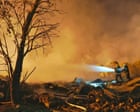
The smell of gasoline is usually a sign of industry, or perhaps a weekend lawn project. But at two in the morning in a quiet Colorado neighborhood, it is the scent of a predator. It lingers in the damp night air, thick and cloying, creeping through the cracks of window frames and under door jams. For the residents of the LGBTQ+ resource center and the surrounding apartments, that smell wasn't an inconvenience. It was a countdown.
When we talk about crime, we often look at the gavel. We look at the mugshot. We look at the dry, ink-stained pages of a court transcript that says a man named Benjamin Casillas-Rocha is ready to plead guilty to all state charges. The legal system loves its tidy boxes. Arson. Possession of an explosive device. Bias-motivated crimes. These words are precise, clinical, and entirely hollow. They don't capture the sound of a shattering bottle or the way a heartbeat thunders against the ribs when you realize your sanctuary has been marked for ashes.
The case against Casillas-Rocha isn't just about a firebomb that failed to consume a building. It is about the fragile architecture of safety and what happens when one person decides that certain neighbors shouldn't exist.
The Chemistry of Hate
A firebomb is a crude instrument. It’s a "Molotov cocktail," a name born from the desperate street fights of the mid-20th century, consisting of little more than a glass bottle, a flammable liquid, and a rag. It is cheap. It is low-tech. But its psychological payload is massive.
Consider the physics of the act. To throw a firebomb, you have to stand close. You have to see the glass in the windows. You have to see the "Open" sign or the rainbow flag taped to the door. You have to smell the fuel on your own hands. There is no distance in arson; it is an intimate act of destruction.
When Casillas-Rocha approached that Colorado Springs building, he wasn't just carrying a bottle of accelerant. He was carrying a conviction. The state’s case built a mountain of evidence—digital footprints, physical remnants, and the undeniable trail of intent. But the facts alone don't explain the "why." They only explain the "how." The "why" is found in the quiet moments after the sirens stop, when a community looks at a scorched brick wall and realizes they are being watched.
The Burden of the Defense
Imagine for a moment you are the defense attorney. Your job isn't to justify the act, but to humanize the person behind it. You sit across from a man facing twenty-four state counts, ranging from felony arson to hate crimes. You look at the evidence—the surveillance footage, the chemical residue—and you realize the wall is too high to climb.
The shift toward a guilty plea isn't usually a moment of sudden moral epiphany. It is a surrender to the inevitable. In this case, the defense signaled that Casillas-Rocha would admit to every single state charge. No deals. No bargaining away the bias-motivated counts.
This is a rare move in a legal system defined by "let’s make a deal." Usually, lawyers spend months chipping away at the charges, trying to turn a mountain into a molehill. To plead guilty to everything suggests a recognition that the evidence is airtight, or perhaps a realization that the weight of the state’s fury is more than one man can withstand. Yet, even as the state charges move toward a close, the federal shadow looms. Federal investigators don't move with the speed of local police; they move with the grinding, unstoppable force of a glacier.
The Invisible Stakes of a Guilty Plea
Why does it matter if he pleads guilty instead of going to trial?
For the victims, a trial is a second assault. It is a process where your trauma is picked apart by experts and your right to feel safe is debated in front of twelve strangers. A guilty plea skips the theater. It provides an immediate, if cold, validation. Yes, he did it. Yes, it was a crime. Yes, it was motivated by who you are.
But there is a lingering cost. When a case ends with a signature on a plea deal, the community loses the chance to hear the full story in open court. We lose the opportunity to see the evidence laid out, to understand the radicalization process, and to confront the hatred head-on. The closure is efficient, but it is silent.
The residents of Colorado Springs are no strangers to this silence. This is a city that has been forced to develop a thick skin, a place where the mountains provide a beautiful backdrop to some of the most harrowing conversations about identity and safety in America. When a firebomb is thrown here, it echoes louder because of the history already written in blood and ash.
The Architecture of Fear
Every time a headline appears about a suspect pleading guilty, we tend to exhale. We think, The system worked.
But the system only cleans up the mess. It doesn't fix the plumbing. The "invisible stakes" here aren't just about whether one man spends decades in a concrete cell. It’s about the person who was going to visit that center for the first time tomorrow and now, hearing about the gasoline and the glass, decides to stay home.
Fear is a tax. It is a tax on movement, a tax on expression, and a tax on being. When an individual targets a community resource center, they aren't just trying to burn wood and drywall. They are trying to raise the tax of existing until it becomes too expensive to pay.
The defense's announcement that a plea is coming is a tactical white flag. It acknowledges that the state has the receipts. They have the proof of the planning, the proof of the execution, and the proof of the bias. But for those who live in the shadow of that building, the "proof" was already felt the moment the air in their neighborhood started to smell like a gas station.
Beyond the Gavel
We are obsessed with the ending of the story. We want to know the sentence. We want to see the handcuffs. But the real story is in the middle—the long, agonizing wait between the crime and the resolution.
Casillas-Rocha will likely face years, perhaps decades, of his life behind bars. The state of Colorado will mark this as a win for justice. The prosecutors will hold a press conference. The defense will move on to the next file on their desk.
But the charcoal smudge on the brick stays. The memory of the smell stays.
Justice, in its truest form, isn't found in a courtroom. It’s found in the fact that the center stays open. It’s found in the people who show up the next day with buckets of soapy water and scrub brushes, refusing to let the scent of gasoline be the last thing people remember.
The suspect's plea is a period at the end of a very dark sentence. But the community is already writing the next chapter, and they are doing it with a pen that won't ignite.
They are still there. They are still breathing. And the air, finally, is starting to clear.