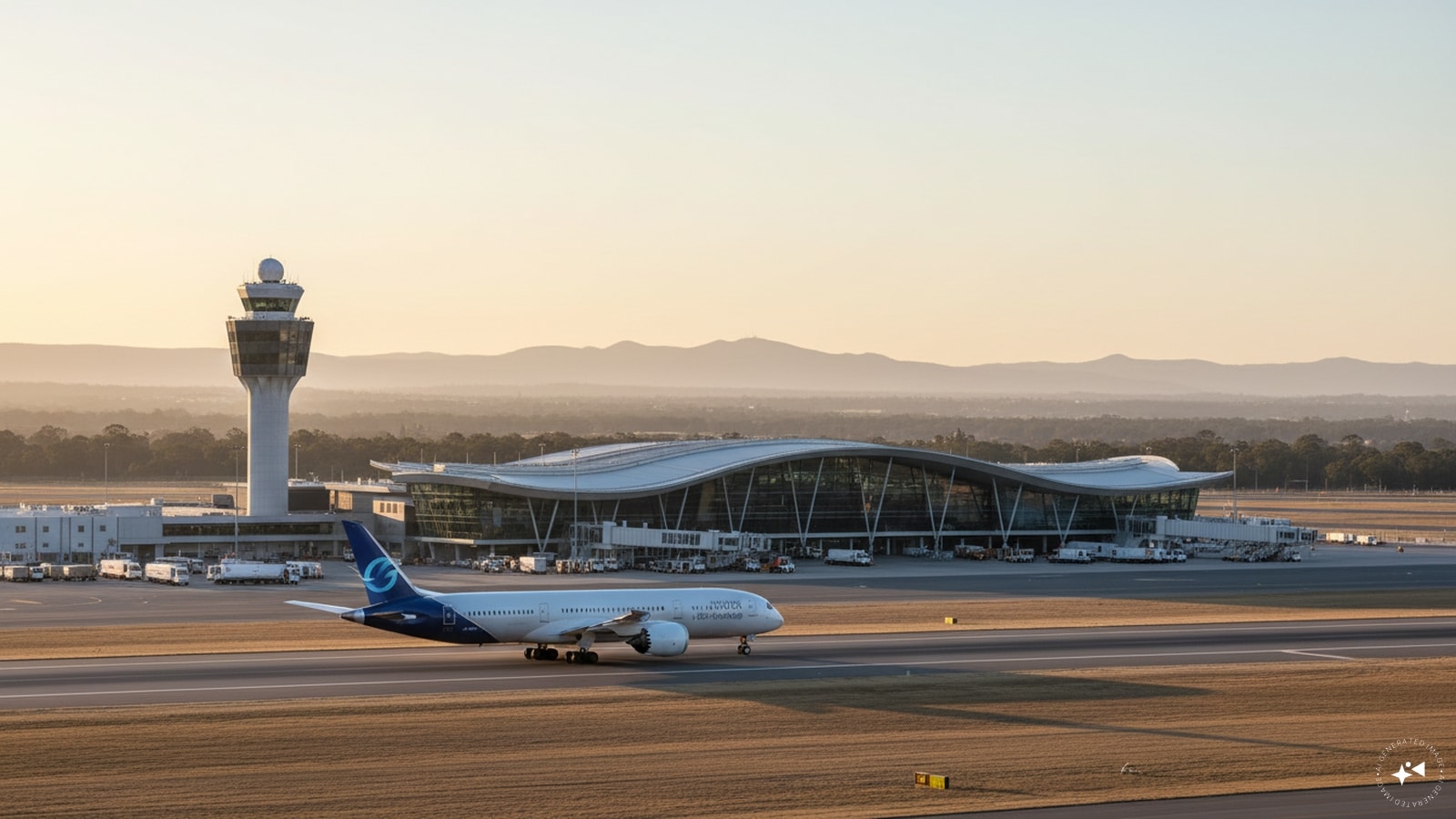
The turbine whine does not sound like progress at two in the morning. It sounds like a low, vibrating bruise pressing against your bedroom windowpane.
For decades, if you lived under the flight path in Marrickville or Sydenham, you knew the exact rhythm of the sky. You knew that at 10:58 PM, the last heavy wide-body jet would claw its way over Botany Bay, rattling the teacups in the cupboard, and then—silence. Blessed, legislated, untouchable silence until six the next morning.
That silence was the price Sydney paid to sleep. It was also an invisible wall holding back half a city.
Then, on a crisp evening in late 2026, a commercial airliner pushed back from a gleaming, timber-lined gate forty-four kilometers west of the Harbour Bridge, taxied onto a brand-new stretch of asphalt at Badgerys Creek, and lifted off into the dark. No curfew alarms went off. No angry phone calls flooded the switchboards in Canberra. For the first time in Australia’s history, a major international flight departed Sydney without watching the clock.
The press releases called it a triumph of infrastructure. They threw around numbers—ten billion dollars in federal investment, ten million annual passengers in the initial phase, sixty thousand jobs by the 2030s. Dry, sterile digits designed to make politicians look visionary and economists nod in approval.
Numbers don't smell like jet fuel and damp eucalyptus. Numbers don't feel the ache in a shift worker's knees at 4:00 AM.
To understand what actually happened when Western Sydney International (Nancy-Bird Walton) Airport sent its first international flight into the night sky, you have to stop looking at the terminal and start looking at the red dirt it was built on.
A Fifty-Year Ghost Story
Australia does not build big things quickly. We argue about them. We commission studies, shelve the studies, change governments, and argue some more.
The idea of a second Sydney airport wasn't born in a boardroom last Tuesday; it was a ghost that haunted Australian politics for over half a century. As early as the 1940s, planners realized that Kingsford Smith Airport—wedged tightly between the suburbs and the sea—was a geographical straitjacket. By 1986, the Hawke government officially selected Badgerys Creek, a quiet patch of market gardens, poultry farms, and rolling paddocks on the Cumberland Plain, as the site.
And then? Nothing. For nearly thirty years, the land sat in a state of suspended animation.
Imagine owning a fifty-acre farm in Luddenham in 1992. Every few years, a rumor sweeps through the local pub that the bulldozers are coming next month. You don't fix the leaky roof on the barn because why bother? You don't plant new orchards. Your neighbors sell up to speculative developers or the Commonwealth, and slowly, the community hollows out like an old gum tree. A whole generation of Western Sydney kids grew up hearing that their backyard was either going to become the economic engine of the nation or remain an overgrown paddock forever. Nobody believed the engine would ever actually turn over.
When I first drove out to the site years ago, before the earthmovers arrived to flatten the hills, the silence out there was heavy. You could stand on a ridge and look east toward the faint, hazy skyline of the Sydney CBD, feeling every single kilometer of the divide. In Sydney, geography isn't just dirt and water; it is destiny. There is the "latte line" running diagonally from the airport to the northwest—a sociological fault line separating the breezy, wealthy coastal suburbs from the scorching, car-dependent sprawl of the west.
For fifty years, if you lived in Penrith, Liverpool, or Campbelltown and wanted to fly to Singapore, Tokyo, or London, your journey began with a grueling ninety-minute pilgrimage east through choked motorways or crowded trains, just to reach a terminal that closed its doors at night. Meanwhile, two million people in the west watched their brightest kids commute hours each day toward the coast for decent jobs, draining the region of its own energy.
Building an airport at Badgerys Creek wasn't about easing congestion for tourists from Los Angeles. It was an attempt to tilt the entire continent's center of gravity inland.
The Anatomy of a 24-Hour Machine
Consider a hypothetical traveler—let’s call her Elena, a logistics manager living in Parramatta. Under the old rules, if Elena needed to get perishable Australian chilled beef or high-grade medical isotopes to a client in Seoul, she was at the mercy of the Mascot curfew. If a truck hit traffic on the M5 motorway and missed the evening cargo cutoff, that shipment sat in a warehouse until dawn. Millions of dollars in Australian exports died on the tarmac because Sydney went to bed at eleven.
Now trace Elena’s reality after that first international takeoff from WSI.
Because Western Sydney International operates 24 hours a day, seven days a week, the airport functions less like a bus stop and more like a beating heart that never skips a pulse. Think of Kingsford Smith as a single-lane bridge over a deep gorge: stunning to look at, historic, and completely paralyzed the moment one truck breaks down or the clock strikes eleven. Western Sydney International is a twelve-lane superhighway built across an open plain.
The engineering behind this shift is deceptive in its simplicity. By placing the airport on 1,780 hectares of relatively flat land—nearly double the footprint of the old airport—planners eliminated the cramped, overlapping taxiways that make Mascot notorious for delays. An aircraft landing at WSI doesn't spend twenty minutes idling in a queue burning expensive aviation fuel; it touches down, turns off, and reaches the gate in under five minutes.
Inside the terminal, the traditional wall between domestic and international travel has been torn down. At almost every major airport on earth, transferring from a regional flight to an overseas flight requires collecting your bags, riding a shuttle bus across miles of concrete, clearing security a second time, and praying your connection hasn't closed. WSI put everything under one sweeping, wave-like timber ceiling inspired by the Blue Mountains escarpment just to the west. Walk off a regional flight from Dubbo, stroll down a single concourse, pass through automated biometric gates, and step onto a Boeing 787 bound for Doha or Singapore.
It sounds effortless on paper. In reality, pulling it off required moving twenty-six million cubic meters of earth—enough dirt to fill Sydney Harbour five times over—and building a brand-new driverless metro rail line before a single passenger ever bought a ticket.
What We Don't Want to Talk About
If you listen only to the aviation executives and state premiers, this story has no villains and zero casualties. That is a lie, and pretending otherwise insults the people who actually live beneath those new flight paths.
Progress always sends a bill. In Western Sydney, that bill is arriving in decibels.
For decades, the residents of the Blue Mountains—places like Blaxland, Glenbrook, and Springwood—chose their homes precisely because of the quiet. They traded urban convenience for the sound of currawongs in the eucalypts and wind in the mountain ash. When the preliminary flight paths for the new 24-hour airport were released, the shockwave through those mountain towns was visceral.
Aircraft don't need to be at five hundred feet to ruin a quiet night. At three in the morning, when the ambient noise of a mountain valley drops to near zero, a wide-body jet descending at five thousand feet cuts through the stillness like a chainsaw in a library. Unlike the inner-west suburbs around Mascot, which eventually won strict flight caps, insulation grants, and the sacred 11:00 PM curfew, the communities west of the Nepean River are facing an uncurfewed sky.
There is a bitter irony here that nobody in power likes to acknowledge out loud. To relieve the wealthy, politically vocal inner-ring suburbs from aircraft noise at night, Australia built an airport that routes midnight flights over working-class outer suburbs and quiet mountain towns.
You can feel that tension in the town hall meetings from Luddenham to Katoomba. People aren't naive; they know the region needs the jobs. A twenty-year-old apprentice electrician in Blacktown doesn't care about acoustic modeling—he cares that he finally has ten years of steady commercial work twenty minutes from his parents' house instead of two hours away on the North Shore. A mother in Mount Druitt sees the new Bradfield City Centre rising next to the airport—a planned metropolis of advanced manufacturing, aerospace research, and clean tech—and sees a future where her daughter won't have to leave home just to build a career.
Both things are true at the exact same time. That is the uncomfortable, jagged reality of nation-building: the same runway that lifts one family out of a two-hour daily commute shatters another family’s peace at three in the morning.
The Shift in the Wind
Stand on the viewing platform near the new precinct just after dusk, and you can physically feel the scale of the gamble Australia has just taken.
For over a century, Australian cities have clung to the coastline like barnacles on a rock. We faced the ocean, exported raw dirt and wheat from coastal ports, and treated the interior of our own country as an afterthought—something to fly over, rarely something to build around. Sydney grew lopsided, choking on its own coastal real estate prices while pushing young families further and further west into heat-trapping housing estates with inadequate trains and scarce local employment.
An international airport changes the chemistry of a place. Cities are not built around train stations anymore; in the twenty-first century, global cities are built around runways.
When that first international jet rotated off Runway 05/23, tucking its landing gear into its belly as it climbed into the Western Sydney night, it wasn't just carrying passengers and cargo. It was carrying the weight of fifty years of broken promises, bitter local fights, and a desperate bet that Australia can still build something monumental before the moment passes.
Look up from a backyard in St Marys tonight. Where there used to be only the faint, distant blink of high-altitude satellites and the hum of the Great Western Highway, there are now landing lights cutting bright white corridors through the dark, descending steadily toward the red earth of the Cumberland Plain.
The silence is gone for good. And for the first time in half a century, Western Sydney isn't waiting for the rest of the city to wake up.


