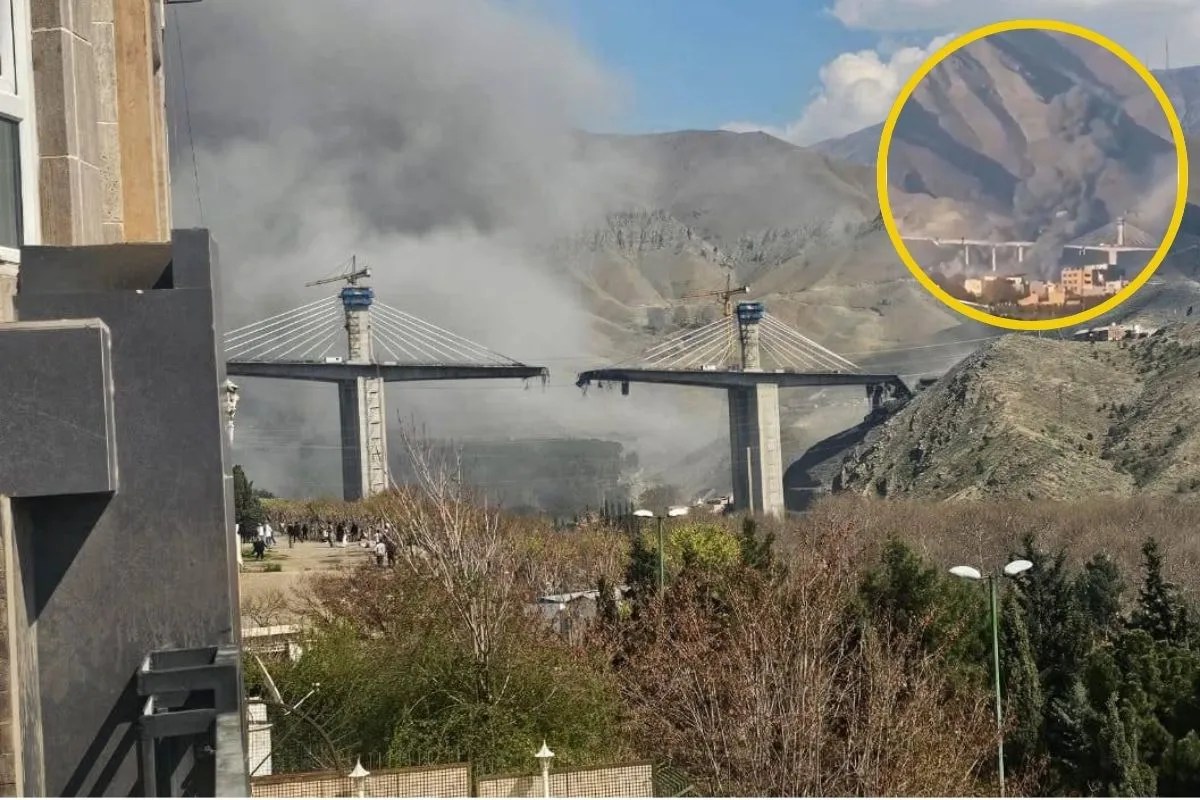
The dust in a war zone has a specific taste. It is metallic, thick with the ghost of pulverized concrete and the acrid sting of burnt rubber. In the early hours near the B1 Bridge, that taste became the only thing left to breathe.
While the world monitors digital maps and satellite feeds from the safety of distant capitals, the reality of the escalating friction between Iran, Israel, and the United States isn't found in a briefing room. It is found in the scream of twisted metal. It is found in the way a cell phone vibrates in a pocket, unanswered, while its owner lies pinned beneath a slab of what used to be a vital artery of commerce.
The headlines will tell you that ninety-five people were injured in the strike on the B1 Bridge. They will tell you that the death toll is rising. But numbers are a sedative. They allow us to process tragedy without feeling it. To understand what happened at that bridge, you have to look past the casualty count and into the eyes of those who saw the sky catch fire.
The Anatomy of a Fracture
Bridges are more than engineering feats. They are promises. They are the physical manifestation of the belief that two points, separated by a chasm, belong together. When a bridge is targeted, the intent is never just to disrupt logistics. It is to sever the connection between yesterday and tomorrow.
The B1 Bridge served as a pulse point for regional movement. On any given Tuesday, it would be clogged with trucks carrying grain, families visiting relatives, and young men commuting to jobs that barely pay enough to keep the lights on. It was a mundane backdrop to thousands of lives.
Then came the flash.
Witnesses described a sound that wasn't just loud; it was physical. A pressure wave that flattened the lungs. In that instant, the geopolitical maneuvering of three nations—nations locked in a decades-long dance of shadows and proxy fire—became a very intimate, very bloody reality for ninety-five human beings.
The geopolitics of the Middle East often feel like a game of high-stakes chess played by grandmasters who never have to reset the board themselves. On one side, you have the Iranian tactical doctrine, a complex web of "strategic patience" and proxy influence. On the other, the Israeli "Mabam"—the war between wars—a relentless effort to decapitate threats before they can take root. Caught in the middle is the American influence, a heavy, often clumsy hand trying to maintain a status quo that has been crumbling for years.
But when the B1 Bridge collapsed, nobody was thinking about doctrine.
The Weight of the Rubble
Consider a man we will call Elias. He isn't a soldier. He’s a mechanic. He was driving home when the world inverted.
Elias represents the "human element" that analysts often leave out of their white papers. When the missile struck, his windshield didn't just break; it turned into a million diamond-sharp projectiles. As his car pitched toward the edge of the fractured span, the grand strategy of Tehran or the security concerns of Jerusalem meant nothing. The only thing that mattered was the smell of leaking fuel and the sound of someone crying out for a mother in a language that transcends borders.
The injured at the B1 site weren't just "casualties." They were teachers, shopkeepers, and children. Ninety-five lives interrupted by the cold logic of "deterrence."
We often talk about these conflicts as if they are inevitable, like the weather. We say the situation is "escalating," as if the missiles are launching themselves. We use words like "retaliation" to make the violence sound like a ledger being balanced. But there is no balance in a hospital ward filled with people who were simply trying to cross a river.
The medical facilities in the aftermath were a study in controlled chaos. Doctors, already exhausted by years of regional instability and economic sanctions, found themselves performing triage by flashlight. Every bed was a story of a day gone wrong. Every bandage was a testament to the fact that when giants move, it is the ground that suffers most.
The Invisible Stakes
Why the B1 Bridge? Why now?
The strategic value of such a target is easy to dissect. It disrupts supply lines. It signals a willingness to strike deep into sensitive territory. It forces the opponent to recalculate their defensive posture.
But the invisible cost is far higher.
Every time a piece of civilian infrastructure is pulverized, the social contract shrivels. People stop looking at the horizon and start looking at the sky. Trust, already a rare commodity in this part of the world, evaporates. The strike on the bridge didn't just break the concrete; it broke the assumption that one can go about a normal life while the "War of Shadows" rages overhead.
The relationship between Iran and Israel has moved out of the darkness and into a blinding, terrifying light. For years, the two hovered in a state of deniable friction—cyberattacks that slowed down centrifuges, mysterious explosions at warehouses, assassinations in the quiet streets of suburbs. It was a cold war fought with hot lead, but it remained contained.
The B1 Bridge marks a shift. It is an overt act, a loud statement in a room that used to value whispers. When the United States enters the equation, the gravity of the situation triples. Washington finds itself in a precarious position: trying to provide a security umbrella for its allies while desperately attempting to avoid being dragged into a regional conflagration that no one truly knows how to end.
The Language of the Fallen
We must be careful with the words we use to describe these events.
To "confirm" a death is a sterile act. It involves a clerk, a stamp, and a notification. But to lose a life in a strike like this is to have a hole ripped out of a community. The deaths at the B1 Bridge are not just data points for a news crawl at the bottom of a television screen. They are empty chairs at dinner tables. They are unfinished conversations.
The tragedy of the modern era is that we have become experts at consuming horror in bite-sized chunks. We swipe past the images of the smoke-choked bridge to look at something lighter, something easier. We tell ourselves that this is just "how it is over there."
But "over there" is a myth.
The global economy is a spiderweb. A strike on a bridge in one corner of the world vibrates through oil prices, shipping routes, and diplomatic tensions that eventually reach every doorstep. More importantly, the moral cost of our indifference is a debt that eventually comes due.
If we accept the injury of ninety-five people as a standard Tuesday, we have already lost the most important battle.
The Silent Aftermath
As the sun rose over the ruins of the B1 Bridge, the fires eventually died down to a smolder. The sirens faded, replaced by the rhythmic clink of shovels and the low murmur of recovery teams.
The bridge will likely be rebuilt. Steel will be welded, and concrete will be poured. Engineers will ensure it is stronger than before, perhaps even adding reinforcements to withstand future shocks.
But the people who were on it that night cannot be so easily repaired. The trauma of the collapse lives in the nervous systems of the survivors. It lives in the way they flinch at loud noises or the way they hesitate before crossing any structure that feels too high or too fragile.
The war between Iran, Israel, and the interests of the West is often described as a chess match, but that is a lie. In chess, the pawns are wood or plastic. They don't have families. They don't feel the heat of the blast.
The real story of the B1 Bridge isn't about who ordered the strike or what model of missile was used. It is about the terrifying fragility of a normal life in an age of giants. It is about the ninety-five people who woke up expecting a commute and ended the day in a nightmare.
The bridge is gone, but the river remains—and the water is rising, dark and indifferent to the names of the fallen. Only the echoes of the iron rattling in the wind remain to remind us of what happens when the world forgets how to build and learns only how to break.
A single shoe, lost in the scramble, sits perched on a jagged edge of the remaining asphalt, staring down at the void below.