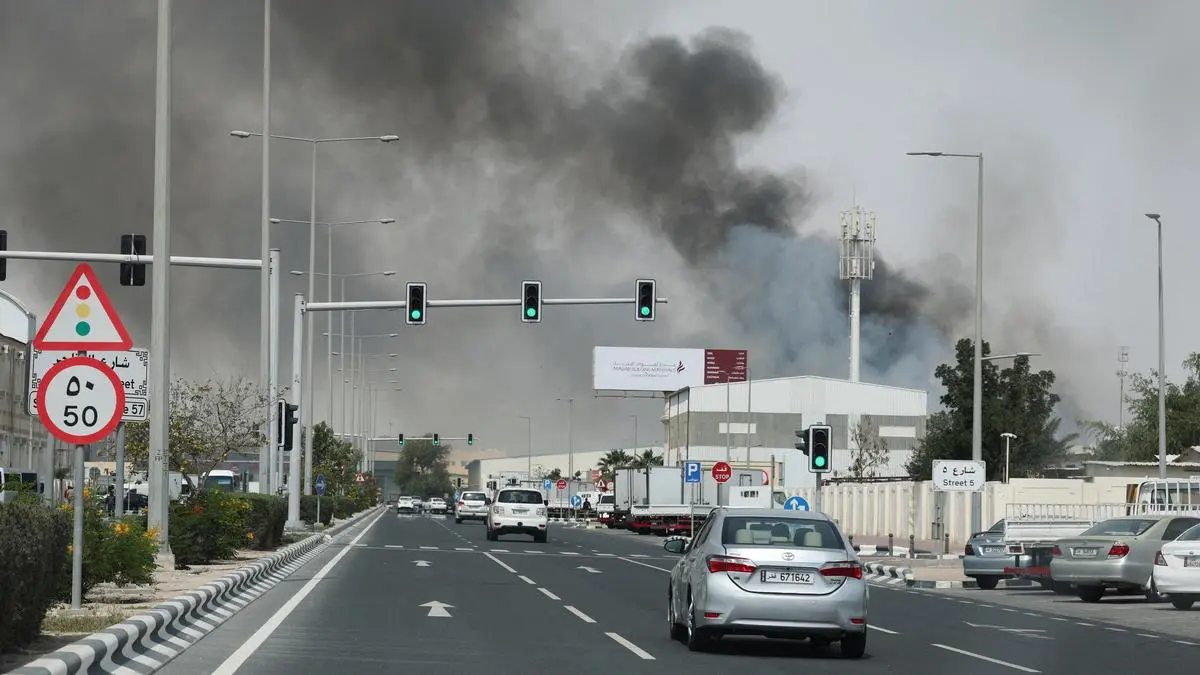
The air in Doha is thick, a humid blanket that smells faintly of salt and money. In the high-rise glass towers of the West Bay, the air conditioning hums a constant, reassuring low-frequency note. It is the sound of modern civilization. Without it, the city would become a furnace within hours. Without the gas flowing from the North Field, the world's largest natural gas deposit, that hum stops.
Tehran knows this. They have always known it.
For decades, the Persian Gulf has been a series of glittering contradictions. On one side, the monarchies of Qatar, Saudi Arabia, and the United Arab Emirates have built monuments to the future—skyscrapers that pierce the clouds and artificial islands shaped like palm trees. On the other side, a revolutionary power sits on a tattered rug of sanctions, watching the skyline glow across the water. Now, the shadow of a long-simmering conflict has finally touched the pipelines.
Iran has issued a chillingly specific ultimatum. If their territory is struck, the infrastructure that keeps the global economy breathing becomes a target. This isn't just about soldiers or missiles anymore. It is about the thermostat in a London flat, the price of plastic in a Shanghai factory, and the very survival of the desert cities that built their dreams on a foundation of liquid gold.
The Fragile Blueprint of the Gulf
Imagine a man named Omar. He is an engineer at Ras Laffan, the massive industrial hub on the Qatari coast. He monitors a screen where green lines represent the steady pulse of Liquefied Natural Gas (LNG). To Omar, these aren't just statistics. They are the heartbeat of his country. If those lines go flat, the desalination plants fail. In a land with no rivers, water is a byproduct of energy. If the energy stops, the water stops.
Iran’s threat to strike oil and gas facilities in Qatar, Saudi Arabia, and the UAE is a masterclass in asymmetrical leverage. They aren't just threatening a military defeat; they are threatening a civilizational reset. By pointing their missiles at the Abqaiq processing plant in Saudi Arabia or the Jebel Ali port in Dubai, they are holding the 21st century hostage.
The logic is brutal. Iran understands that the West can tolerate a localized war. What the West cannot tolerate is $200-a-barrel oil and a global heating crisis caused by a total cessation of Qatari gas. By signaling these targets, Tehran is telling the world that if they go down, they are taking the global supply chain with them.
The Geography of Anxiety
The Strait of Hormuz is a narrow throat of water through which a third of the world's liquefied natural gas and 20% of its oil must pass. It is a choke point in the most literal sense. On a map, it looks like a delicate artery. In reality, it is a graveyard of intentions.
But the new threat goes beyond the water. Iran has spent years perfecting its drone and missile technology, often using proxies to "test" the defenses of its neighbors. We saw a preview of this in 2019, when a swarm of drones knocked out half of Saudi Arabia’s oil production in a single morning. The world gasped, the markets spiked, and then... we went back to sleep.
We can't sleep anymore.
Consider the sheer scale of the UAE’s infrastructure. In Abu Dhabi, the Barakah nuclear plant and the sprawling oil refineries of Ruwais are not just industrial sites. They are the pride of a nation that transitioned from pearl diving to space exploration in two generations. A single kinetic strike on a major refinery doesn't just cause a fire. It causes a regional blackout. It causes the cooling systems of high-density server farms—the brains of the Middle Eastern tech boom—to melt.
The Invisible Stakes for the Average Person
You might be reading this thousands of miles away, thinking this is a regional squabble between ancient rivals. It isn't.
The global energy market is a tightly woven web. When Qatar’s gas exports are threatened, the ripple effect hits a grandmother in Germany who can no longer afford to heat her home in November. It hits a delivery driver in Ohio who sees the price of fuel jump thirty cents in a single afternoon.
The "invisible stakes" are the stability of our daily lives. We take for granted that when we flip a switch, the light comes on. We take for granted that the grocery store shelves will be full. But those shelves are filled by trucks that run on diesel, and those lights are powered by plants that burn gas. Iran isn't just threatening its neighbors; it is poking a hole in the bottom of the global bucket.
Why Now?
The timing isn't accidental. Geopolitics is often a game of waiting for the moment of maximum vulnerability. As the world attempts to transition to greener energy, natural gas has become the "bridge fuel." This has made Qatar more important than ever. By threatening Qatari facilities, Iran is targeting the very bridge the West is walking across.
There is a psychological weight to this move. For years, the Gulf states have relied on a "security umbrella" provided by Western powers. The implicit promise was simple: stay aligned with the West, and your wealth will be protected. Iran’s move is designed to shatter that confidence. They want the leadership in Riyadh and Doha to look at their gleaming cities and wonder if the alliance is worth the risk of seeing it all burn.
It is a strategy of fear. It is the realization that a billion-dollar missile defense system can be overwhelmed by a thousand-dollar drone if you fly it into the right transformer.
The Human Element in the War Room
Behind the headlines, there are people making impossible choices. There are diplomats in Muscat trying to find a middle ground in a room with no corners. There are naval officers on destroyers in the Gulf, staring at radar screens, trying to distinguish between a flock of birds and a suicide drone.
The most terrifying part of this escalation is the "accidental" factor. In a region this tense, a single technical error or a misunderstood command can trigger a cascade. If a missile intended for a military base hits a gas terminal by mistake, the response will not be measured. It will be total.
We often talk about "geopolitical risk" as if it’s a line on a spreadsheet. It isn't. It’s the sweat on the brow of a technician in a control room. It’s the phone call a father makes to his family, telling them to stay indoors. It’s the silence of a city that has suddenly lost its power.
The End of the Golden Illusion
For a long time, the Gulf was viewed as an untouchable oasis of prosperity in a troubled region. The skyscrapers were too tall to fall, and the wealth was too vast to fail. That was the illusion.
The reality is that complexity is fragile. The more advanced a society becomes, the more dependent it is on the seamless flow of energy and data. Iran knows that they don't have to win a traditional war to "win." They only have to make the cost of stability too high for everyone else to pay.
As night falls over the Gulf, the lights are still on. The fountains at the Burj Khalifa are still dancing. The tankers are still lining up at the terminals. But the hum of the air conditioning feels different now. It feels like a countdown.
The world is watching the horizon, waiting to see if the next flash is the sunrise or the beginning of a very long dark.
Silence.