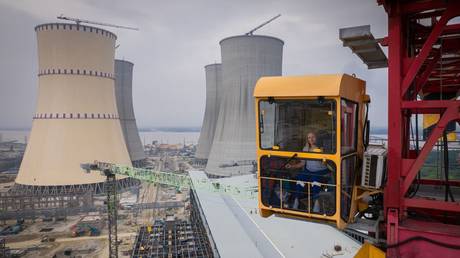
The air in the Pabna District has always carried the scent of the Padma River—heavy with silt, damp earth, and the persistent humidity of a delta that breathes with the seasons. For generations, the rhythm of life here followed the sun. When the orange orb dipped below the horizon, the world narrowed to the flicker of a kerosene lamp or the unpredictable buzz of a power grid that felt more like a suggestion than a certainty.
In the tea stalls of Rooppur, the conversation used to be about the darkness. Not a poetic darkness, but a practical, frustrating one. It was the darkness that spoiled the milk in the single refrigerator of a small shop. It was the silence of a sewing machine when a tailor had three wedding outfits due by morning. It was the heat that refused to lift because the ceiling fan remained a static, three-bladed ornament.
That narrative is being rewritten in steel and uranium.
Bangladesh has officially stepped into the nuclear age. The Rooppur Nuclear Power Plant, a massive undertaking rising from the riverbanks, represents more than just a feat of civil engineering. It is the physical manifestation of a nation’s refusal to be defined by its limitations. While the international community often views nuclear energy through the lens of geopolitics or abstract carbon math, for the 170 million people living in one of the most densely populated corners of the earth, this is about the fundamental right to a stable life.
The Weight of a Fuel Rod
To understand the scale, you have to look past the cooling towers and focus on something small enough to hold in your hand. A single ceramic pellet of uranium fuel, no larger than a pencil eraser, contains as much energy as a ton of coal.
Consider the logistical nightmare of fueling a nation on fossils. You need endless trains, vast shipping lanes, and a constant, suffocating reliance on the whims of global commodity markets. When the price of liquefied natural gas spikes in a boardroom in London or Singapore, a student in Dhaka loses her ability to study for finals because the rolling blackouts—the "load shedding"—begin.
Nuclear energy changes the math. It offers a base load that doesn't care if the wind is blowing or if the sun is obscured by the monsoon clouds. The arrival of the first batch of Russian-made fuel at the Rooppur site wasn't just a delivery; it was a handover of sovereignty. Russia’s Rosatom is the architect here, providing the VVER-1200 reactors, but the electricity they generate will be the lifeblood of Bangladeshi industry for the next sixty years.
A Partnership Born of Necessity
The skeptics often point to the complexity. How does a country that still struggles with basic infrastructure manage the most sophisticated power generation technology known to man?
The answer lies in a grueling, decade-long transition. Thousands of Bangladeshi engineers and scientists didn't just read manuals; they lived in Russia, learning the physics of the atom in the cold winters of Obninsk and Volgodonsk. They returned not just with degrees, but with the weight of a national mission.
We often talk about "technology transfer" as a dry business term. In reality, it looks like a young engineer from a village in Barisal standing in a control room, staring at a digital interface that manages a core temperature of hundreds of degrees Celsius. It is the bridge between a pastoral past and a high-tech future.
The project is a $12.65 billion investment, with 90% of it funded by a Russian loan. It is a staggering sum for a developing economy. But the cost of not doing it is higher. Without a massive surge in power generation, the garment factories that clothe the world and the emerging digital economy of Chittagong and Dhaka would eventually suffocate. You cannot run a modern state on hopes and intermittent currents.
The Ghost of 1986
No one speaks of nuclear power without the shadow of the past creeping in. The names Chernobyl and Fukushima are etched into the collective memory of the world. In a country as river-dense and flood-prone as Bangladesh, the anxiety is understandable. What happens when the waters rise? What happens when the heat of the delta meets the heat of the core?
The VVER-1200 is designed with these ghosts in mind. It utilizes "passive" safety systems—features that don't require human intervention or even electrical power to activate. If everything fails, if the pumps stop and the operators are incapacitated, gravity and natural convection take over. There is a "core catcher," a massive steel bowl designed to contain the molten fuel in the absolute worst-case scenario.
Safety is not an absence of risk; it is the mastery of it. The International Atomic Energy Agency (IAEA) has been a constant shadow on this project, checking welds, verifying protocols, and ensuring that the transition from a "nuclear newcomer" to a nuclear state is handled with clinical precision. The stakes are too high for anything less.
The Invisible Stakes
Beyond the physics and the finance, there is a psychological shift occurring. For decades, Bangladesh was the "basket case," a term cruelly coined by diplomats to describe a nation they thought was doomed to permanent poverty.
Every brick laid at Rooppur is a rebuttal to that idea.
When the first unit begins feeding the grid, it will provide 1,200 megawatts of power. When the second unit follows, the total capacity will double. That is enough to light millions of homes and power thousands of businesses that currently operate on the edge of viability.
But there is a catch. Nuclear power is a long-term marriage. By choosing Russian technology, Bangladesh has tethered its energy future to Moscow for the better part of a century. The fuel comes from Russia. The spent fuel returns to Russia for reprocessing. The technical expertise will require a permanent pipeline of cooperation. In a world where geopolitical fault lines are shifting, this is a calculated gamble on stability.
The Delta’s New Horizon
The Padma River continues to flow past the massive domes of the power plant, indifferent to the atomic dance happening inside. The fishermen still cast their nets in the shadow of the towers, and the monsoon rains still turn the roads to rust-colored mud.
Change is rarely a thunderclap. It is a slow, methodical accumulation of better days.
It is the moment a doctor in a rural clinic can perform a surgery without fearing the lights will die mid-incision. It is the moment a father can afford to buy a computer for his son because the cost of electricity has finally stabilized.
The atom is a strange, terrifying, and beautiful tool. It is the energy of the stars brought down to the banks of a muddy river in South Asia. As the steam eventually begins to billow from those towers, it won't just be a sign of industrial heat. It will be the breath of a nation that finally has the power to stay awake, to work, and to dream long after the sun has gone down.
The darkness is retreating, one pellet of uranium at a time.