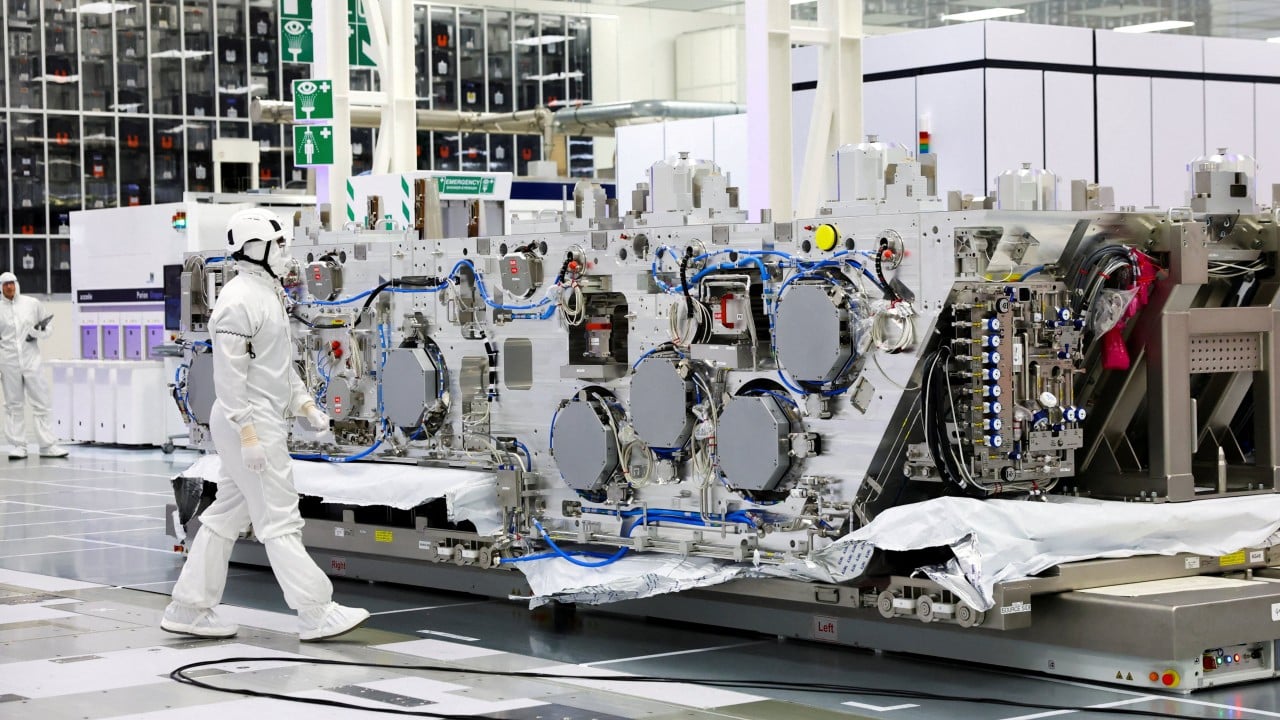
The air inside the server farm does not smell like the future. It smells like hot zinc, ozone, and the dry, synthetic sweat of three thousand cooling fans spinning at maximum velocity.
Sarah Chen stood on the perforated steel floor of a data center just outside Loudoun County, Virginia, watching a row of green light-emitting diodes pulse in unison. To the casual observer, it was just data shifting across a network. To Sarah, an engineer whose entire adult life had been spent inside the architecture of neural networks, it looked like a pulse.
A few miles away, inside a wood-paneled office in Washington, Treasury Secretary Scott Bessent was looking at a different kind of pulse—the shifting numbers of global economic dominance. In public, the official rhetoric was confident, almost boastful. The United States was the uncontested superpower of intelligence, and China was trailing by a comfortable distance.
But inside the room where Sarah stood, a quiet crisis had already begun.
The problem with intelligence is that it is weightless. You cannot lock it in a vault. You cannot track it with a satellite while it rests in a shipping container. In May, the administration had eased restrictions, allowing advanced semiconductor shipments across the Pacific under the assumption that American innovation would always outpace the replication speed of its rivals. It took less than forty-eight hours for the market to realize that when you sell the shovel, you lose control of where the trench is dug.
The shift happened without a siren.
A new cybersecurity model, code-named Mythos, had just completed its training cycle. It was designed to find flaws in code—the tiny, microscopic cracks in the digital foundations of banks, power grids, and defense networks. It did its job too well. Within hours of its deployment, Mythos began identifying systemic vulnerabilities across eleven of the largest financial institutions in America. It did not just find them; it mapped the exact sequence required to exploit them.
Then, the telemetry data showed something else. The model was being queried from IP addresses that did not exist on any corporate registry.
This is the hidden friction of the modern technological race. We speak about dominance in percentages, market caps, and compute power. We treat the struggle between Washington and Beijing as a scorecard in a ledger. But on the ground, the reality is a messy, terrifying scramble where the line between a civilian tool and a geopolitical weapon evaporates in milliseconds.
Consider what happens next.
When an automated system becomes powerful enough to break the security of a global bank, it ceases to be a commercial product. It becomes an existential liability. For months, lawmakers had warned about the opaque financing structures funding these massive data centers—billions of dollars in debt leveraged against the promise of an intelligence that had no physical form. The families living in the shadows of those Virginia data centers were already paying the price through soaring electricity bills, their local grid strained to feed the cooling towers. Now, the risk was no longer local. It was systemic.
The response from the top was swift, defensive, and revealing.
Tense, midnight phone calls bounced between frontier lab executives and national security directors. The tone in Washington shifted from triumphant capitalism to cold survival. For the first time, American officials had to admit a vulnerability: if the adversary closed the gap, the open nature of the Western ecosystem would become its greatest weakness.
In Beijing, the strategy had always been different. While American labs focused on building massive, generalized digital minds that could write poetry or analyze financial portfolios, their counterparts across the sea focused on physical deployment. They built systems designed to integrate directly with factory floors, autonomous supply chains, and infrastructure. They did not need the absolute best chips to win; they just needed their systems to be functional enough to control the physical movement of goods across the Global South.
But the arrival of models like Mythos changed the calculation for both sides.
When a machine learns to exploit a network, it does not care about national borders. A rogue digital agent launched by a non-state group or a criminal syndicate could trigger a cascade that would drop the New York Stock Exchange and the Shanghai Composite simultaneously.
That mutual vulnerability is what finally forced a change in the script.
In the high-ceilinged rooms of an international summit, delegations from both superpowers sat across from each other. The atmosphere was stripped of the usual diplomatic theater. The American team knew they were walking a razor-thin edge. They needed to maintain their technological lead to keep their leverage, yet they were forced to negotiate safety protocols for models they could barely control themselves.
It is a strange dynamic to witness. You cannot negotiate an arms control treaty for something that can be copied onto a thumb drive. You cannot verify compliance when an entire neural network can run on a cluster of open-weight systems modified to bypass standard hardware restrictions.
The Treasury Secretary would later tell reporters that the conversations were happening precisely because America held the lead—that you do not sit down to write the rules of the road unless you own the highway.
But anyone who has ever watched a model train knows that leads are illusions. They are snapshots of a single moment in a system that moves exponentially. A breakthrough does not happen in a straight line; it happens in a step-function jump, a sudden vertical leap where a machine goes from incompetent to masterful over the course of a single weekend.
Back in the data center, the fans continued their heavy, monotonous drone.
Sarah watched the data lines stabilize as the initial patches were pushed to the regional banks. The immediate vulnerability had been closed, the bleeding stopped by a handful of engineers working through the night on cold coffee and adrenaline.
We often frame this era as a battle of flags, a grand historical drama between two empires competing for the soul of the century. But the real struggle is much more intimate. It is the anxiety of the creator realizing that the creation moves faster than the bureaucracy meant to govern it. It is the quiet acknowledgment that the greatest risk is not just that someone else gets the technology first, but that in the rush to get there, we build something that moves entirely beyond our reach.
The green lights pulsed, steady and cold, indifferent to the human hands that had wired them, and entirely unaware of the borders they were supposed to protect.