The water in the Strait of Hormuz does not look like water at 2:00 AM. It looks like poured obsidian. It is a thick, terrifying black that absorbs the moon and spits back nothing but the low, rhythmic hum of supertankers dragging global commerce through a choke point just twenty-one miles wide.
To the men and women who fly over it, the strait is a psychological pressure cooker. On one side lies the Arabian Peninsula; on the other, the jagged, hostile coastline of Iran. Between them sits a strip of sea that holds the literal fuel of the modern world.
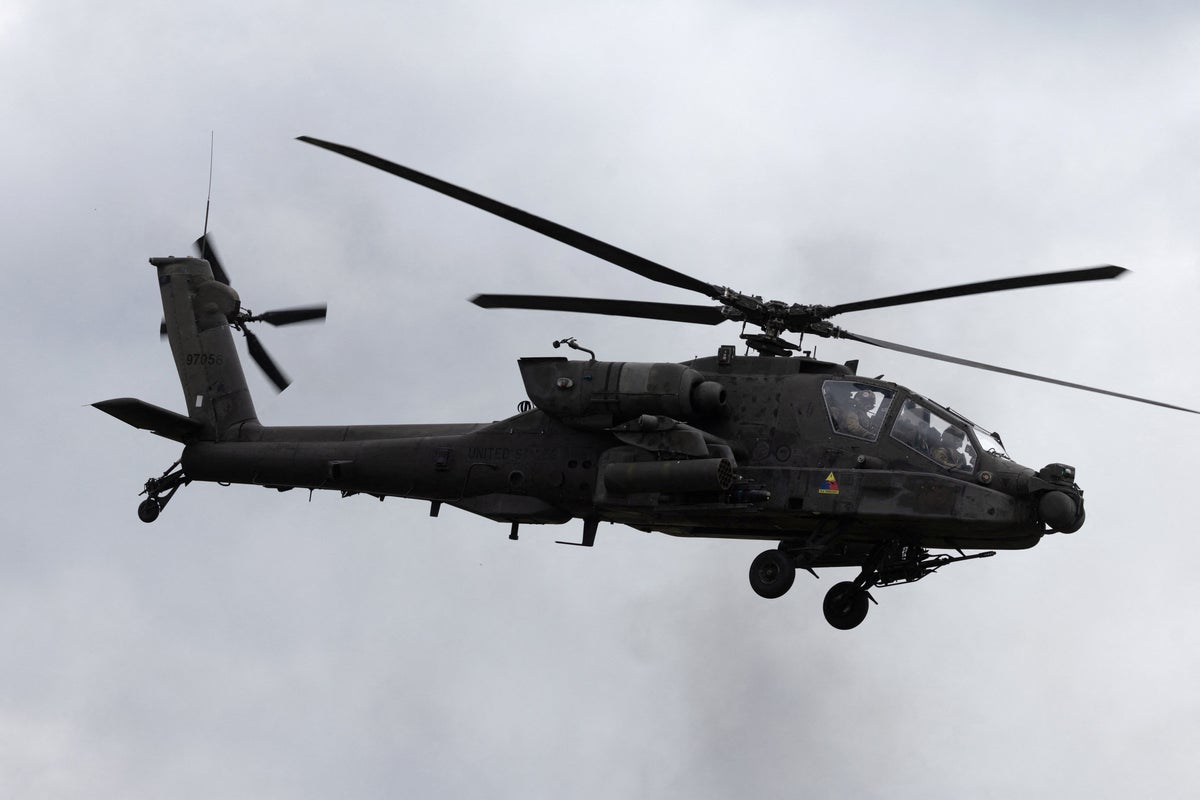
When an AH-64 Apache helicopter goes down in these waters, the universe shrinks.
Forget the geopolitical chessboard. Forget the billions of dollars of military hardware or the macroeconomics of oil supply lines. In that exact second, reality reduces to a pair of human beings bobbing in a vast, predatory dark, wearing survival vests, listening to the suffocating silence of an ocean that wants to pull them under.
Historically, saving them meant throwing a massive, loud, slow-moving net of human assets at the problem. You spun up the rotodomes of search planes. You redirected guided-missile destroyers. You risked more lives to save lives.
But on this night, the rescue did not come with the thudding blades of a secondary carrier group or the heroic roar of a midnight armada.
It arrived with a hiss. It arrived via a machine that felt no fear, breathed no air, and possessed no heartbeat.
The Anatomy of a Blind Drop
Military aviation is built on redundancy, but redundancy is a polite word for waiting for things to break.
The Apache is a flying tank. It is designed to take punishment from anti-aircraft rounds and keep its crew alive. But the ocean is an entirely different kind of adversary. It does not care about armor plating. When a mechanical failure or a sudden loss of situational awareness forces a multi-million-dollar aircraft into the drink, the clock starts ticking backward toward zero.
Hypothermia is the first enemy, even in the warm currents of the Gulf. Panic is the second. The third is the Iranian Revolutionary Guard Corps Navy, whose fast-attack boats routinely prowl these exact grids, looking for any geopolitical leverage they can scoop out of the surf.
Consider the perspective of the rescue coordination center miles away. The emergency beacon flashes on a digital display. It is a single, pulsing red dot against a grid of cold blue.
Every protocol written since World War II dictates the same response: launch the human rescue team. You send a crew out into the dark. But doing so creates a secondary vulnerability. In a high-threat environment like the Strait, a slow-moving rescue helicopter is a massive target for shoulder-fired missiles.
The dilemma is brutal. Do you risk six lives to save two?
This is where the paradigm cracked. The commander on duty did not look toward the flight deck. They looked toward a technician sitting in a climate-controlled container, staring at a panoramic array of monitors. They looked toward an unmanned surface vessel—a drone boat.
The Ghost in the Surf
The vessel in question does not look like something from a movie. It is not a sleek, sci-fi cruiser with neon accents. It is a low-slung, gray, angular hull that sits deep in the water, designed to minimize its signature on enemy radar. It looks less like a boat and more like a floating blade.
To understand why this machine changed everything that night, you have to understand how difficult it is to find a human head in the ocean.
Imagine tossing a single black walnut into a football field covered in undulating black velvet, then turning off all the lights and trying to find it with a penlight while someone shakes the floor. That is a maritime search-and-rescue operation. Waves create clutter. Sea spray blinds conventional optics.
The drone boat, however, does not see the way we see.
It utilizes a fusion of forward-looking infrared sensors, millimeter-wave radar, and artificial intelligence trained to filter out the noise of the waves. While a human lookout on a rolling deck eventually succumbs to fatigue, eye strain, and the hypnotic effect of the dark water, the machine’s attention span is infinite. It calculates probability fields. It sweeps the water with mathematical coldness.
On this night, the drone boat was already on a routine patrol, gliding through the swells like an autonomous phantom.
When the alert came, the human operators ashore did not need to brief a crew or wait for pre-flight checks. They punched in a set of coordinates. The drone’s electric propulsion system surged. It adjusted its course in microseconds, calculating the optimal intercept path against the shifting drift of the Gulf's currents.
It traveled alone. No support vessels. No air cover.
If it were ambushed, the loss would be measured in plastic and silicon, not folded flags and grieving families. That single fact changes the entire calculus of military risk. It allows commanders to be aggressive where they would normally be hesitant. It allows them to send the asset directly into the teeth of danger.
The Intercept
The pilots in the water heard it before they saw it.
When you are floating in a survival suit, every sound is amplified by the water pressed against your skull. You hear the deep, thrumming vibrations of distant shipping lanes. You hear the slap of chop against your visor.
Then came a high-pitched, metallic whine—the sound of an autonomous hull slicing through the water at high speed.
For a terrifying minute, it could have been anyone. In the Strait of Hormuz, an approaching boat is just as likely to mean captivity as it is rescue. The pilots held their breath, their hands drifting toward their sidearms, the water lapping at their chins.
Then the shape emerged from the gloom. It was small. Uninhabited. A ghost ship.
The drone boat slowed, its sensors locking onto the thermal signatures of the two human beings. It did not possess arms to haul them aboard. It did not have a medic to offer hot coffee or words of comfort. What it had was a payload bay that opened via remote command from a trailer three hundred miles away.
Inside that bay were life rafts, thermal blankets, communication gear, and strobe beacons.
The machine did not just find them; it anchored itself against the current to create a windbreak, shielding the exhausted pilots from the worst of the chop. It became a floating sanctuary. Through the onboard comms system, a human voice finally spoke to the pilots—not from the boat, but through it, relayed across satellite constellations from an operations room half a world away.
“We have you. Help is on the way.”
The Quiet Turning Point
We often look for the future in loud moments. We look for it in massive explosions, sweeping declarations of war, or the unveiling of trillion-dollar aircraft.
But the future usually arrives in absolute silence, in the middle of nowhere, witnessed by nobody but two terrified pilots and an array of automated cameras.
The extraction of those Apache pilots by a coordinated team—using the drone boat as the tip of the spear to locate, protect, and hold them until a swift-boat crew could finalize the pickup—marks a boundary line in history. The machine proved that the most dangerous jobs on earth no longer require a human heart to beat through the terror.
The implications ripple far beyond the Persian Gulf.
Every navy on earth is watching this integration. They are realizing that the old metrics of naval power—tonnage, hull counts, the sheer size of a carrier strike group—are being undermined by small, smart, expendable pieces of autonomous hardware. The ocean is becoming a web of sensors and autonomous responders.
But as the drone boat turned back toward its patrol vector that morning, its payload bay empty and its sensors already scanning the horizon for the next anomaly, it left behind a stranger truth.
The machine did not save those pilots because it valued human life. It saved them because it was programmed by people who do. In the cold, calculating world of autonomous warfare, the most human thing about the technology is the purpose we give it when we let it loose in the dark.
The two pilots were flown back to their base. They walked away with their lives, a few bruises, and a story that sounds like fiction.
Somewhere out in the Strait, the water is still black. The tankers are still moving. And the gray boat is still slicing through the waves, waiting for a signal that someone, somewhere, has slipped beneath the surface.