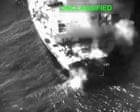
Salt crusts the bridge windows long before the first alarm breaks the quiet of the watch. Out here, the horizon is not a line; it is a breathing edge where the dark water meets a starless sky. For hours, the rhythm is only the steady thrum of the turbines, the hum of filtered air, and the low murmur of men drinking lukewarm coffee from heavy mugs. You watch the radar sweep. You track the faint, ghost-like contacts miles away, trading in green light and digital coordinates.
Then the green changes.
War does not always arrive with a brass band or a declaration printed on heavy parchment. Sometimes, it announces itself as a sudden, sharp spike on a cathode-ray display—a tiny vector moving at supersonic speed, crossing the invisible boundary from theoretical tension to immediate, physical reality.
Consider what happens next: a missile, born of industrial chemistry and cold calculation, tears through the troposphere toward a hull of steel and flesh.
The air pressure shifts. Sirens shriek—not the polite chimes of an office building, but a raw, metallic howl that vibrates in the teeth. In seconds, abstract geopolitics collapses into a very localized problem of physics, reaction time, and survival.
(Note: The following reconstruction of the engagement involving American warships and Iranian tankers is drawn from official military reporting and standard naval defense protocols.)
The Anatomy of a Second
When an incoming threat locks onto a warship, human choice shrinks to the width of a razor blade.
Imagine standing in the combat information center. The air smells of ozone and hot electronics. The lighting is dimmed to a dull, bruised blue. Voices are clipped, stripped of all pleasantry. There is no room for hesitation, because hesitation has a mass and a velocity, and both of them kill.
Radar operators call out bearings. The automated defense systems hum, calculating intercept vectors with a terrifying, mathematical indifference. The missile is closing at hundreds of miles per hour. It is a streak of kinetic energy that has forgotten where it started and cares only about where it will impact.
When the decision is made to fire, it is never casual. It is the culmination of decades of strategic posture, intelligence briefings, and a grim awareness that the sea lanes connecting continents are painfully fragile.
In this specific encounter, the threat was not an isolated projectile. It was paired with maritime targets—three Iranian tankers operating within a volatile corridor where economic lifeblood and military posturing cross paths every single day. When the American warships came under direct attack, the response was instantaneous. It had to be.
The Weight of the Water
We talk about the Middle East, about the Gulf, about oil routes and maritime choke points as if they were lines drawn on a classroom whiteboard. We treat them like chess squares.
They are not. They are wet, deep, unpredictable spaces where human beings live in tight compartments of steel, surrounded by miles of freezing, indifferent ocean.
When the retaliatory strikes hit those three tankers, the shockwaves rolled across the water long before the smoke cleared. To read about it in a morning headline is to see a sanitized equation: Three vessels struck in self-defense. But behind that sentence lies the reality of fuel igniting, bulkheads buckling, and men scrambling through smoke-filled corridors to find damage control gear.
I have spoken with sailors who have smelled that smoke. It is an unforgettable cocktail of burning hydraulic fluid, scorched insulation, and superheated metal. It clings to hair and skin for days. It is the smell of a system breaking down under extreme duress.
Why were those tankers there? In the grand theater of statecraft, commercial shipping is often used as a pawn or a shield. Ships carry the crude that keeps global engines turning, but they also move through waters where gray-hull warships shadow them like silent guard dogs. When the line is crossed—when a missile leaves a launcher—the distinction between civilian utility and military vector blurs into ash.
The Invisible Threshold
We live in an era that pretends safety is our natural state. We scroll through news feeds on glass screens while sitting in climate-controlled rooms, treating global conflict as a distant spectator sport, like a match played on another continent.
But the global economy is a glass house, and the Gulf is one of its primary load-bearing walls.
Every barrel of oil, every microchip, every container ship moving from East to West depends on the unspoken agreement that the sea remains open. When surface-to-air or anti-ship missiles fly toward American decks, that agreement fractures. The retaliation—the strike on the three tankers—is not merely an exchange of blows. It is a violent reinforcement of a boundary. It is a way of saying: If you push past this point, the ground gives way beneath everyone's feet.
Yet, the aftermath is where the true weight settles.
Back on the bridge, after the tracking screens clear and the last echoes of the interceptors die away, the silence returns. It is a heavier silence than before. The water looks the same, black and indifferent, but everyone knows the air has changed. You look out over the bow, watching the dark swells rise and fall against the steel, wondering what is being written in the quiet hours just beyond the horizon.
The watch continues. The radar sweeps. The coffee grows cold again. But the invisible lines have been redrawn in fire, and the world is a little smaller, a little sharper, and infinitely more dangerous than it was yesterday.