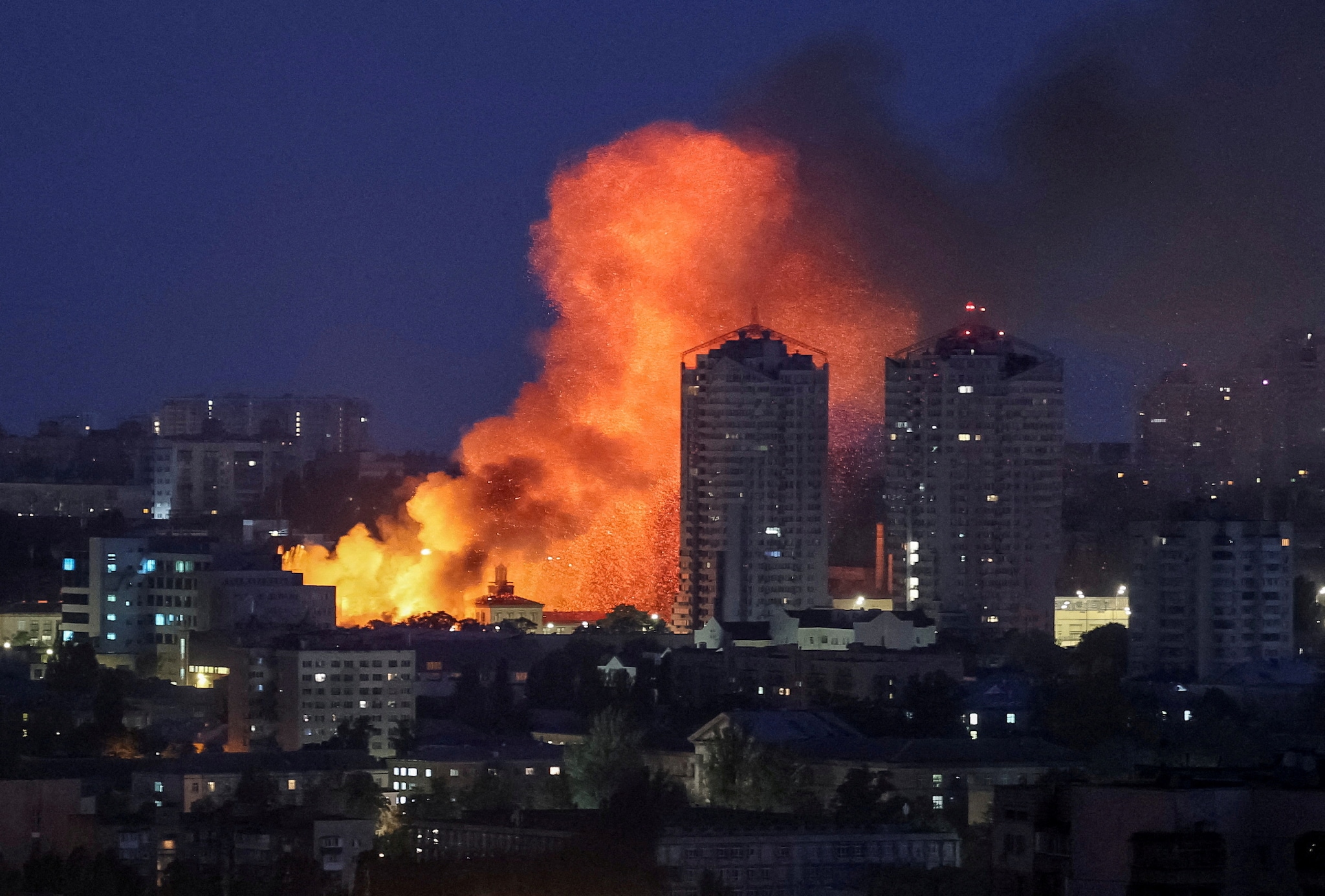
Oleksandr does not look at the stars anymore. When the sun dips below the horizon in Dnipro, the sky ceases to be a romantic expanse and becomes a vector. He listens. Everyone in Ukraine listens. They have developed a second sense, a subconscious acoustic mapping that distinguishes the low-frequency hum of a refrigerator from the lawnmower drone of an Iranian-designed Shahed drone.
For two years, the safety of Oleksandr’s family rested entirely on the shoulders of the state. It was a binary existence: either the Soviet-era S-300 batteries and Western-supplied IRIS-T systems caught the incoming fire, or they didn't. But the math of national defense is cold, and the geography of a country the size of Ukraine is unforgiving. There are never enough missiles. There are never enough batteries. Recently making news in related news: The $100 Million Shield Against a Sleeping Giant.
Now, the silence of the night is being guarded by something new. It isn't the army. It is a private security detail for the air.
The Privatization of the Horizon
We are witnessing the birth of an industry that, until recently, lived only in the fever dreams of techno-thriller novelists. Private air defense is no longer a concept; it is a line item on a corporate balance sheet. As the war in Ukraine grinds into its third year, the monopoly on violence—long held by the nation-state—is eroding at the edges. Further information regarding the matter are detailed by The Guardian.
Large agricultural conglomerates, energy providers, and even high-end logistics hubs are realizing that waiting for the government to protect their specific patch of dirt is a losing game. The state must prioritize the power grid, the hospitals, and the military barracks. If you own a grain silo in the middle of a vast, golden field in Poltava, you are, for all intents and purposes, on your own.
This isn't about mercenaries holding rifles. It is about sensor fusion, electronic warfare (EW) suites, and "soft-kill" technology. It is about a CEO deciding that a $500,000 investment in a private jamming array is cheaper than losing a $50 million processing plant to a $20,000 drone.
The Geometry of the Kill Zone
To understand why this is happening, you have to understand the sheer, exhausting scale of the threat. Imagine a swarm of insects. If you have a shotgun, you might hit one or two. But if there are fifty, and they are coming from every direction, the shotgun is useless.
Traditional air defense is the shotgun. A single Patriot interceptor missile can cost $4 million. Using it to down a drone built with parts found in a remote-controlled hobbyist shop is a fast track to bankruptcy. This is the "cost-asymmetry" trap. The Russian strategy is simple: saturate the sky with cheap junk until the defender runs out of expensive silver bullets.
Enter the private sector. Companies like Piranha Tech and various smaller, agile engineering firms are building "bubbles." These aren't physical domes, but electromagnetic ones. When a drone enters the radius of a private EW system, the invisible tether between the pilot and the machine is severed. The drone becomes blind. It loses its GPS. It wanders aimlessly until it falls into a field, harmless as a brick.
The Invisible Shield in Practice
Consider a hypothetical—but highly representative—scenario. A massive sunflower oil refinery sits near the border of the Sumy region. The state’s high-altitude defenses are busy protecting Kyiv. The refinery manager, let's call her Irina, knows her facility is a "soft target."
In the old world, Irina would pray. In this new world, she hires a private firm to install a mast-mounted detection system. It’s a modest setup: a thermal camera, a sensitive acoustic array, and a localized jammer.
One Tuesday, at 3:14 AM, the sensors pick up a heat signature moving at 120 kilometers per hour. There is no call to the Ministry of Defense. There is no frantic request for a surface-to-air missile. Instead, an automated system triggers a focused burst of radio frequency interference. On a screen in a darkened security room, the red dot representing the drone wavers, circles, and then disappears. The refinery continues to hum. The oil continues to flow.
But this shift brings a haunting question: who gets to live under the bubble?
The Morality of the Micro-Cordon
If safety can be bought, then safety is a luxury good. This is the friction point that no one wants to talk about. When a private company jammers a drone, that drone doesn't just vanish into another dimension. If it hasn't been destroyed, it might simply crash somewhere else. Perhaps it hits a fallow field. Perhaps it hits the cottage of a pensioner who couldn't afford a private EW contract.
The legal landscape is a chaotic thicket. In almost every country on Earth, jamming radio frequencies is a high-level crime, strictly reserved for government agencies. Ukraine has been forced to look the other way, creating a "grey zone" of legality out of pure necessity. The government is essentially saying: Protect yourselves, because we are busy protecting everyone.
This creates a tiered society of survival. On one street, a tech company has outfitted its roof with sensors that create a 500-meter "safe zone." Two blocks over, a residential apartment complex sits exposed. The signals don't care about fairness. They only care about the power of the transmitter.
The Engineers in the Garage
This isn't just a story of big business. It is a story of frantic, desperate innovation. Across Ukraine, small teams of engineers—men and women who used to build smart-home devices or high-end speakers—are now hacking together "trench EW."
They are using off-the-shelf components to build handheld jamming "guns" that look like something out of a low-budget sci-fi movie. These devices are being bought by volunteer groups and private donors to give to individual units or even protect specific neighborhoods.
There is a raw, jagged edge to this expertise. It is born of the immediate threat of death. When your friend's house was hit last week because the local radar had a blind spot, you find ways to fix that blind spot with a Raspberry Pi and a few custom-soldered circuit boards.
The Global Ripple
What is happening in the wheat fields and industrial outskirts of Ukraine is a preview of the next fifty years of global security. The "Private Air Defense" industry is the new "Private Security Guard." In the 1990s, if you were a wealthy person in a volatile region, you hired men with pistols. In the 2030s, you will hire a firm to manage your local airspace.
The implications for international law are staggering. If a private entity can shoot down—or "soft-kill"—an airborne object, do they own the wreckage? If their jamming interferes with a commercial airliner’s navigation, who is liable? We are building the plane while it is in the air, and the engines are on fire.
The tech is also evolving toward "hard-kill" private options. We are seeing the rise of automated turrets equipped with machine guns or even small, interceptor "suicide" drones designed to ram into intruders. The line between a security company and a private air force is thinning to the point of transparency.
The Weight of the Signal
Back in Dnipro, Oleksandr sits on his balcony. He knows that somewhere nearby, on the roof of a high-end office complex, a silent sentinel is scanning the dark. He feels a strange, modern conflict. He is grateful for the protection, even if it wasn't meant for him. He benefits from the "spillover" of the corporate jammer.
But he also feels the weight of the invisible. The sky used to be a common good, a shared ceiling for all of humanity. Now, it is being partitioned. It is being mapped into zones of protection and zones of vulnerability.
The real shift isn't just in the hardware. It is in the psychology of the citizen. We are moving away from the idea that the state is the sole provider of our most basic need: the ability to wake up in the morning under a roof that is still there.
The hum in the night is no longer just the sound of a threat. It is the sound of a marketplace. It is the sound of a world where the air above your head is only as safe as your ability to pay for the signal that keeps it that way.
The drone is still out there, somewhere in the black, searching for a gap in the frequency. And somewhere else, a server is calculating the cost of the next five minutes of peace.