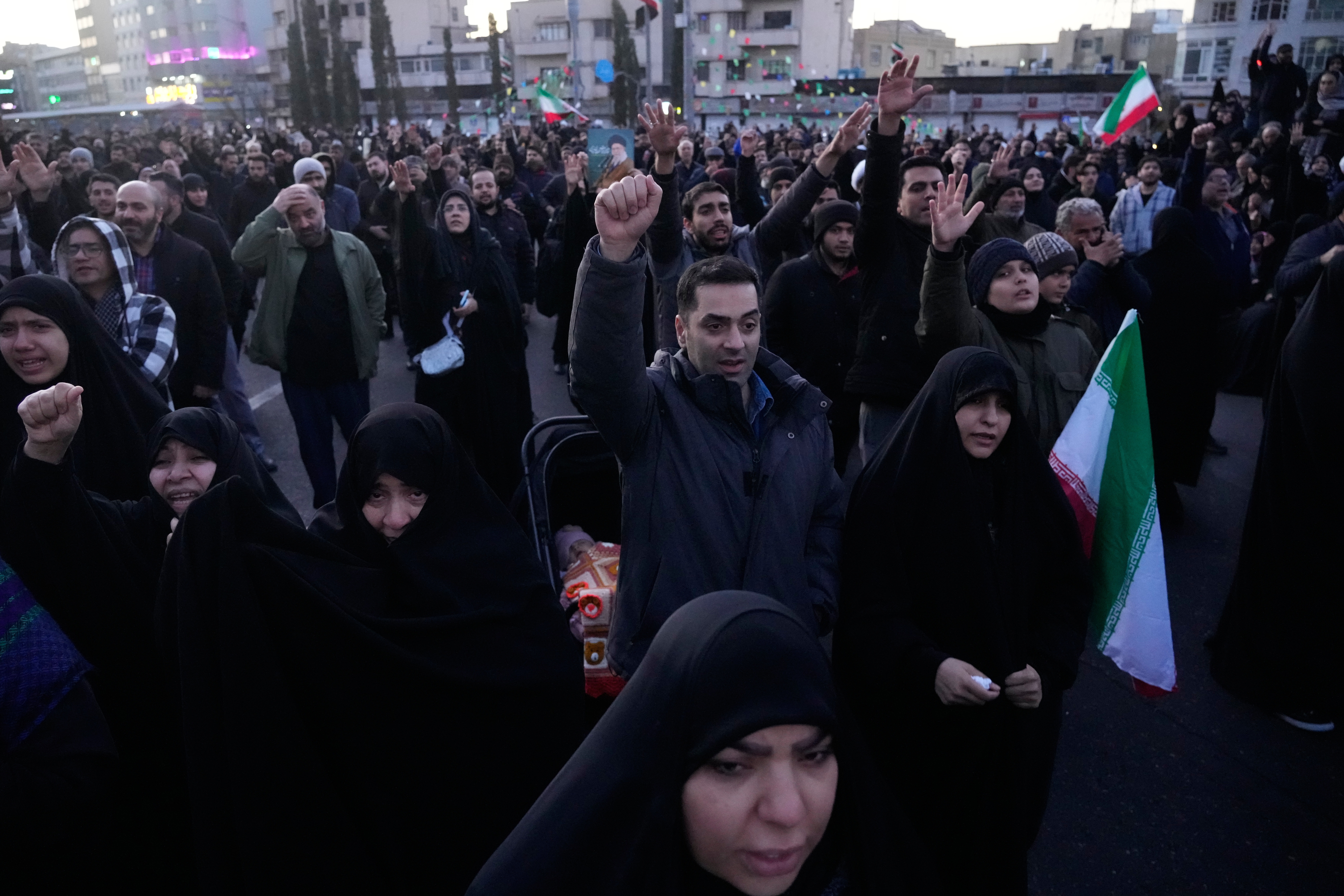
The tea was still hot when the windows rattled. In the Valiasr neighborhood of Tehran, the mundane rituals of a Friday night—the rhythmic hiss of a samovar, the muffled sound of a television soap opera, the distant hum of a motorbike—were swallowed by a sound that didn't belong to the city. It wasn't the sharp crack of a car backfiring or the low rumble of a passing truck. This was a physical weight. A pressure that pressed against the eardrums and made the glass in its frames vibrate with a frantic, crystalline anxiety.
Then came the light.
It didn't flicker. It bloomed. For a few heartbeats, the horizon toward the east shed its midnight velvet and donned a bruised, synthetic orange. People stepped onto balconies, clutching robes against the night chill, their eyes reflecting a glow that hadn't been there a second before. They looked at each other, silent, asking the same question with their eyebrows: Is this the moment the world finally changes?
The Anatomy of an Echo
Geopolitics is often discussed in the sterile air of map rooms and news studios, where pundits use terms like "strategic depth" and "kinetic signaling." But on the ground, war is an auditory experience. It is the sound of a daughter’s breath catching in her throat. It is the frantic scrolling of a thumb against a smartphone screen, searching for a Telegram update that hasn't been censored yet.
The facts, as they trickled out through the official filters of the Islamic Republic News Agency (IRNA) and the defiant social media feeds of the capital’s youth, were sparse. Israel had launched a series of "precise strikes." The targets were military—missile manufacturing sites, air defense batteries, the iron skeleton of a nation’s pride. From Jerusalem, the rhetoric was equally sharp. This was a response. A debt being settled. A message delivered at the speed of sound.
Yet, to understand the weight of these explosions, one must look past the charred metal of a drone factory. Consider a hypothetical resident—let’s call her Samira. She is a thirty-year-old graphic designer who has spent her entire life under the shadow of "the situation." To Samira, the "Axis of Resistance" and the "Zionist Entity" are not just headlines; they are the invisible architects of her anxiety. When the explosions started, she didn't think about the technical specifications of an F-35 or the range of a ballistic missile. She thought about her mother’s heart medication, which is already hard to find because of sanctions. She thought about whether the internet would be cut off by morning.
War, in its modern form, is a psychological Siege of Troy played out on the digital screens of twenty million people.
The Geography of Fear
Tehran is a city built on a slope, stretching from the smog-choked plains of the south to the opulent, snow-capped foothills of the Alborz mountains in the north. This geography dictates more than just the climate; it dictates the acoustics of a crisis. In the south, near the sprawling industrial complexes and military garrisons, the strikes felt like an earthquake. In the north, they were a ghostly reminder of a vulnerability the wealthy often pay to forget.
The Israeli military's choice of targets was a masterclass in "the art of the almost." By avoiding oil refineries and nuclear sites, they stayed just below the threshold of a total, scorched-earth regional conflagration. It was a calculated surgical procedure performed with a sledgehammer. They wanted to prove that the "Ring of Fire"—the network of proxies surrounding Israel—could be pierced at its center.
But what happens to a population when the "center" no longer feels safe?
Since the 1980s, during the grueling eight-year war with Iraq, Iranians have lived with the memory of the "War of the Cities." Grandparents tell stories of sleeping in basements while Iraqi Scuds rained down. For decades, those stories were relics. Museum pieces. On this night, those memories were dusted off and thrust into the present. The psychological barrier had been breached. The invulnerability of the capital was a ghost.
The Invisible Stakes
While the world watches the flashes on the horizon, the real damage is often done in the silence that follows. We talk about "deterrence" as if it’s a mathematical formula. If $X$ hits $Y$, then $Z$ must respond. But the human heart doesn't follow $X$ and $Y$.
Consider the economic fallout of a single night of fire. By the time the sun rose over the Alborz, the rial—Iran's already battered currency—was shivering. In the gray light of dawn, the crowds at the exchange shops weren't looking for news; they were looking for security. They were trading their life savings for pieces of paper printed in Washington or Brussels, betting against the stability of their own sky.
This is the hidden cost of the strike. It isn't just the millions of dollars in destroyed radar equipment. It is the erosion of the social contract. When a state cannot guarantee the silence of the night for its citizens, the foundation of its authority begins to crack in ways that no air defense system can repair.
The Israeli government called the operation "Days of Repentance." The name itself is a heavy metaphor, draped in the religious gravity of the Yom Kippur period. It implies a moral reckoning. On the other side, the Iranian leadership spoke of "legitimate defense" and "crushing responses." Both sides are trapped in a script written decades ago, performing for a global audience while their own people hold their breath.
The Rhythm of the Aftermath
Morning in Tehran usually smells of diesel and fresh sangak bread. On the day after the strikes, the smell was the same, but the rhythm was off. There was a frantic quality to the traffic. A sharpness to the way people greeted their neighbors.
"Did you hear it?"
"Which one?"
"The third one. The one that felt like it was inside the house."
The government played down the damage. The state television showed footage of calm streets and fruit markets, a visual sedative designed to prevent panic. They spoke of "limited damage" and "successful interceptions." It is a necessary fiction. To admit the full extent of a breach is to admit a lack of control.
But the sky doesn't lie.
The streaks of smoke left by interceptor missiles were still visible for those who knew where to look. They were like scars on the atmosphere. They served as a reminder that the distance between "peace" and "catastrophe" in the Middle East is exactly the length of a flight path from the Negev Desert to the outskirts of Karaj.
The Echo in the Room
We often treat these events as a spectator sport. We check the live blogs, we look at the satellite imagery, and we wait for the next "escalation ladder" to be climbed. We forget that the ladder is leaning against a house where people are trying to sleep.
The real story of the Tehran explosions isn't found in the charred remains of a radar dish. It's found in the quiet conversations in the shared taxis. It’s found in the eyes of the students at Sharif University, who wonder if their degrees will ever be used in a country that isn't preparing for an apocalypse. It’s found in the trembling hands of an old man who lived through the revolution and now sees the horizon glowing orange once again.
There is a specific kind of exhaustion that comes from living in a state of permanent "almost." Almost at war. Almost at peace. Almost at a breakthrough. Almost at a collapse. It is a wearying, soul-crushing limbo.
As the smoke cleared and the international community began its predictable dance of "calling for restraint," the people of Tehran simply went back to work. Not because they weren't afraid, but because fear is a luxury they can no longer afford to prioritize. They swept the dust from their windowsills. They brewed more tea. They looked at the mountains, which remained indifferent to the fire below.
The amber light was gone. The sky was black again. But the darkness felt different now. It felt heavy. It felt like a curtain that had been pulled back, revealing a stage where the actors had lost their scripts and the ending was anyone's guess.
The city waited for the next sound. For the next rattle of the glass. For the next time the night would decide to turn into day.
Somewhere in a small apartment, a child asked why the sky had been orange. The mother didn't talk about missiles or geopolitics. She didn't talk about Israel or the Revolutionary Guard. She just pulled the blanket a little higher and told the child to sleep, hoping that her lie would hold until morning.


