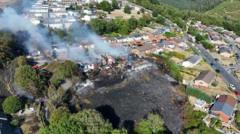
Ash does not fall like snow. Snow drifts, dances, clings softly to the edges of windowpanes, melts into a quiet puddle. Ash arrives with a heavy, oily finality. It settles on the hood of your car like gray silt, gets trapped in the treads of your sneakers, and tastes like copper and burnt plastic if you forget to pull your collar over your nose.
When the wind shifts, the world smells like a house that has already burned down.
Most disasters are advertised. They arrive with sirens, emergency text alerts pinging in a synchronized panic, and anchors on television screens warning you to seek higher ground or a safer zip code. But sometimes, the threat creeps in under the radar of your daily routine. You are boiling water for pasta. You are helping a child find a misplaced sneaker. You look out the kitchen window, and the afternoon light has turned the sickly, bruised color of a dying plum.
That was the absolute fear. Not just the sudden roar of an advancing wall of flame, but the creeping realization that the ordinary structures of your life—the mortgage papers in the desk drawer, the framed family photographs on the mantel, the mismatched coffee mugs in the cupboard—were remarkably, terrifyingly fragile.
Smoke does not care about your history.
To understand what happened when the fire swept through the neighborhood, you have to look past the charred beams and the official incident reports filed by district commanders. You have to look at the kitchen table.
Imagine sitting there at three in the morning, hours after the mandatory evacuation order came banging on your front door. The house is empty of people, but heavy with ghosts. Every room holds an artifact of a life interrupted. A half-read book face-down on the nightstand. A damp towel draped over the bathroom door. These are the invisible stakes of any disaster. When a home burns, it is not merely wood and drywall that vanish into the atmosphere; it is the physical container of your memories.
When the flames hit the outer perimeter of the residential zone, the first casualty was silence.
The night fractured. Car alarms wailed in frantic, metallic unison as electrical grids shorted out under the blistering heat. Dogs barked until their throats went raw, picking up on the primal terror radiating from their owners. And beneath it all came that low, rhythmic roar—a sound like a freight train speeding through a living room, tearing the night apart.
People often ask how fast a fire moves. They picture a wall of orange creeping up a lawn, giving everyone ample time to pack a suitcase, fold their sweaters, and choose their favorite heirlooms. That is a comforting fiction. In reality, wind-driven embers leap hundreds of yards ahead of the primary front. They land quietly in dry gutters, on wood-shingle roofs, in the mulch beneath backyard rosebushes. A house does not always fall because the main fire reaches it. Sometimes, a house ignites because a single stray ember finds a forgotten pile of leaves, turning your own backyard into the point of origin.
Consider what happens next.
You grab the hard drive from the home office. You grab the canvas bag containing birth certificates and insurance policies. You throw the cat into a carrier that she claws at with desperate fury. And then you walk out the front door, pull it shut behind you, and lock it.
The absurdity of locking your front door as you flee an inferno is a testament to human habit. We cling to our routines even as the world dissolves around us. We lock out looters from a house that may not exist by sunrise.
Driving away was a surreal navigation through an orange fog. Streetlights flickered and died, leaving the navigation entirely to the pulsing glare of hazard lights and the amber glow of burning brush along the ridgeline. Neighbors you had only ever nodded to across a shared hedge were now ghost-shapes in vehicles packed to the roof with bicycles, lamps, and televisions. Everyone shared the same destination: somewhere else, anywhere else, as long as it was away from the heat.
In the days that follow, the statistics take over.
Insurance adjusters arrive with clipboards and calibrated sympathy. They speak in dry percentages and square-foot valuations. They ask you to itemize every spoon, every sock, every childhood drawing pinned to the refrigerator door. It is a grueling, bureaucratic excavation of trauma. You realize quickly that the system is designed to measure loss in dollars, which is a bit like trying to measure the grief of losing a loved one by weighing their winter coat. The math never balances.
We are living through an era where these sudden, violent shifts are becoming less of an anomaly and more of a seasonal tax. Prolonged droughts dry the brush until the hillsides resemble tinderboxes waiting for a stray spark. Urban expansion pushes deeper into the wildland-urban interface, placing delicate wooden structures directly in the path of ancient, unstoppable ecological cycles.
We build our dream homes against breathtaking backdrops—nestled in pine-scented canyons, perched on sun-bleached ridges—and we forget that nature operates on a timeline stretching back millennia. When the bill comes due, it arrives all at once.
Yet, amid the ash, something else happens.
It is easy to romanticize community resilience, but the truth is messier and more profound. It looks like a stranger handing you a bottle of water in a high school gymnasium smelling of damp wool and nervous sweat. It looks like a local restaurant owner cooking fifty pounds of pasta on a portable camp stove because the power grid is down. It looks like a group of teenagers sorting donated clothes with quiet, uncharacteristic seriousness.
We are remarkably fragile creatures, easily undone by a shift in the wind and a sudden drop in barometric pressure. Our sanctuaries are made of paper, timber, and glass. But we are also relentlessly stubborn. We return to the smoking foundations. We sift through the gray debris with gloved hands, searching for a single undamaged spoon, a charred metal ring, a stubborn green sprout pushing up through the scorched soil.
The fire takes what it came for.
We pick up what is left, sweep the ash from the doorstep that no longer has a door, and begin again.