The siren does not scream; it moans. It is a rising and falling wail that vibrates in the marrow of your teeth, a sound that strips away the veneer of modern life—the Wi-Fi, the cold brew, the morning commute—and reduces existence to a single, primal question: where is the nearest thick slab of concrete?
In Tel Aviv, a young father named Elias (a composite of those living through this reality) doesn’t look at the news notifications lighting up his phone like a digital forest fire. He grabs his daughter. He doesn’t grab her shoes. He doesn’t grab his wallet. He moves toward the stairwell, his heart hammering a rhythm that matches the dull thuds already echoing from the coast.
High above the Mediterranean, the physics of modern statecraft are being written in streaks of burning propellant. Iran has launched a wave of ballistic missiles. This isn't the shadow war of the last decade—the whispered assassinations or the deniable cyber-attacks. This is metal meeting sky.
The Weight of the Atmosphere
When a missile leaves a launchpad in western Iran, it carries more than a high-explosive warhead. It carries the collapse of a thousand diplomatic dinners. For years, the world operated under the assumption that the Middle East existed in a state of managed chaos. There were "red lines" and "understandings."
That era ended tonight.
The sheer scale of the bombardment—hundreds of projectiles—is designed to overwhelm. Think of it as a saturation of the senses. Israel’s Iron Dome and Arrow systems are technical marvels, but they are governed by the same laws of probability as everything else. If you throw enough stones, eventually one finds a window.
But the missiles didn't just target the Galilee or the coastal plains of Israel. They drifted toward the borders of Gulf neighbors, forcing Jordan and others into a frantic, high-stakes game of aerial defense. To live in Amman or Dubai tonight is to realize that the sky has no borders. A piece of falling debris, a spent booster, or a miscalculated trajectory doesn't care about your nation’s GDP or its peace treaties. It only cares about gravity.
The Ghost of the Campaign Trail
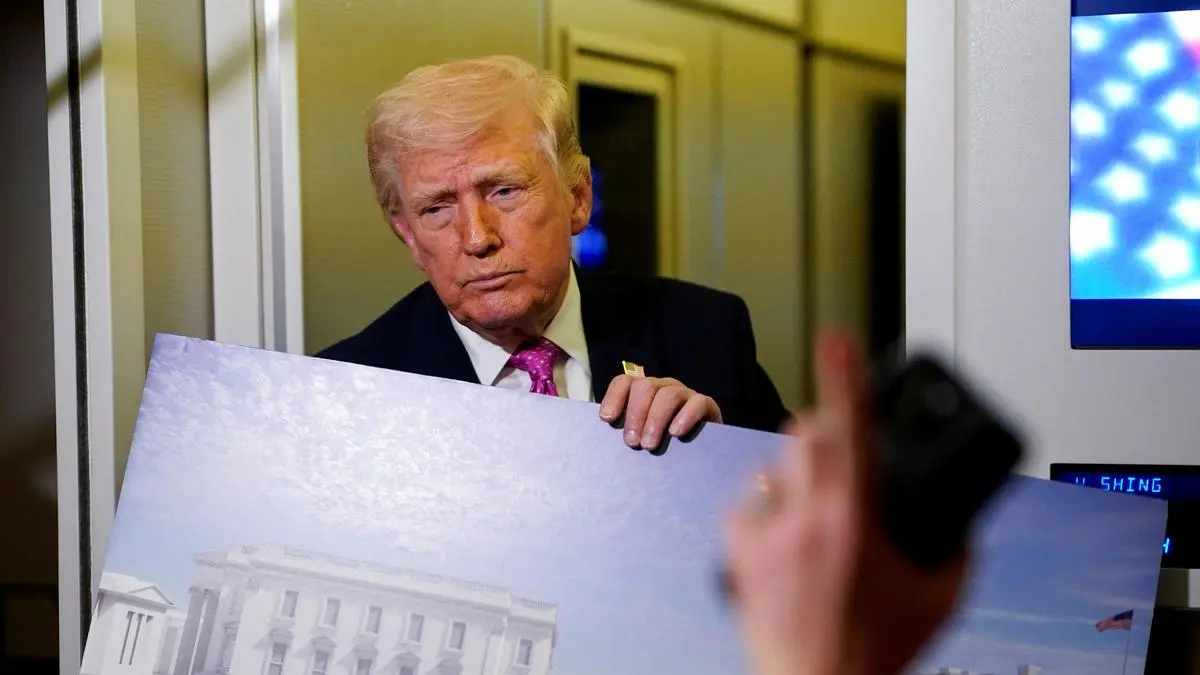
Thousands of miles away, in a climate-controlled room smelling of stale coffee and expensive wool, Donald Trump is speaking. The timing is not accidental. Geopolitics is rarely about the "what" and almost always about the "when."
Trump’s rhetoric has shifted. The man who once spoke of "fire and fury" is now leaning into the language of the weary. He talks of winding down the Mideast war, of bringing "peace through strength," and of the fundamental exhaustion of the American taxpayer. To the families in the bomb shelters, these words feel like oxygen and ash simultaneously.
There is a profound disconnect between the geopolitical chess move and the human casualty. While the former President frames the conflict as a mess to be cleaned up, the people on the ground see it as a house on fire. You don't "wind down" a house on fire. You either put it out or you watch it burn to the foundations.
The irony is thick enough to choke on. Just as the American political machine gears up to promise an exit from the "forever wars," the wars themselves are evolving into something more intense, more direct, and far more unpredictable. It is a collision of two different realities: the televised world of campaign promises and the charred reality of the Negev desert.
The Invisible Stakes
We often talk about these events in terms of "escalation ladders." It’s a clean, academic term. It suggests a structured climb, one rung at a time, where leaders can choose to stop.
But talk to Sarah, an Israeli grandmother who remembers 1967 and 1973. She will tell you that it feels less like a ladder and more like a landslide. When the missiles are in the air, the "invisible stakes" become visible. It’s the price of oil. It’s the stability of the Jordanian monarchy. It’s the silent, terrifying question of whether the next strike will be the one that triggers a regional dark age.
The Gulf neighbors—Saudi Arabia, the UAE, Qatar—are watching the horizon with a specific kind of dread. For them, stability is the currency of the future. They have built gleaming cities of glass and steel on the promise that the old animosities could be contained. Every flash in the night sky over the Red Sea is a crack in that glass. They are caught in the middle of a titanic struggle between a revolutionary power in Tehran and a defiant state in Jerusalem, all while their traditional protector in Washington debates the merits of isolationism.
Consider the math of a single interception. An Arrow 3 interceptor costs millions of dollars. The missile it destroys might cost a fraction of that. It is an economic war of attrition played out in the stratosphere.
$$Cost_{Defense} \gg Cost_{Offense}$$
This simple inequality is the nightmare of every defense minister in the region. You cannot win a war of math if the other side has more "math" than you have "money."
The Silence After the Boom
There is a specific kind of silence that follows a missile strike. It isn't the absence of noise; it's the presence of shock. It’s the sound of car alarms fading out and the smell of ozone and dust.
In the shelters, the children start to ask if it’s over. The adults check their phones, looking for a signal, looking for a sign that the world hasn't tilted off its axis. They find videos of orange glows over the Temple Mount and the suburbs of Tel Aviv. They see the frantic updates from Washington, Moscow, and London.
The human element is often lost in the "breaking news" banners. We see the maps and the troop movements, but we don't see the trembling hands of a baker in Isfahan who wonders if the retaliatory strike will hit his street. We don't see the Lebanese student who just wanted to finish a degree but now watches the horizon for the tell-tale signature of a fighter jet.
The conflict has become a spectator sport for the rest of the world, filtered through X feeds and cable news pundits. But for the millions living under the flight paths, it is a lived trauma that rewires the brain. It turns the sound of a motorcycle backfiring into a heart attack. It turns a clear blue sky into a source of anxiety.
The Illusion of Control
Western leaders often speak as if they hold the steering wheel of history. They issue "stern warnings" and "call for restraint." They behave as though the Middle East is a thermostat they can adjust.
Tonight proves the thermostat is broken.
The Iranian leadership has calculated that the risk of a direct confrontation is now preferable to the slow strangulation of their proxies. Israel has decided that "containment" is a failed policy that only leads to larger disasters. These are two high-speed trains on a single track, and the passengers—the civilians, the neighbors, the bystanders—are just beginning to realize there are no brakes.
Trump’s talk of winding down the war is a seductive melody for a tired American public. It promises an end to the complexity. It suggests that if we just stop looking, the problem will go away. But the missiles over Israel and the tension in the Gulf suggest otherwise. The world is too small for isolation to be anything other than a fantasy.
A missile fired from a mobile launcher in the Iranian desert has a ripple effect that touches a gas station in Ohio, a shipping lane in the Bab el-Mandeb, and the sleep of a child in a basement in Haifa. We are connected by the very weapons designed to tear us apart.
Elias eventually walks back up the stairs. His daughter is asleep in his arms, her head heavy against his shoulder. She didn't wake up for the explosions. He wonders how many more nights like this he can tell her were just "thunder." He looks out the window at the skyline. The smoke is rising, black against the deep purple of the pre-dawn sky.
The sirens have stopped, but the air still feels electric, charged with the terrifying knowledge that the rules have changed. The sky is no longer just the sky; it is a ceiling that could collapse at any moment, and no amount of political theater can change the fact that we are all living under it.