Commercial haunted houses charge forty bucks a head to rush you through a dark warehouse while teenagers in cheap rubber masks scream in your face. You wait in a freezing line for two hours, get shoved through a plywood maze in seven minutes flat, and leave feeling like you just paid for a bad cardio workout.
Then there's Nightmare on Moore Street in East Boston.
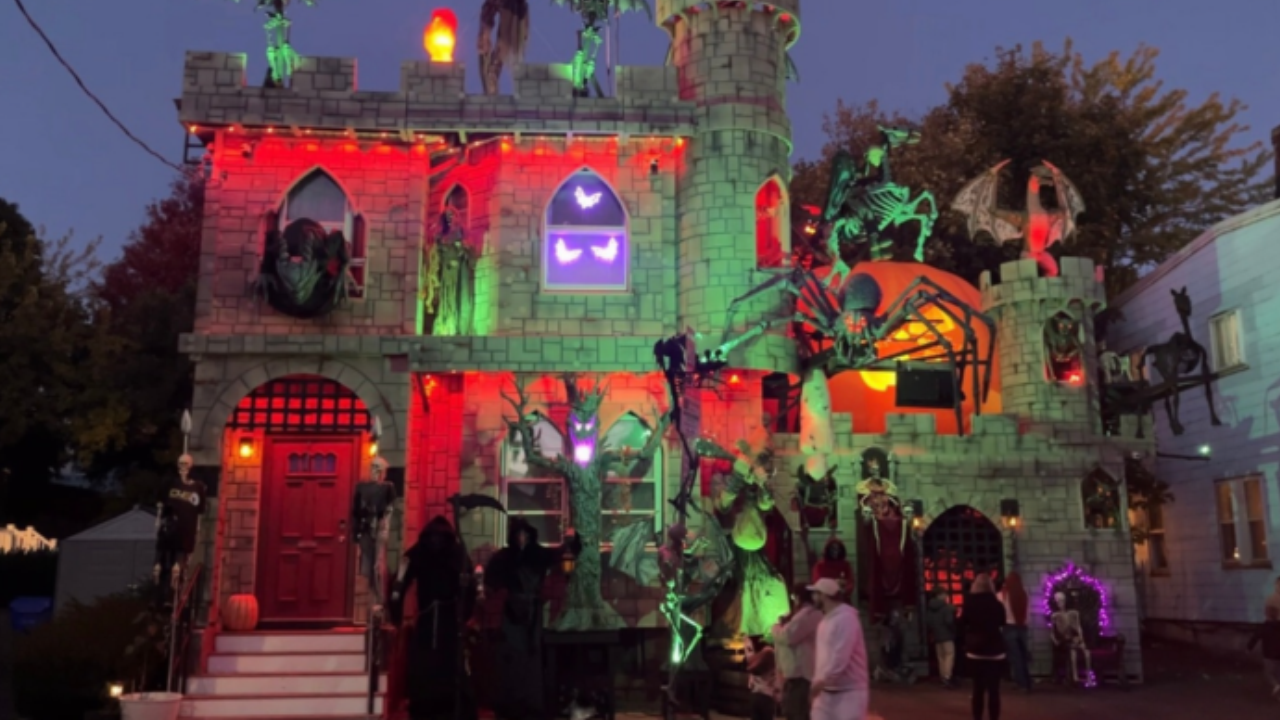
Every October, a local couple transforms their residential property into a towering, Gothic Dracula castle—and they don't charge a single dime to walk through it. Crowds don't just show up once out of novelty; families, horror diehards, and curious commuters return year after year because this grassroots spectacle achieves something multi-million-dollar theme park attractions routinely miss. It has soul.
What Actually Happens at Nightmare on Moore Street
If you've never been to East Boston in late October, the sheer scale of a residential home haunt can catch you completely off guard. Unlike standard neighborhood Halloween displays that rely on a few inflatable pumpkins and a store-bought fog machine, the Moore Street setup operates like an independent theater production built directly onto a city lot.
The centerpiece is a massive, custom-built Dracula castle facade that swallows the front of the property. We're talking Gothic arches, weathered stone textures, towering spires, and intricate theatrical lighting that turns an ordinary residential block into a slice of Transylvania. Visitors don't just stand on the sidewalk snapping photos from behind a velvet rope. They line up down the block to actually enter the structure, moving through detailed, multi-room scenes populated by live actors, animatronics, and atmospheric sound design.
Here's the kicker. The entire experience is free.
In an era where seasonal entertainment has become aggressively monetized—where even local pumpkin patches charge admission fees just to look at gourds—keeping a high-production haunt completely free changes the entire dynamic of the crowd. Nobody is standing in line complaining about whether they're getting their money's worth. Instead, the vibe on Moore Street feels like a massive neighborhood block party filtered through a classic Universal Monsters movie.
Why Grassroots Home Haunts Outshine Big-Budget Attractions
I've walked through dozens of professional haunted attractions across New England, from massive scream parks in New Hampshire to historic prison tours in Pennsylvania. Big-budget haunts have massive lighting rigs, Hollywood prosthetic artists, and strict fire-marshal throughput quotas. That last part is what kills the magic.
Commercial haunts operate on a conveyor-belt business model. To turn a profit on a short six-week season, operators have to push thousands of paying customers through the doors every night. Security guards bark at you to keep moving. Actors barely have time to finish a line of dialogue before the next group bumps into your heels. You see the scares happen to the people ten feet ahead of you, which ruins every single jump before you even turn the corner.
Home haunters don't answer to investors or throughput spreadsheets. When a couple builds a Dracula castle in their East Boston yard, their only metric for success is the reaction on a visitor's face.
Because they aren't trying to maximize ticket revenue per hour, they can pace the experience properly. You actually get to look at the set dressing. You notice the hand-painted details on the faux stonework, the period-appropriate props tucked into dusty corners, and the subtle lighting cues that build dread rather than relying on deafening air horns. It's the difference between a fast-food drive-thru and a meal someone spent all weekend cooking from scratch.
The East Boston Community Factor
East Boston has a tight-knit, fiercely proud neighborhood identity that shapes how events like Nightmare on Moore Street survive and grow. Pulling off a large-scale public attraction on a residential street isn't easy. You're dealing with dense urban parking, narrow sidewalks, foot traffic spilling onto neighboring stoops, and strict city noise ordinances.
A display of this size only lasts for years if the surrounding block buys into it. Neighbors have to tolerate lines of excited kids and costumed adults winding past their front steps every evening in late October. Local parents treat it as an annual milestone, bringing their toddlers for early-evening walkthroughs before the scare actors ramp up the intensity after dark.
That intergenerational buy-in is rare. Most commercial haunts target teenagers and twenty-somethings looking for an adrenaline rush. By keeping the castle accessible and rooted in the neighborhood, the creators turned a personal Halloween obsession into an unofficial East Boston civic tradition.
The Hidden Engineering Behind a Backyard Dracula Castle
People walk past a towering castle facade and assume it's just painted cardboard or flimsy foam board. Anyone who has actually built outdoor scenic structures in New England knows better. Boston weather in October is unpredictable, brutal, and completely unforgiving to amateur construction.
Coastal winds whipping off Boston Harbor will tear poorly anchored scenery apart in minutes. Heavy autumn rain turns untreated wood into warped, soggy junk, while early cold snaps wreak havoc on standard pneumatic props and cheap fog fluids. Building a multi-story castle exterior that can survive weeks of coastal weather requires real structural planning.
- Modular framing systems: Experienced home haunters build large facades in interlocking wall sections using standard dimensional lumber, allowing the entire castle to be bolted together in October and flat-packed into storage come November.
- Weatherproof scenic coatings: Exposed foam and plywood get sealed with exterior-grade primers, drylock masonry paint, or fiberglass resins so rain beads off instead of soaking into the structural core.
- Weighted ballast over stakes: On urban lots with concrete, pavers, or shallow utility lines, massive vertical flats rely on sandbags, water barrels, and internal bracing rather than ground stakes to handle high wind gusts.
- Low-voltage lighting design: Running theatrical effects off standard household circuits means swapping high-draw halogen stage lights for efficient LED floodlights and DMX-controlled pixel strips so you don't trip the main breaker mid-show.
Storage is the silent killer of most ambitious home haunts. Where do you put a twenty-foot castle for the other eleven months of the year? Every square foot of scenery built for October has to fit inside a basement, a garage, or a rented storage unit by Thanksgiving. That constraint forces builders to become ruthless problem-solvers, designing hinged towers and collapsible archways that look monumental on Halloween night but stack like dominoes in a shed.
Common Misconceptions About Free Neighborhood Haunts
Whenever a local attraction draws massive crowds without charging admission, outsiders tend to make a few bad assumptions about how it works.
The biggest myth is that free haunts are safe from liability or city oversight because they aren't commercial businesses. Wrong. The moment you invite the public onto your property—whether you charge a penny or not—you're dealing with municipal inspectional services, fire safety codes, and homeowner insurance realities. Emergency exits have to remain unobstructed. Extension cords can't create trip hazards across public sidewalks. Flame-retardant treatments on fabrics and scenery aren't optional if an inspector walks through before opening night.
Another misconception is that "free" means "low budget." Home haunters routinely sink thousands of dollars of their own money into lumber, latex masks, animatronic controllers, and theatrical fog machines. While some neighborhood haunts put out a voluntary donation box for a local charity or food bank to offset goodwill, the core construction costs almost always come straight out of the builders' personal bank accounts. They do it because the craft itself is the addiction.
How to Visit Nightmare on Moore Street Without the Hassle
If you're planning to make the trip to East Boston this October, don't treat it like a casual drive-by. Showing up unprepared at 8:30 PM on Halloween night is a guaranteed way to spend half your evening circling residential blocks looking for a parking spot that doesn't exist.
Ditch the car and take the T. East Boston is notoriously tough for street parking even on a quiet Tuesday, and resident-only permit zones are strictly enforced. Take the MBTA Blue Line to Wood Island or Airport Station and walk over. You'll save yourself thirty minutes of frustration and skip the traffic bottleneck entirely.
Time your arrival around your scare tolerance. Like most great neighborhood haunts, the atmosphere shifts dramatically as the sun goes down. If you're bringing young kids or people who appreciate theatrical set design more than sudden jump scares, arrive right around dusk when the lights first kick on. If you want the full, high-intensity Dracula experience with live actors working the shadows, wait until full dark—just expect longer lines on Friday and Saturday nights.
Respect the block. Remember that you're standing in a real residential neighborhood, not a theme park parking lot. Keep voices down while waiting in line, don't block neighbors' driveways or front steps, and pack out any trash or coffee cups you bring with you. Grassroots traditions like Moore Street only survive as long as the surrounding residents feel respected by the crowds.
Start Building Your Own Neighborhood Tradition
You don't need an East Boston lot or a full Dracula castle to pull off something memorable on your own street this fall. Most iconic home haunts started with a single plywood tombstone, one decent fog machine, and a homeowner willing to sit outside in costume instead of leaving a bowl of candy on the porch. Pick one focal point for your yard—a lit archway, a costumed mannequin hidden in the bushes, or a directional audio speaker playing subtle ambient thunder—and execute that single element cleanly. Once you see the first group of kids freeze on the sidewalk trying to figure out if a prop is real, you'll understand exactly why the couple on Moore Street keeps building that castle every single year.