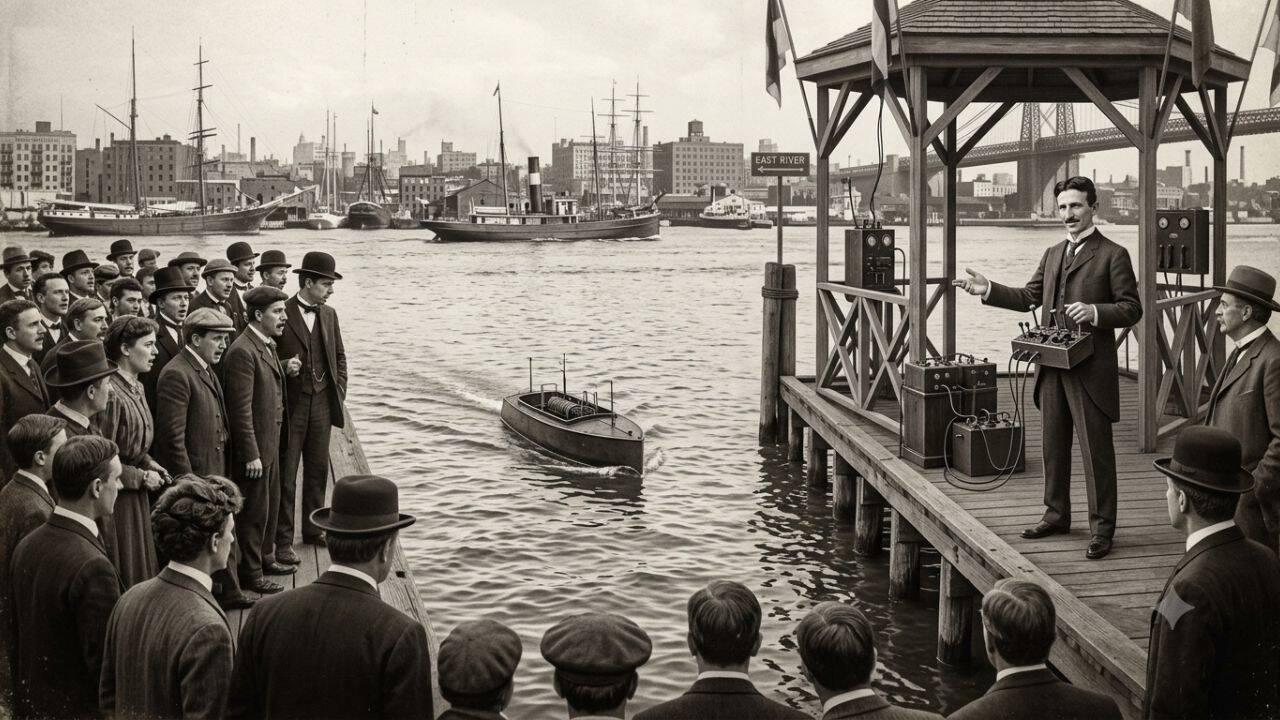
Crowds gathered inside Madison Square Garden in 1898 expecting normal electrical novelties, but they got a glimpse of the future instead. Nikola Tesla stood before a specially built indoor pool holding a small box with a telegraph key and a single lever. Floating in the water was a four-foot steel boat with a whip-like antenna. Without a single physical wire connecting him to the vessel, Tesla commanded it to start, stop, reverse, and turn. Spectators whispered about telepathy, hidden accomplices, and magic.
It wasn't magic. It was the birth of wireless remote control.
The Machine Behind the Spectacle
Tesla called his invention the "telautomaton". To understand why it baffled New York, you have to look at what was happening inside that iron-hulled model. Radio technology as we know it didn't even have a formal patent yet. Tesla packed the hull with heavy storage batteries, an electric motor for the propeller, and a steering mechanism.
The clever part was his custom coherer—a small cylinder filled with metal oxide powder. When radio waves hit the antenna from Tesla's hand-held box, the powder clumped together and became conductive. This closed an electrical circuit, triggered a tiny relay, and stepped a contact disk forward to adjust the rudder or motor. A mechanical tap would then reset the powder back to its loose state.
You're looking at an early ancestor of modern logic gates and robotics. Tesla built a machine that could listen to invisible signals and make physical choices based on them.
Why the Military Rejected the Future
Tesla didn't build the boat as a toy. He pitched it directly to the United States military as a weaponized defense system.
He envisioned radio-guided torpedoes that could protect harbors without risking human lives. Imagine steering an explosive charge straight into an enemy ironclad from miles away. Naval officers watched the demonstration in Madison Square Garden and completely missed the point. They thought the craft looked too fragile for open ocean combat. They assumed an enemy could easily shatter it with a single cannon shot, ignoring the fact that the human operator would be miles away out of harm's way.
Frustrated by bureaucratic shortsightedness, Tesla moved on to other obsessions like global wireless power. He couldn't sell the military on remote control because the brass wanted brute steel and thick armor, not invisible electromagnetic waves.
The Real Impact of the Telautomaton
It took decades for the rest of the world to catch up to what happened in that New York exhibition hall. By the time World War I rolled around, militaries finally started experimenting with remotely guided explosives. Today, you hold Tesla's ghost boat in your hand every time you unlock your car doors with a key fob, fly a drone, or operate a robotic arm on Mars.
Tesla solved the problem of distance before anyone else even realized distance was a barrier worth breaking. Stop thinking of him as just a mad scientist who played with lightning. He was a systems architect who mapped out the invisible grid we live on today.
Next time you use a wireless controller, remember the indoor pool at Madison Square Garden and the baffled New Yorkers who thought they were watching sorcery.
How did Nikola Tesla invent remote control boat
This video provides a visual breakdown of how Nikola Tesla's pioneering remote-control boat operated during its 1898 debut.
http://googleusercontent.com/youtube_content/1