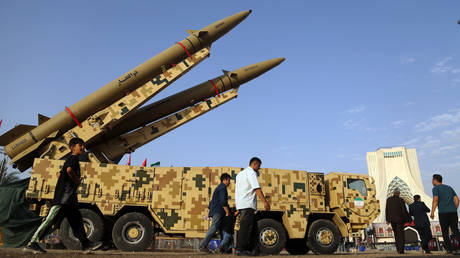
The headlines are running hot with the same lazy narrative. Defense desks in Tel Aviv are reportedly stunned, caught completely flat-footed by how fast Iran bounced back from thirty thousand joint strikes. Analysts are writing breathless columns about resilient missile footprints, hidden tunnel entrances near Dezful, and underground assembly lines spinning up faster than expected.
Stop buying the theater. Nobody with a basic grasp of modern industrial economics and military history should be surprised by this output.
The lazy consensus says that dropping thousands of precision munitions on a sovereign state's defense sector permanently breaks its spine. It treats a nation-state like a commercial airliner hitting a mountain. But countries under decades of heavy sanctions do not operate like consumer economies. They operate like distributed survivalist compounds.
The Fallacy of the Permanent Setback
Every time an air campaign concludes, intelligence boards pull out satellite imagery, point at leveled concrete buildings, and declare a multi-year delay on enemy production. It happened after the limited exchanges in late 2024. It happened again after the June 2025 strikes. And it is happening right now, four months after the main phase of the 2026 conflict.
Intelligence agencies confuse flattening a factory with erasing an engineering curriculum.
I have watched defense contractors blow millions chasing flashy perimeter damage while ignoring the core architecture of redundant manufacturing. When you bomb a visible assembly plant, you destroy sheet metal and expensive machinery. You do not destroy the blueprint, the metallurgical formulas, or the workforce's institutional memory.
Iran's missile program is not a centralized Detroit assembly line. It is a modular, decentralized web of machine shops, university labs, and subterranean maintenance nodes.
Decentralization Beats Massed Airpower
Let us look at the mechanics of what the military establishment misses. Imagine a scenario where a corporate supply chain loses its main distribution hub to a fire. A traditional firm takes a year to rebuild the single warehouse. But a decentralized operation simply shifts production to fifty regional garages overnight.
Tehran treats military hardware the way guerrilla tech networks treat software code. They rely on commercial-off-the-shelf components, simple metalworking, and redundant regional workshops that can turn out rocket bodies using basic industrial tooling.
"You can blow up a factory, and have pictures and video that look great for the newsreels. But then people go back and fix the facility, and it's working well enough within a month or so." — Defense Analyst Consensus
When you look at the numbers cited by regional reporting, the baseline math tells the real story. Despite thousands of targets struck and billions in damage, the ballistic inventory climbs back because the constraint was never concrete walls. The constraint is willpower and resource allocation. By channeling every available scrap of industrial capacity into a single high-priority vector—ballistic missiles—the regime can afford to let civilian infrastructure rot while keeping the production line humming.
The Intelligence Failure is Strategic, Not Tactical
The real shock here is not that Iran rebuilt. The shock is that military planners still believe air campaigns can achieve strategic annihilation without total ground occupation.
We saw this playbook fail in the twentieth century. Strategic bombing surveys proved decades ago that flattening industrial centers often hardens a population's resolve and forces efficient adaptations. Yet, modern defense apparatuses cling to the delusion that dropping heavy ordnance solves structural geopolitical problems.
If your entire strategic framework relies on the assumption that an adversary will stay down after a beating, your framework is broken. Tehran's rapid turnaround is proof that economic isolation creates antibodies. Decades of sanctions forced Iran to build a self-reliant domestic supply chain for military hardware long before the first modern missile exchange occurred.
Stop looking at the smoking craters in satellite photos and start looking at the blueprints that survived in the filing cabinets.
The next confrontation will not be decided by how many concrete roofs you can collapse. It will be decided by the realization that you cannot bomb an idea out of a country that learned how to build it in the dark.