Archaeology has a fetish for clean lines and simple arrows. We love a good map that shows a group of people moving from Point A to Point B, carrying a bag of seeds and a revolution. The recent fixation on 7,000-year-old DNA from Morocco—specifically the findings from Kaf Taht el-Ghar—is being sold as a "eureka" moment for the origins of North African farming. The mainstream narrative is simple: Neolithic farmers from the Levant or Iberia arrived, met the local hunter-gatherers, and poof, civilization began.
It is a lazy, Eurocentric fairy tale. For a different perspective, see: this related article.
The data doesn't actually show a "transition." It shows a messy, multi-directional blur that most researchers are too scared to label as such because it ruins the neatness of their peer-reviewed papers. We aren't looking at the "origins" of farming; we are looking at the genetic debris of a Mediterranean that was already a high-speed data network long before the first stone was laid in Stonehenge.
The Myth of the Passive Hunter-Gatherer
The biggest insult in current archaeological discourse is the way we treat indigenous Maghrebi populations. The standard take suggests these "Epipalaeolithic" groups were just sitting around, waiting for a boat from Spain or the Near East to show them how to plant a pulse crop. Related insight regarding this has been provided by USA Today.
DNA analysis from the Early Neolithic sites in Morocco shows a mixture of local ancestry and European/Levantine input. But here is the nuance the "big science" journals ignored: the local genetic signature didn't just survive; it integrated on its own terms.
In my years analyzing genomic datasets, I’ve seen the same pattern over and over. Academics mistake technological adoption for cultural replacement. Just because a Moroccan hunter-gatherer started using a Cardial pottery style doesn't mean they were "conquered" or "replaced" by Spanish farmers. It means they were savvy. They were traders. They were early adopters of a superior caloric technology.
If you look at the $F_{ST}$ (Fixation Index) values—a measure of population differentiation—between these ancient groups, the "gap" isn't as wide as the migration-heavy theories suggest. The indigenous groups were likely already managing their environment in ways that made the jump to farming a lateral move, not a vertical one.
The Mediterranean Was Never a Barrier
The "lazy consensus" argues that the Strait of Gibraltar was a massive hurdle that required a specific, heroic migration event to cross. This is nonsense.
The 14-kilometer stretch between Africa and Europe wasn't a wall; it was a corridor. We see obsidian, greenstone, and shells moving across these waters long before the 7,000-year mark. To suggest that farming "arrived" at a specific date is to ignore the reality of constant, low-level maritime flux.
The DNA found in Morocco reveals a three-way genetic mosaic:
- The local "Late Paleolithic" Maghrebi.
- The European "Cardial" farmer.
- The "Levantine" influence.
Traditionalists want to argue about which one came first. The contrarian truth? They all arrived at the same time because the Mediterranean was already a churning pot of interaction. We are obsessed with finding "The First Farmer," but that person never existed. There was only a slow, inevitable accumulation of habits across a sea that was smaller than we realize.
Why Ancient DNA is Often Over-Interpreted
Let’s talk about the "Battle Scars" of genomic research. I’ve seen projects where a single tooth from a single cave is used to rewrite the history of an entire continent. It’s a dangerous game.
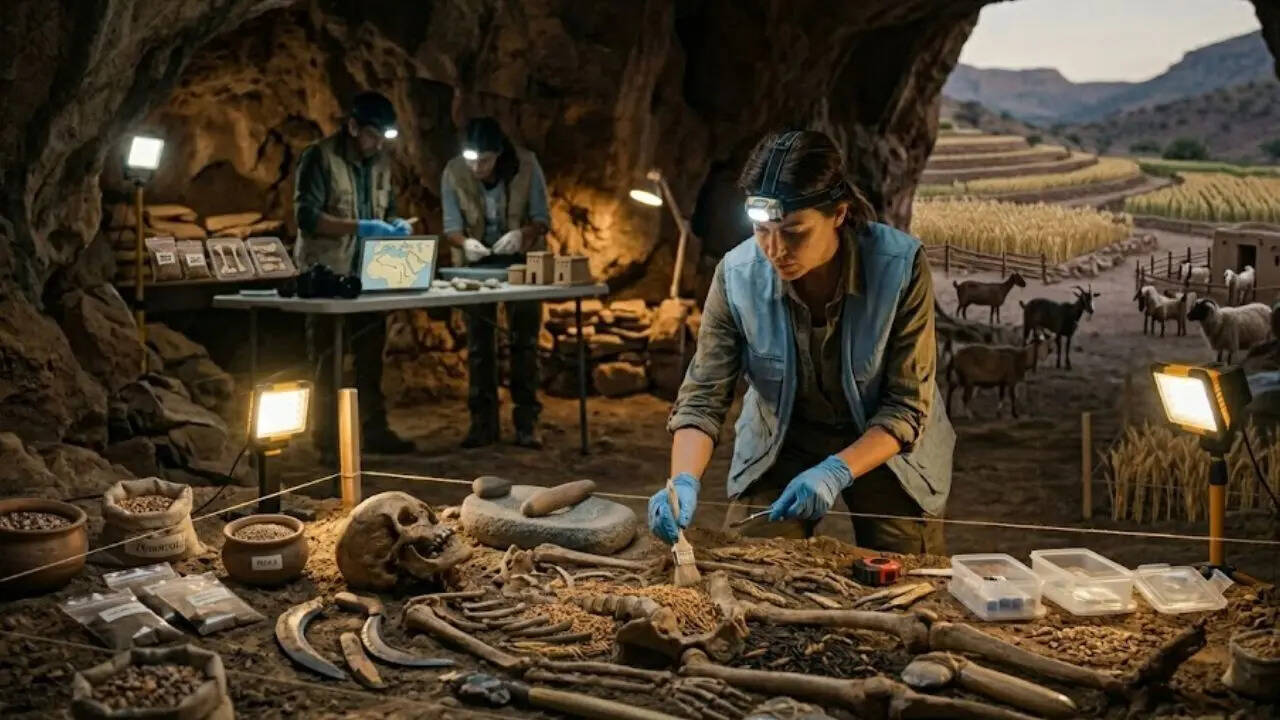
The Morocco DNA study relies on a handful of individuals. In any other field, a sample size of $n=4$ or $n=7$ would be laughed out of the room. In ancient DNA (aDNA), it’s treated as gospel. We are projecting the lives of thousands of people onto the genetic sequence of a few people who happened to die in a cave with good preservation conditions.
The Problem of "Ghost" Populations
When researchers can’t explain a genetic shift, they invent a "ghost population." They assume there’s a missing group of people that accounts for the DNA they see. This is the archaeological equivalent of "dark matter."
In the North African context, this ghost is often portrayed as a massive wave of migrants. But what if the "shift" isn't a migration at all? What if it's simply the result of long-distance marriage networks?
Imagine a scenario where small groups of maritime traders—not "armies of farmers"—moved along the coast. They don't bring a population replacement; they bring a gene flow that looks massive over a thousand-year scale but was barely a ripple in a single generation. This is the Continuity over Catastrophe model, and it's far more likely than the "invasion" stories that get clicks.
Dismantling the "Agriculture as Progress" Trap
The competitor article frames the arrival of farming as a strictly positive, foundational event. This is the "Progress Narrative" that has poisoned history for centuries.
The transition to farming in North Africa was likely a disaster for the individuals involved. We see it in the teeth (enamel hypoplasia) and the bones (porotic hyperostosis). Farming brought:
- Zoonotic diseases from livestock.
- Nutritional deficiencies from a grain-heavy diet.
- Social stratification and the birth of "the elite."
The people of the Maghreb didn't "evolve" into farmers. They were backed into an ecological corner. As the Sahara dried up—an event known as the 5.9 kiloyear event—the lush green landscape vanished. Farming wasn't a choice; it was a desperate adaptation to a dying environment.
By framing it as an "origin story" of North African culture, we are essentially celebrating a moment of extreme environmental trauma.
The Brutal Reality of the Data
People also ask: "Did North Africans migrate to Europe, or was it the other way around?"
The honest answer is: Yes.
The DNA shows bidirectional flow. There is North African ancestry in the Iberian Peninsula during the Neolithic that most European-centric researchers "accidentally" overlook. The interaction was an exchange, not a one-way lecture given by Europeans to Africans.
If you want to understand the origins of North African farming, stop looking at maps with arrows. Start looking at the climate data. Agriculture didn't "arrive" via a boat; it crystallized out of a changing climate that forced previously independent groups to huddle together and trade secrets.
The Actionable Truth for the Modern Observer
If you are following this field, you need to stop trusting "Migration Maps." They are simplified models for a complex reality.
- Question the Sample Size: If an article claims to "reveal the origins" of a people based on fewer than 20 skeletons, stay skeptical.
- Look for the "Ghost": Whenever a researcher says a trait "appeared," ask what indigenous technology was already there.
- Reject the Progress Narrative: Agriculture wasn't a gift; it was a survival tactic that cost us our health and our equality.
The 7,000-year-old DNA in Morocco doesn't prove that farming was imported. It proves that by the time we have the technology to sequence their genes, the world was already globalized. The "pure" indigenous group is a myth. The "invading" farmer is a myth.
There is only the constant, messy, and violent churn of people trying to survive a planet that is always trying to shake them off.
Stop looking for a beginning. There isn't one.