Diplomacy rarely announces its shifts with a single dramatic explosion. Sometimes, it looks like a tightly choreographed reception line in Pyongyang, where ten foreign delegations walk across a crimson carpet while the United States isn't even on the guest list.
Reports framing this moment as a direct snub to Donald Trump capture the surface-level drama, sure. Yet looking closely at how Kim Jong Un has restructured North Korea's foreign policy reveals something far more calculated than a personal slight. Pyongyang isn't just ignoring Washington's overtures or waiting around for another bilateral summit. It is actively building an alternative diplomatic circuit that makes American approval irrelevant to its immediate survival.
When you track the history of U.S.-North Korea relations, the pattern becomes obvious. Years of stalled nuclear talks, maximum pressure sanctions, and dramatic photo-ops in Hanoi and Panmunjom ultimately left North Korea without the sanctions relief it demanded. Instead of returning to the negotiating table on Western terms, Kim Jong Un pivoted toward nations that either oppose American hegemony or prioritize pragmatic trade over denuclearization preconditions.
What Actually Happened With The Ten Nations In Pyongyang
To understand why Western media outlets framed the event as a snub to Trump, you have to look at the optics. North Korean state media, specifically the Korean Central News Agency, routinely broadcasts high-profile diplomatic receptions to project legitimacy at home and defiance abroad. When Pyongyang rolls out the red carpet for delegations from ten countries—typically spanning traditional allies, non-aligned states, and nations deepening bilateral ties with the regime—it sends a clear visual message. North Korea is not isolated.
For years, the core premise of U.S. foreign policy toward the Korean Peninsula rested on diplomatic and economic quarantine. The logic seemed straightforward enough. Cut Pyongyang off from global capital, restrict its access to diplomatic forums, and eventually the regime will have no choice but to trade its nuclear arsenal for survival.
That assumption broke down.
By hosting representatives from ten nations while freezing out Washington, Pyongyang demonstrated that its diplomatic dance card is full. Whether those delegations represent major powers like Russia and China or smaller nations across Asia, Africa, and Latin America looking for diplomatic leverage or niche trade agreements, the collective presence undermines the narrative of a hermit kingdom begging for American attention.
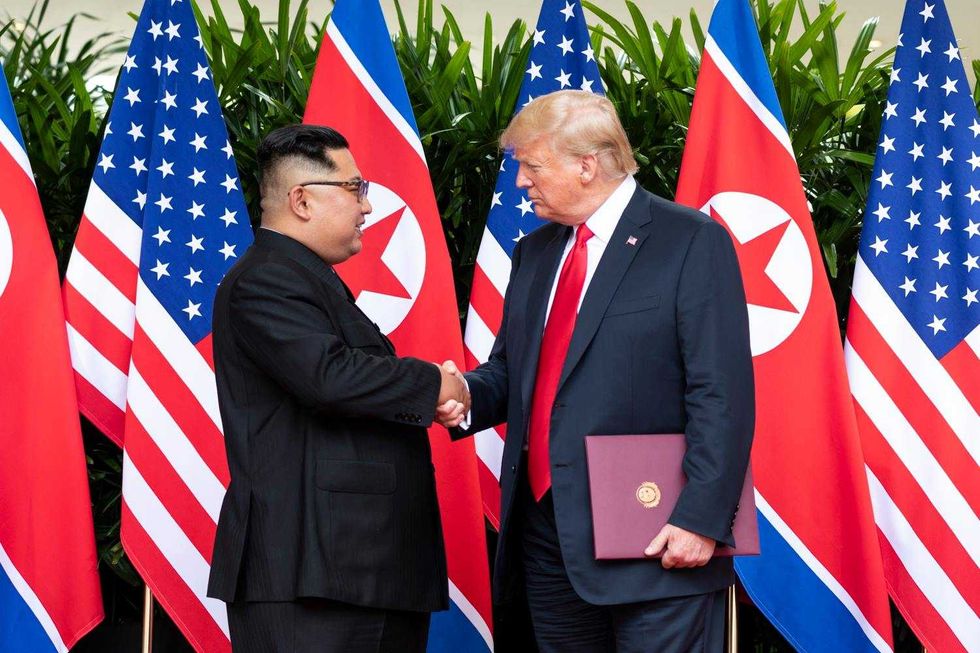
Trump has frequently pointed to his past personal rapport with Kim Jong Un as a unique asset that could restart talks where other administrations failed. He has suggested on numerous occasions that getting along with Kim was a good thing and hinted that personal diplomacy could yield results. Pyongyang's cold shoulder complicates that narrative. You can't rely on personal chemistry when the other party refuses to pick up the phone and is busy hosting ten other guests in the parlor.
Why Pyongyang Stopped Waiting For Washington
If you've followed Korean Peninsula politics for any length of time, you know that North Korea treats every diplomatic move as a transactional calculation. Nothing happens by accident in Pyongyang. The decision to sideline the United States while embracing a coalition of friendly or neutral nations stems from three concrete shifts in global politics.
First, the geopolitical landscape shifted dramatically following Russia's invasion of Ukraine. Before that conflict, Moscow largely went along with United Nations Security Council sanctions against North Korea, even if enforcement at the border was sometimes porous. Once Russia needed artillery shells, ballistic missiles, and diplomatic backing, that dynamic flipped overnight. Suddenly, Pyongyang had a permanent member of the UN Security Council willing to veto new sanctions resolutions and dismantle the UN panel monitoring sanctions violations.
When you have Moscow providing fuel, food, technological assistance, and diplomatic cover, what can Washington realistically offer? Very little, especially when American offers always come attached to the non-starter demand of complete, verifiable, and irreversible denuclearization.
Second, China remains North Korea's economic lifeline. Despite occasional friction between Beijing and Pyongyang, China has zero interest in seeing the North Korean regime collapse and create a U.S.-allied unified Korea right on its border. As U.S.-China competition intensified across trade, technology, and security in the Indo-Pacific, Beijing grew even less inclined to help Washington solve its North Korea problem.
Third, Kim Jong Un learned a hard lesson from the 2019 Hanoi summit. Going into that meeting with Trump, Pyongyang believed it could trade partial dismantling of its Yongbyon nuclear complex for major sanctions relief. When Trump walked away demanding a much broader concession, Kim returned home empty-handed after taking a multi-day train ride across China. In North Korean political culture, where the supreme leader is portrayed as infallible, that kind of public setback leaves a mark. Kim isn't going to risk another high-stakes gamble with an American president unless the payoff is guaranteed upfront.
The Myth Of Personal Diplomacy In Nuclear Negotiations
A common misconception in American political commentary is that foreign policy deadlocks can be solved simply by putting two strong leaders in a room together. Trump leaned heavily into this idea during his first term, exchanging letters with Kim and stepping across the Military Demarcation Line at Panmunjom. Critics called it theater, while supporters argued it lowered tensions on the peninsula after the "fire and fury" rhetoric of 2017.
Both perspectives miss the structural reality of North Korea's state ideology.
For the Kim family, nuclear weapons aren't bargaining chips meant to be cashed in for McDonald's franchises or foreign investment. They are the ultimate insurance policy against regime change. North Korean officials constantly cite the fates of Muammar Gaddafi in Libya and Saddam Hussein in Iraq—leaders who gave up or lacked nuclear programs and were subsequently toppled with Western military intervention.
Here's what most people miss when they read headlines about Kim snubbing Trump:
- Domestic legitimacy comes first. Every diplomatic reception in Pyongyang is filmed primarily for domestic consumption. Showing foreign dignitaries bowing to Kim Jong Un reinforces his status as a respected global statesman to his own population and military elite.
- Multipolarity works in Pyongyang's favor. As global power fractures between Washington, Beijing, and Moscow, smaller authoritarian states gain room to maneuver. North Korea doesn't need a peace treaty with the U.S. if it has defense pacts and trade corridors with its neighbors.
- Time is on Pyongyang's side. Every month that passes without talks is another month North Korea spends refining its solid-fuel intercontinental ballistic missiles, tactical nuclear warheads, and reconnaissance satellites.
When Trump speaks warmly about Kim, North Korean state media occasionally acknowledges the remarks, usually to remind Washington that personal feelings don't erase hostile U.S. policies. By rolling out the red carpet for ten other nations, Pyongyang is basically telling Washington that the price of admission to Korean diplomacy has gone up.
How The Ten-Nation Strategy Undermines Sanctions
Sanctions only work when the international community enforces them uniformly. The moment a significant bloc of nations decides to ignore or work around financial and trade restrictions, the entire architecture starts leaking.
North Korea has spent decades perfecting sanctions evasion through shell companies, ship-to-ship oil transfers, cyber theft, and overseas labor networks. Hosting delegations from ten countries signals an effort to formalize and expand those relationships out in the open.
Consider what these delegations actually represent. While Western analysts naturally focus on Russia and China, North Korea maintains historical ties with several nations in Southeast Asia, Africa, and Latin America—relationships dating back to the Cold War and the Non-Aligned Movement. Some of these countries maintain embassies in Pyongyang, engage in cultural or educational exchanges, or look the other way when North Korean workers or trading companies operate within their borders.
Even symbolic diplomatic visits carry weight. When a foreign minister or parliamentary delegation visits Pyongyang, signs a bilateral cooperation agreement, and poses for photos in front of monumental statues, it chips away at the narrative that North Korea is a global pariah. It tells other developing nations that engaging with Pyongyang carries minimal diplomatic penalty from Washington, especially when the U.S. is distracted by conflicts in Eastern Europe and the Middle East.
Honestly, Washington's sanctions toolkit has hit diminishing returns. You can't sanction a country that is already disconnected from the Western banking system and now gets its essential imports overland from Russia and China.
What Experts And Think Tanks Are Saying
Foreign policy analysts across Washington, Seoul, and Tokyo have been sounding the alarm over this exact dynamic. Researchers at institutions like the Center for Strategic and International Studies (CSIS) and the Stimson Center's 38 North project have documented the rapid expansion of rail traffic between North Korea and Russia, alongside the steady modernization of North Korean missile testing facilities.
Victor Cha, a former White House official and Korea chair at CSIS, has pointed out in multiple analyses that North Korea's alignment with Russia fundamentally alters the deterrence equation in Northeast Asia. Instead of an isolated rogue state acting alone, Pyongyang now operates as part of a looser network of revisionist powers willing to share resources and diplomatic cover.
Meanwhile, analysts at the Carnegie Endowment for International Peace have noted that North Korea's nuclear doctrine has shifted from pure deterrence toward coercive diplomacy and potential battlefield use. In 2022, Pyongyang passed a law declaring its nuclear status "irreversible" and outlining conditions under which it would launch preemptive nuclear strikes.
Look at how those pieces fit together:
- Pyongyang declares its nuclear status permanent by law.
- It secures veto protection at the UN Security Council through Moscow.
- It hosts ten foreign delegations to showcase active diplomatic engagement.
- It ignores Washington's signals for renewed dialogue.
That isn't a random series of events. It's a coherent strategy designed to force the United States and its allies to accept North Korea as a de facto nuclear-armed state.
Why Headlines Call It A Trump Snub
Media outlets love a personalized narrative because conflict between two recognizable leaders drives clicks. Framing North Korea's diplomatic outreach as a direct snub to Donald Trump simplifies a complex geopolitical shift into an easy-to-digest rivalry.
There is a kernel of truth to the framing. Trump has repeatedly contrasted his approach with that of other U.S. presidents, arguing that his direct engagement prevented war and brought North Korea to the table. When Pyongyang responds to his overtures with silence while rolling out red carpets for other nations, it undercuts the idea that Kim Jong Un is eager to resume their correspondence.
Yet focusing exclusively on Trump misses the broader institutional reality. Pyongyang isn't just snubbing one politician; it is rejecting the entire framework of U.S.-led diplomacy on the Korean Peninsula. Whether a Republican or a Democrat sits in the Oval Office, Washington's official position remains anchored in denuclearization and extended deterrence—including joint military exercises with South Korea and the deployment of strategic assets like nuclear-capable submarines and bombers to the region.
From Pyongyang's perspective, U.S. administrations change every four or eight years, making any long-term agreement with Washington inherently fragile. North Korean negotiators frequently point to the U.S. withdrawal from the Iran nuclear deal as proof that American diplomatic commitments don't survive domestic political turnover. Why make irreversible concessions to a U.S. president when the next administration might tear up the deal?
The Impact On South Korea And Japan
While Washington debates how to interpret Pyongyang's signals, the immediate consequences fall on Seoul and Tokyo. Both allies rely on the U.S. nuclear umbrella for security, and both face the direct threat of North Korean short- and medium-range ballistic missiles.
In South Korea, North Korea's diplomatic pivot has sparked intense debate over the future of the alliance. Public polling in South Korea consistently shows high support for acquiring an independent nuclear deterrent—a prospect that alarms non-proliferation experts in Washington. If Seoul concludes that Washington can neither deter North Korea nor bring it back to the negotiating table, pressure to build domestic nuclear weapons will only grow.
Japan faces a similar dilemma. Tokyo has responded to North Korean missile launches over its territory by dramatically increasing its defense budget and acquiring counterstrike capabilities. For Japanese policymakers, seeing ten nations normalize diplomatic interactions with Pyongyang while North Korea expands its missile arsenal is a stark reminder that international pressure alone won't secure their airspace.
The trilateral partnership between the United States, South Korea, and Japan—bolstered by the Camp David summit framework—was designed to counter both North Korean aggression and Chinese assertiveness. Pyongyang's ten-nation outreach is a direct countermove aimed at proving that regional alliances work both ways.
How To Read North Korean Diplomatic Signals Going Forward
If you want to understand what North Korea is actually doing without getting distracted by sensationalist headlines, stop watching the rhetoric and start watching structural indicators. State media insults and red-carpet ceremonies are part of the show, while real policy shifts happen in quieter ways.
Pay attention to these specific markers over the coming months:
- Trade volume and border crossings. Watch customs data from China and satellite imagery of the Tumangang rail bridge connecting North Korea and Russia. Rising cargo volume tells you far more about Pyongyang's economic resilience than any speech at the UN.
- Diplomatic postings and ambassador exchanges. Track which of those ten visiting nations actually send permanent ambassadors back to Pyongyang or open trade missions. Symbolic visits fade quickly, but resident diplomats indicate sustained engagement.
- Weapons testing cadence. Notice what North Korea tests alongside its diplomatic receptions. Pairing a red-carpet event with a solid-fuel missile test or satellite launch signals that Pyongyang intends to negotiate only from a position of irreversible strength.
- Language regarding South Korea. Kim Jong Un formally abandoned the long-standing goal of peaceful reunification, designating South Korea as the regime's "primary foe." Any shift back toward inter-Korean dialogue would be a massive policy reversal, whereas continued hostility confirms Pyongyang is locked into confrontation.
Washington faces a difficult choice. Continuing to demand complete denuclearization before offering any sanctions relief guarantees that Pyongyang will keep ignoring American calls while deepening ties with Moscow, Beijing, and its broader network of partners. Pivoting toward arms control or risk-reduction talks—effectively accepting North Korea as a nuclear power—risks shattering global non-proliferation norms and unsettling allies in Seoul and Tokyo. Until policymakers in Washington resolve that contradiction, Kim Jong Un will gladly keep rolling out the red carpet for everyone else.


