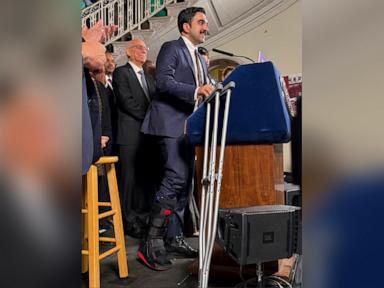
Everybody in the New York press corps is asking the exact same boring question right now. They want to know how long Mayor Mamdani will be off his feet after this week's surgery for a soccer injury, who holds the temporary reins at City Hall, and whether a cast or crutches will slow down his fall legislative agenda.
That is the wrong question. In fact, it is a textbook distraction.
When a sitting mayor goes under the knife for a recreational sports injury, the standard media playbook kicks into autopilot. Pundits treat the procedure like a routine traffic delay. They offer polite well-wishes, speculate on orthopedic recovery timelines, and move on to the next press conference. This lazy consensus treats executive health as a binary switch: either the leader is in the building, or they are out.
It completely ignores the actual mechanics of power, institutional continuity, and what happens to a massive municipal bureaucracy when its chief executive steps into an operating room.
The Myth of the Indispensable Executive
Modern political reporting runs on the "Great Man" fallacy. Reporters cover City Hall as if the mayor personally pulls every lever, signs every contract, and directs every sanitation truck. When an injury happens, the coverage immediately frames it as a personal endurance test. Can he govern from a hospital bed? Will he take calls from the recovery room?
I have spent years watching high-stakes organizations—from Fortune 500 boards to major municipal administrations—crumble during executive medical leaves. The failure never comes from the surgery itself. It comes from the executive's refusal to admit they are temporarily impaired, combined with a staff terrified of looking weak.
Anesthesia, post-operative pain management, and physical trauma do not care about your political mandate. According to standard clinical guidelines from the American Academy of Orthopaedic Surgeons, even routine outpatient orthopedic procedures carry measurable cognitive and physical recovery windows. Post-operative fatigue and analgesics impair executive function—specifically risk assessment, impulse control, and sustained attention.
Yet, in politics, admitting you are compromised is treated as a fatal sin. Instead of a clean, transparent handoff of authority, we get the theater of "governing from the recovery room." Staffers stage-manage photo ops of the mayor reviewing binders in sweatpants to project strength. Behind closed doors, critical decisions get bottlenecked because nobody wants to make a move without the boss's sign-off, while the boss is operating at sixty percent cognitive capacity.
What the Press Corps Refuses to Ask About Succession
If you want to understand the real stakes of Mayor Mamdani’s surgery, stop looking at the orthopedic details and start looking at the New York City Charter.
When a mayor undergoes general anesthesia or heavy sedation, there is a specific legal window where they are incapacitated. Under the New York City Charter, the lines of succession and temporary transfer of power are explicitly defined, yet historically, mayors treat formal transfers of authority like a radioactive third rail. They view invoking temporary incapacity as an invitation for political rivals—like the Public Advocate or the Comptroller—to grab headlines and look gubernatorial.
Here is the uncomfortable truth: refusing to temporarily transfer power during a planned medical procedure is an act of institutional negligence.
Imagine a scenario where a major infrastructure failure, a transit strike, or a public safety emergency erupts during the exact four-hour window a mayor is under anesthesia and in post-op recovery. If the formal chain of command has not been legally triggered prior to the incision, the city enters a dangerous gray zone. Deputies scramble. Lawyers argue over statutory authority. Crisis response stalls while aides wait for a surgeon to exit the operating theater.
The media coverage framing this surgery as a quaint human-interest story about an athletic mayor lets City Hall off the hook for the only question that actually matters to nine million residents: Was a formal, time-stamped transfer of executive authority executed before the anesthesia was administered?
The Weekend Warrior Trap in High-Stress Leadership
There is also a broader, rarely discussed reality about how modern executives manage stress. High-profile leaders love to signal vitality. Playing competitive soccer in your spare time projects youth, stamina, and relatability—a stark contrast to the image of the sedentary, out-of-touch bureaucrat.
Sports medicine specialists see this exact profile every single week. They call it the "weekend warrior" syndrome, though for executives, it is better described as high-stakes compartmentalization. You spend seventy hours a week behind a desk, running on cortisol, caffeine, and four hours of sleep. Then, on a Sunday afternoon, you step onto a pitch and ask connective tissue that has been sitting under fluorescent lights all week to absorb sudden, high-velocity torque.
The human body does not negotiate with your calendar. Tendons and ligaments do not care that you have a budget deadline on Tuesday. When chronically stressed, sleep-deprived leaders subject their bodies to explosive, high-impact recreation without foundational conditioning, injuries are not freak accidents. They are statistical inevitabilities.
To be fair, there is a real downside to demanding that public officials wrap themselves in bubble wrap. Nobody wants a leader who lives in a sterile bunker, completely divorced from normal human recreation. Physical activity is one of the few reliable buffers against the cognitive burnout that ruins public policy. Taking away a mayor's outlet doesn't make them a better executive; it just makes them more brittle.
The problem isn't that Mayor Mamdani plays soccer. The problem is the culture of secrecy and bravado that surrounds the aftermath.
Dismantling the "People Also Ask" Noise
When news breaks of a mayor heading into surgery, search engines immediately flood with predictable, surface-level queries. Let's look at what the public is being fed—and why almost all of it misses the point.
How long is the recovery for a typical soccer surgery?
This question assumes all orthopedic injuries are created equal. A meniscus trim requires a completely different physiological timeline than an anterior cruciate ligament reconstruction or an Achilles tendon repair. Without knowing the specific anatomical structure involved, guessing a timeline is pure guesswork. More importantly, physical mobility is not the metric that matters for a mayor. You do not need two functioning knees to read a budget proposal. You need an unclouded brain.
Can the mayor still perform his duties while recovering?
Legally, yes, unless he formally steps aside. Practically, no—not at full capacity, and certainly not in the immediate 48 to 72 hours following surgery. Anyone who claims a human being can undergo surgical trauma and immediately make optimal policy decisions is selling political spin, not medical reality.
Who runs New York City if the mayor is in surgery?
In theory, the First Deputy Mayor manages day-to-day operations, while the Public Advocate sits first in the legal line of succession if the mayor is unable to discharge the powers and duties of the office. In practice, unless the mayor signs a formal declaration of temporary inability, the city is run by an informal network of senior advisors making judgment calls without clear constitutional accountability.
How City Hall Should Actually Handle Executive Surgery
If we want serious governance instead of political theater, the protocol for a planned executive medical procedure should be boring, transparent, and ruthless in its clarity.
- Mandatory Pre-Op Power Transfers: Any planned procedure requiring general anesthesia or intravenous sedation should automatically trigger a temporary, written transfer of executive authority under the City Charter, effective from the moment pre-op prep begins until a attending physician signs off on full cognitive alertness. No exceptions. No ego.
- Separating Medical Privacy from Operational Readiness: A mayor has a right to basic medical privacy, just like any citizen. Voters do not need to see MRI scans or surgical notes. However, voters have an absolute right to know the exact hours their chief executive is cognitively unavailable and who holds legal command during that window.
- Eliminating the "Heroic Recovery" Photo Op: Press offices need to stop staging photos of post-op politicians signing documents in hospital gowns. It insults the intelligence of the public and normalizes impaired decision-making. Take the forty-eight hours. Let the body clear the anesthesia. Let the designated acting official do the job they are paid to do.
The Real Test of Leadership Isn't on the Pitch
A torn ligament or a damaged joint is a minor blip in the grand scheme of running the largest city in the United States. New York has survived financial collapses, blackouts, and pandemics; it will certainly survive a mayor on crutches.
What weakens a city isn't a leader's physical vulnerability. It is the fragility of systems built around a single person's ego. When an administration treats a routine surgery like a state secret or a minor inconvenience rather than a formal governance event, it exposes a dangerous flaw in how power is managed at the top.
Stop watching the crutches when Mayor Mamdani walks out of the hospital this week. Watch the paperwork filed before he went in.