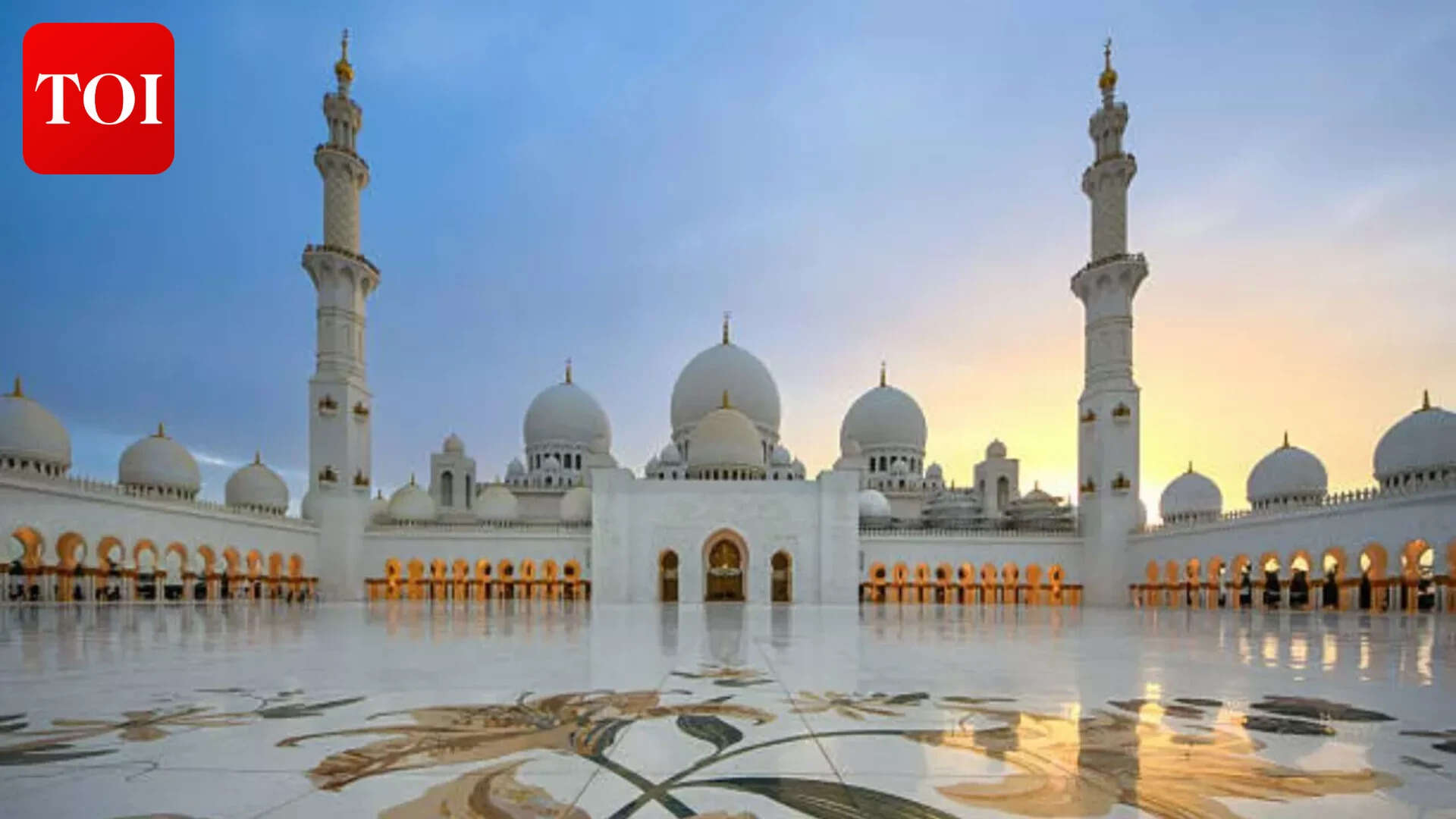
The surge in attendance at the Sheikh Zayed Grand Mosque during the final ten nights of Ramadan represents one of the most concentrated urban mobility challenges in the Middle East. Managing this influx requires a shift from passive infrastructure to active, synchronized logistics. The deployment of 100 dedicated taxis and augmented bus fleets is not merely a capacity increase; it is a tactical response to a localized demand spike that threatens to saturate the surrounding transport network. By deconstructing the mosque’s operations into three distinct layers—Predictive Capacity, Fluid Transit, and Pedestrian Throughput—we can quantify how Abu Dhabi prevents a total systemic failure of its traffic grid during peak spiritual events.
The Triad of Urban Load Management
Effective mass-gathering management rests on three pillars that convert chaotic human movement into a predictable flow. When 100 taxis are deployed, they are not acting as independent agents; they are part of a closed-loop system designed to minimize the "dwell time" of visitors.
- Pillar 1: Elastic Transport Capacity. This involves the rapid scaling of the fleet to meet non-linear demand. While standard daily operations handle a baseline, the Laylat al-Qadr period sees a vertical spike in arrivals.
- Pillar 2: Spatial Buffer Zones. Large-scale mosques utilize their vast peripheries to act as pressure valves. By designating specific pick-up and drop-off points, the mosque separates high-speed arterial traffic from slow-moving pedestrian clusters.
- Pillar 3: Multi-Modal Synchronization. The integration of buses and taxis creates a tiered exit strategy. Heavy-duty buses handle high-volume, fixed-route dispersal, while taxis provide granular, door-to-door transit for the last mile.
The Mathematics of Peak-Hour Congestion
The efficiency of the mosque’s transport strategy is governed by the fundamental relationship between density, flow, and velocity. Traffic engineers model this using the Fundamental Diagram of Traffic Flow. At a certain point—the critical density—flow begins to collapse.
$$q = k \cdot v$$
In this equation, $q$ represents the flow (vehicles per hour), $k$ is the density (vehicles per kilometer), and $v$ is the mean velocity. As density increases due to the massive influx of pilgrims, velocity drops. If left unmanaged, $v$ approaches zero, resulting in a gridlock state. The deployment of 100 taxis and extra buses aims to maintain the flow $q$ by optimizing the dispersion rate. By increasing the frequency of bus departures, the system artificially lowers the density $k$ on the roads leading to the mosque, preventing the breakdown of the entire network.
Technical Architecture of the Sheikh Zayed Grand Mosque Fleet
The decision to deploy 100 taxis specifically is a calculated logistical move. This number is not arbitrary; it represents a specific percentage of the city’s total active fleet diverted to a single node to ensure that wait times do not exceed a critical threshold—typically 15 to 20 minutes for a high-volume site.
Intelligent Dispatch Systems
Modern fleet management at this scale relies on GPS-based dispatching and real-time data feeds. The Integrated Transport Centre (ITC) in Abu Dhabi uses these systems to monitor demand levels in real-time.
- Demand Forecasting: Historical data from previous Ramadan cycles allows the ITC to predict the exact hour the "mass-exit" will occur. This is usually immediately following the final prayers of the night.
- Geofencing: By creating a virtual perimeter around the mosque, dispatchers can prioritize taxis that are already within a certain radius, reducing deadheading—the time a taxi spends driving without a passenger.
- Real-Time Rerouting: Buses are not restricted to their standard routes. During the final nights of Ramadan, the ITC can authorize temporary route modifications to bypass traffic bottlenecks identified by live sensors.
The Problem of Terminal Saturation
Every transport system has a physical limit: the number of vehicles the arrival and departure bays can physically hold. The Sheikh Zayed Grand Mosque, with its expansive parking lots and designated taxi ranks, must manage this "terminal capacity."
- Queue Management: To prevent taxis from backing up onto the main highways, marshals use a staged queuing system. Only a fraction of the 100 taxis are at the mosque’s doorstep at once; the rest are held in nearby "overflow" zones until paged.
- Throughput Rate: The mosque’s success is measured by its "turnover rate"—how quickly a vehicle can enter the rank, load passengers, and exit. A delay of even 30 seconds per vehicle across a fleet of 100 can create a 50-minute backlog.
Pedestrian Dynamics and the "Last 500 Meters"
Transport does not end at the parking lot. The most critical failure point in religious logistics is the transition from a vehicle to the prayer hall—the "last 500 meters." If pedestrian movement is stalled, it ripples back into the transport system, causing buses to wait longer at stops and taxis to become trapped in pedestrian-clogged lanes.
Behavioral Flow Patterns
Analysis of pilgrim behavior suggests that movement is rarely uniform. Instead, it follows a "burst" pattern. The end of a prayer session releases thousands of individuals simultaneously.
- Unidirectional Flow: To manage this, security and logistics teams often implement one-way walking paths. This prevents "counter-flow" friction, which can reduce pedestrian speed by up to 40%.
- Signage and Cognitive Load: Clear, multilingual signage is essential. In a high-stress, high-density environment, pilgrims experience increased cognitive load. Reducing the number of decisions a person has to make (e.g., "Where is the taxi stand?") speeds up the overall evacuation of the site.
The Cost Function of Overcrowding
From a strategy consultant's perspective, overcrowding carries a hidden cost. Beyond safety risks, there is a "reputational cost" and an "operational cost."
- Operational Friction: The more crowded the mosque becomes, the harder it is for support staff (security, cleaners, medical teams) to move. This increases the response time for any incident.
- Service Degradation: When the mosque exceeds its optimal capacity, the quality of the spiritual experience diminishes. This is why the extra transport is a necessity, not a luxury; it facilitates a rapid exit, allowing the site to "reset" for the next group of visitors.
Economic and Societal Impacts of Logistics Scaling
The investment in additional transport during Ramadan is a demonstration of the "Service Excellence" model common in the UAE. It reflects a prioritization of public welfare and religious observance over immediate profitability.
Public-Private Synergy in Transit
The 100 taxis belong to various franchised companies but are coordinated by the ITC. This is a prime example of a public-private partnership (PPP) where the government provides the regulatory framework and the private sector provides the assets.
- Incentivizing Drivers: Drivers are often given incentives to work these high-demand shifts, ensuring that the 100-taxi quota is met even during late-night hours.
- Subsidy Structures: In many cases, the cost of the extra bus fleets is subsidized by the state to ensure that public transit remains a viable—and often faster—alternative to private cars.
Environmental Considerations of Mass Transit
While 100 taxis and dozens of buses add to the local emissions during the event, they actually represent a net reduction in carbon footprint compared to thousands of individual private vehicles attempting to park at the mosque.
- Bus Efficiency: One articulated bus can replace approximately 40 to 60 private cars.
- Congestion Mitigation: By reducing the time cars spend idling in traffic, the mosque’s transport plan significantly lowers the total emissions produced during the peak hours of Ramadan.
Limitations and Systemic Vulnerabilities
No logistical plan is without flaws. Even with 100 extra taxis, the system faces inherent limitations that can be mitigated but never fully eliminated.
- The Unpredictability of Human Factors: A single vehicle breakdown or a medical emergency on a key access road can render the entire transport plan ineffective.
- Weather Extremes: In the UAE, high temperatures—even at night—can affect the performance of bus engines and cooling systems. Logistics teams must account for "technical fatigue" in the fleet.
- Digital Divide: While many use apps to book transport, a significant portion of older pilgrims may rely on physical hail-down methods. The logistics plan must accommodate both digital-native and traditional users to avoid bottlenecks at the physical taxi ranks.
Strategic Play for Future Capacity Building
To move beyond the current 100-taxi model, the mosque and the ITC should consider the following strategic enhancements:
- Autonomous Shuttle Integration: Small, autonomous electric shuttles could be used to ferry passengers from distant parking lots to the mosque gates, reducing the need for full-sized buses on short-haul routes.
- Predictive AI for Queue Management: Implementing computer vision at taxi ranks to monitor queue length and automatically adjust dispatch rates would create a more responsive system.
- Dynamic Pricing Control: During peak Ramadan nights, implementing a "low-fare zone" for buses could further incentivize pilgrims to leave their private cars at home, shifting the load more heavily toward mass transit.
The operational success of the Sheikh Zayed Grand Mosque during Ramadan is not a product of luck but of rigorous, data-driven planning. The deployment of 100 taxis serves as a critical pressure release valve in a complex urban machine.
The Strategic Action:
Transport authorities must move from reactive scaling (adding more cars) to predictive sculpting (shaping demand through tiered arrival times and pre-booked transit slots). This shift will transform the mosque from a logistical challenge into a global benchmark for high-density religious site management.


