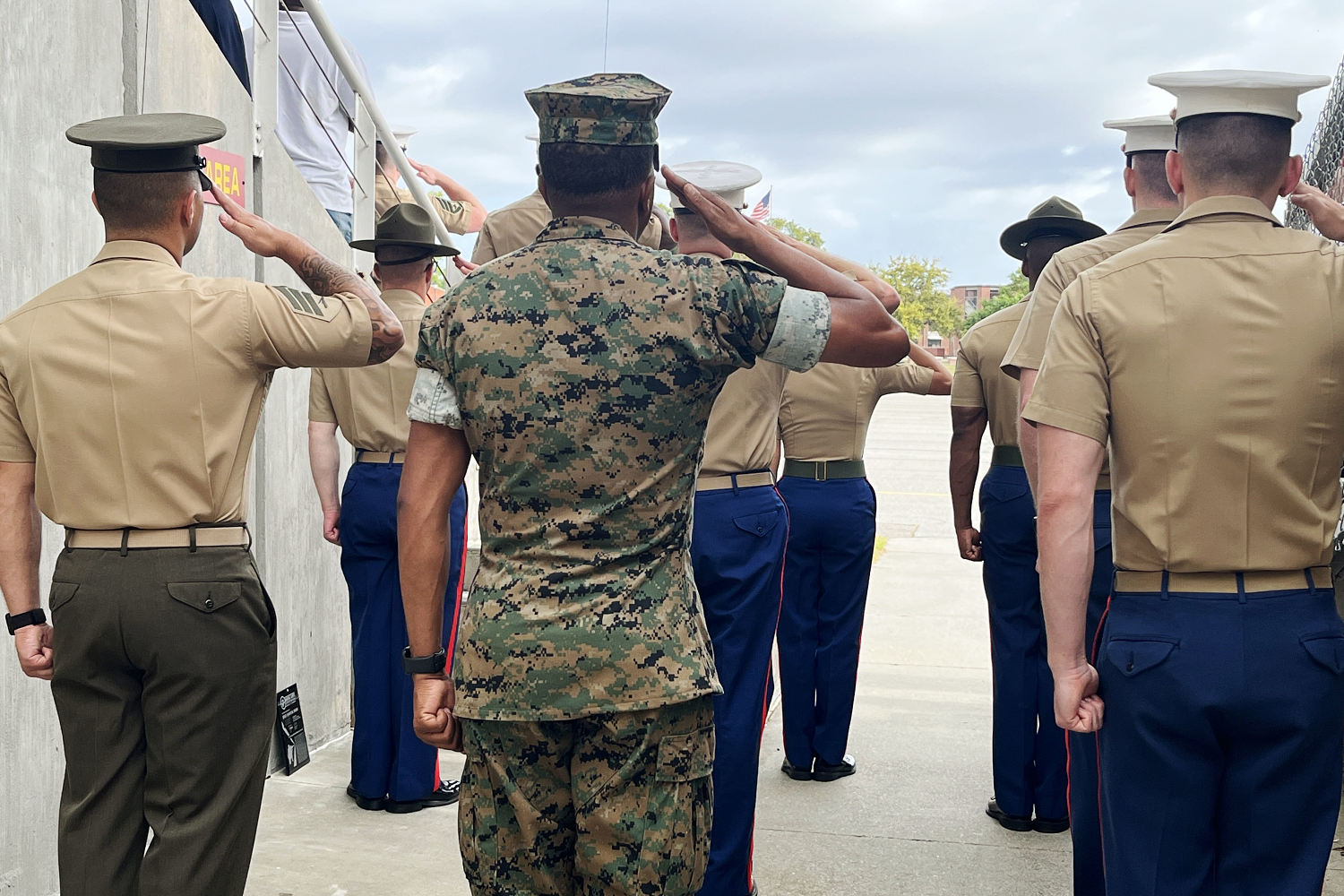
The intersection of Department of Defense (DoD) security protocols and Department of Homeland Security (DHS) enforcement priorities creates a systemic bottleneck at military installations that effectively bifurcates the graduation experience for service members. While military tradition emphasizes the "whole of family" approach to readiness and morale, the physical gate at a Marine Corps Recruit Depot (MCRD) acts as a filter where legal status overrides the symbolic transition from civilian to Marine. This disconnect is not a glitch in the system but a predictable outcome of conflicting federal mandates: the mandate to secure military assets versus the mandate to enforce immigration statutes.
The Tri-Lens Security Framework
Access to a military installation is governed by a three-tiered risk assessment that determines who witnesses a graduation ceremony. Understanding why certain families are absent requires deconstructing these layers, as the barrier is rarely a single "fear" but a sequence of structural hurdles.
1. Identity Verification Requirements
The REAL ID Act of 2005 established minimum security standards for license issuance and production. Because several states provide driving privileges to undocumented residents without meeting REAL ID compliance, the primary form of identification for many families is fundamentally incompatible with the Defense Biometric Identification System (DBIDS). When a visitor lacks a compliant ID, they must provide secondary documentation—often a passport from their country of origin. This requirement forces a disclosure of foreign citizenship status at a high-security federal checkpoint.
2. Vetting and Background Screening
Every non-DoD cardholder must undergo a background check before entering an installation. Security personnel scan identification against National Crime Information Center (NCIC) databases. While these checks primarily target criminal history or active warrants, they also interface with civil immigration databases. The presence of an administrative removal order or a "hit" in the system triggers an immediate protocol that security forces are legally bound to follow, often involving the detention of the individual until federal law enforcement can be notified.
3. Discretionary Authority of the Installation Commander
Installation commanders possess the legal authority to grant or deny access based on perceived risk. However, this authority is rarely used to waive federal identification standards for large-scale public events like graduations. The liability associated with an unauthorized entry at a high-visibility event outweighs the localized benefit of family morale. This creates a risk-aversion feedback loop where the default response to non-standard documentation is denial of entry.
The Cost Function of Parental Absence
The military justifies its rigorous training through the concept of " esprit de corps," yet the exclusion of family during the culminating moment of basic training introduces a measurable friction into the Marine’s early career cycle.
- The Morale Deficit: The graduation ceremony serves as the formal "rite of passage" that validates the recruit’s transformation. When the primary support structure is absent due to external legal risks, the psychological payoff of the training cycle is diminished. This is not a sentiment; it is a degradation of the social contract between the service and the family unit.
- Retention Implications: Historical data suggests that family buy-in is a leading indicator for first-term reenlistment. If a family perceives the military environment as a threat to their safety rather than a source of pride, the recruit faces domestic pressure to exit the service at the first available opportunity.
- Operational Security vs. Family Integration: There is a fundamental tension between the need to vet 2,000+ visitors in a four-hour window and the desire to be an inclusive institution. The logistics of processing "vulnerable populations" at a gate are non-existent, leading to a binary outcome: you have the papers, or you stay in the parking lot.
The Enforcement Nexus and the Chilling Effect
The phenomenon of empty seats at graduation is exacerbated by the "chilling effect," a psychological mechanism where the perceived risk of an action far exceeds the statistical probability of a negative outcome. Even if a specific MCRD has an informal "no-check" policy regarding immigration status for graduation day—which is rare and legally precarious—the presence of uniformed federal agents and heavy surveillance equipment acts as a deterrent.
For families with mixed immigration status, the MCRD gate represents a high-stakes gamble. The geography of these bases often complicates the risk. MCRD San Diego, for instance, sits in close proximity to major transit hubs and Border Patrol checkpoints. The journey to the base itself involves navigating multiple layers of federal oversight before even reaching the gate.
Institutional Silence as a Risk Factor
The Marine Corps typically maintains a neutral stance on these issues, citing federal law and security regulations. This silence is often interpreted by families as a lack of protection. Without explicit "safe passage" guarantees—which the military is not authorized to give—the rational choice for an undocumented parent is to avoid the federal installation entirely. This creates a "shadow graduation" where families celebrate in off-base motels or restaurants, physically close but legally miles away from the ceremony.
Structural Bottlenecks in the Naturalization Pipeline
A significant irony in this dynamic is the existence of MAVNI (Military Accessions Vital to the National Interest) and other pathways for service members themselves to gain citizenship. While the recruit may be on a fast track to naturalization, their immediate family remains in a legal vacuum.
- The Disconnect: The military focuses on the individual's legal status for security clearances and occupational specialties but lacks a mechanism to extend that status to the family during training.
- The Parole in Place (PIP) Limitation: While "Parole in Place" exists for certain family members of military personnel to stay in the U.S. legally, the application process is lengthy and requires the service member to have completed training and reached their first duty station. It offers zero protection or utility during the basic training graduation phase.
Quantifying the Information Gap
The primary failure in the current system is not necessarily the law itself, but the information asymmetry between the institution and the recruit.
- Recruiter Misalignment: Recruiters are incentivized to ship candidates to boot camp. They often gloss over the logistical realities of graduation day access for undocumented families to avoid losing a "contract."
- Command Ignorance: Drill instructors and company commanders are focused on the "production" of Marines. The specific visa or status issues of a recruit's mother are often viewed as a "civilian problem" outside the scope of the training mission.
- Third-Party Liability: Non-profit organizations and legal aid groups often provide conflicting advice, either overstating the risk of deportation at the gate or underestimating the rigidity of military security protocols.
The Strategic Shift Toward Virtual Participation
In response to these physical barriers, the Marine Corps has unintentionally pivoted toward a digital solution. The livestreaming of graduation ceremonies, accelerated by the COVID-19 pandemic, has become the primary mode of participation for excluded families. While this solves the immediate security problem for the base, it cements the exclusion as a permanent feature of the military experience for certain demographics.
Digital participation is a functional workaround, but it fails to address the underlying erosion of the military-family bond. It validates the gate as an insurmountable barrier rather than a point of integration.
Necessary Operational Adjustments
To address the friction between security and ceremony, the institution must move beyond vague "concerns" and implement specific procedural changes.
- Standardized Visitor Access Briefings: Recruiters should be required to provide a "Base Access Requirements" sheet to every family during the DEP (Delayed Entry Program) phase. This document must clearly state the REAL ID requirements and the implications of using foreign passports, allowing families to make an informed risk assessment months in advance.
- Civilian-Military Liaison Expansion: Assigning dedicated ombudsmen to handle non-standard visitor requests could provide a "buffer" between families and the military police. This would allow for the pre-screening of documents in a non-confrontational environment, potentially identifying "safe" secondary IDs before the family travels cross-country.
- Integration of Legal Services: Moving the "Parole in Place" application earlier in the pipeline—potentially during the 13 weeks of training—would signal an institutional commitment to the family unit. While it would not grant immediate access to the base, it would reduce the overall threat profile for the family.
The current state of graduation exclusion is a byproduct of a security apparatus that views "visitors" as a uniform block of risk. Until the system can differentiate between a security threat and a family member of a service member, the "gate" will remain a site of strategic failure. The objective must be to move the point of vetting away from the physical gate and into the administrative lead-up to the ceremony, transforming a high-stakes encounter into a managed logistical process.