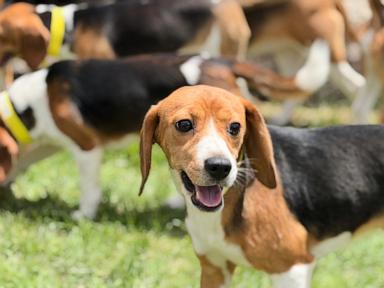
The closure of a major canine breeding facility in Wisconsin and the subsequent transfer of hundreds of beagles to a Florida rescue organization exposes a complex logistics problem. Mass animal relocations are rarely restricted by a lack of public empathy; instead, they are bottlenecked by the rigid constraints of veterinary capacity, regulatory compliance, and multi-jurisdictional supply chains. When an institution of this scale shuts down, the immediate challenge is not sentimental, but structural: how to safely transition a highly concentrated population of vulnerable biological assets across thousands of miles without crashing the operational capacity of the receiving network.
To understand the mechanics of a mass rescue operation, the entire event must be stripped of emotional framing and evaluated as a high-stakes reverse logistics exercise. The process operates under a strict three-part framework: supply-side liquidation, transit capacity management, and demand-side absorption. Failure in any single phase triggers a compounding cascade of systemic stress, resulting in elevated mortality rates, quarantine breaches, or financial insolvency for the participating non-profit entities.
The Microeconomics of Facility Liquidation
The cessation of operations at a commercial breeding facility creates an immediate inventory crisis. Unlike manufacturing operations where excess stock can be mothballed or discounted, living creatures incur fixed, non-negotiable daily operating costs.
Daily Holding Cost = Feed Costs + Labor Hours + Waste Management + Preventative Veterinary Care
The moment a closure is finalized, the facility enters a phase of rapid asset depreciation. If the offloading of animals is delayed, the owner faces mounting overhead costs with zero incoming revenue, creating a perverse incentive to minimize care or pursue mass euthanasia.
The selection of a single receiving partner in Florida, rather than a fragmented network of local shelters, indicates a deliberate strategy to minimize transaction costs. Dealing with one consolidated counterparty reduces the administrative friction of transferring ownership titles, standardizes the medical history handoff, and creates a single point of accountability. However, this strategy introduces a significant single-point-of-failure risk. If the Florida rescue group experiences an operational disruption, the entire liquidation pipeline stalls.
Trans-Jurisdictional Logistics and Transport Constraints
Moving hundreds of canines from the Midwest to the southeastern United States is a highly regulated logistical maneuver governed by federal and state agricultural laws. The primary constraint during the transit phase is the maintenance of biosecurity and animal welfare standards across changing climates and legal jurisdictions.
Regulatory Compliance and Interstate Health Certificates
Before any animal crosses a state line, it must secure an Interstate Certificate of Veterinary Inspection (ICVI). This is not a bureaucratic formality; it is a critical epidemiological defense mechanism. Each dog must be individually assessed by an accredited veterinarian to verify the absence of infectious diseases such as canine influenza, brucellosis, and virulent parasites. For hundreds of animals, the labor requirement for this step alone creates a massive operational bottleneck.
- The Labor Variable: A rapid screening takes an average of 10 minutes per animal. Processing 300 dogs requires 50 veterinarian-hours of continuous labor, excluding the time required to generate and file the digital paperwork.
- The Validation Window: Most states require ICVIs to be executed within 30 days of entry, but highly stringent states reduce this window to 10 days, forcing a tight alignment between medical clearance and vehicle departure.
Vehicle Dynamics and Climate Risk Mitigation
The physical transit requires specialized climate-controlled transport units. Standard cargo configurations are utterly inadequate due to the thermal output of the animals themselves.
An enclosed space filled with dozens of high-metabolism dogs experiences a rapid accumulation of heat and relative humidity. Without continuous, redundant HVAC systems operating at a fixed range of 65°F to 75°F, animals face a high risk of heat prostration. Furthermore, the transport route must factor in mandatory rest stops for sanitization, hydration, and waste clearance, meaning the transit time between Wisconsin and Florida routinely exceeds 24 hours of continuous operational management.
Absorption Capacity and the Veterinary Bottleneck
The arrival of hundreds of animals at a single rescue organization in Florida shifts the operational burden from logistics to infrastructure. A common analytical error is assuming that a rescue group's capacity is defined by its physical square footage or kennel count. In reality, the true constraint is the throughput velocity of its veterinary medical pipeline.
The Intake Triage Protocol
Upon arrival, the population cannot be directly integrated into the general adoption pool. They must enter a mandatory quarantine protocol to account for disease incubation periods. The intake process requires an immediate deployment of clinical resources to execute a standardized medical matrix:
- Diagnostic Screening: Comprehensive bloodwork, heartworm testing, and fecal flotations to identify underlying pathologies hidden during the initial field screenings.
- Prophylactic Administration: Immediate administration of core vaccines (DHPP, Rabies, Bordetella) alongside broad-spectrum parasiticides to prevent facility-wide outbreaks.
- Surgetical Processing: High-volume spay and neuter services. Florida statute dictates that rescue organizations cannot release unsterilized animals to the public, turning the surgical suite into the ultimate operational funnel.
The Veterinary Staffing Deficit
The limiting factor in this formula is the availability of licensed veterinary surgeons. A highly efficient shelter surgeon can perform a canine sterilization in approximately 15 to 20 minutes including pre-op prep and post-op recovery transitions.
$$Total\ Surgical\ Hours = \frac{Population \times 20\ minutes}{60\ minutes}$$
For a influx of 300 intact animals, this translates to 100 hours of pure surgical time. Operating at a grueling pace of 8 hours per day, a single surgeon would require 12.5 consecutive days just to clear the sterilization backlog, during which time the daily holding costs of the unsterilized population consume the organization's liquid financial reserves.
Long-Term Capital Demands and Churn Management
A sudden capital injection is required to sustain this operational surge. While public donations typically spike during the media coverage of a mass rescue event, these funds are front-loaded, whereas the expenses are back-loaded over months of rehabilitation.
The financial sustainability of the rescue group relies on converting this temporary asset surge into a highly structured adoption pipeline. Beagles from breeding facilities frequently present with severe behavioral deficits, including a lack of socialization, profound neophobia, and absence of house-training. These behavioral pathologies extend the average Length of Stay (LOS) in the shelter.
Extended Length of Stay -> Increased Daily Holding Costs -> Reduced Kennel Turnover Rate
When the turnover rate drops, the shelter's capacity to accept new, local intake cases is severely compromised, demonstrating how an isolated rescue event in one region can inadvertently restrict animal welfare capacity thousands of miles away.
Strategic Execution Plan for Large-Scale Relocations
To optimize future operations of this magnitude, organizations must abandon ad-hoc planning in favor of a formalized, scalable framework. The following tactical steps establish a baseline for highly resilient animal logistics systems:
- Establish Decentralized Triage Hubs: Rather than routing the entire population to a single central facility, deploy regional staging hubs along the transit corridor. This distributes the veterinary labor burden and mitigates the risk of a single facility-wide disease outbreak.
- Deploy Standardized Digital Health Ledgers: Transition away from paper-based ICVIs to cloud-based, blockchain-verified medical records. This allows the receiving veterinary team in Florida to review diagnostic data in real-time while the transport vehicles are still in transit, eliminating intake administrative delays.
- Pre-Saturate the Foster Network: Before the transport vehicles depart the originating facility, the receiving organization must pre-allocate at least 40% of the incoming population directly to vetted foster homes. This bypasses the physical shelter infrastructure entirely, drastically reducing the baseline holding costs and lowering the epidemiological load on the main facility.