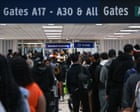
The stability of domestic civil aviation relies on a delicate synchronization between federal labor funding and high-volume passenger throughput. When the Department of Homeland Security (DHS) faces a funding lapse, the Transportation Security Administration (TSA) transitions from a steady-state operational model to a crisis-management framework defined by "essential worker" mandates. This friction creates a cascading failure across the National Airspace System. The bottleneck is not merely a lack of personnel; it is a breakdown in the Psychological and Operational Contract between the government and its frontline screeners.
The Three Pillars of Security Throughput Degradation
Airport security delays during a shutdown are the byproduct of three distinct but intersecting vectors. Analyzing these pillars reveals why wait times do not increase linearly, but rather exponentially, as a shutdown persists.
1. The Variable Labor Participation Rate
While TSA officers are legally categorized as "essential" and required to work without immediate pay, their participation rate is subject to the Economic Pressure Threshold. Officers living paycheck-to-paycheck face immediate liquidity crises. This manifests in:
- Increased Unscheduled Absences: Officers prioritize finding temporary bridge income or managing childcare costs that they can no longer afford without a liquid salary.
- Morale-Induced Attrition: Experienced officers in the top tier of the pay scale often possess transferable skills in private security or logistics, leading to permanent exits from the federal workforce during periods of uncertainty.
2. Efficiency Friction and Search Accuracy
Under normal conditions, TSA screeners maintain a specific cadence of "divestiture"—the process of passengers removing electronics and liquids. During a shutdown, the Stress-Cognitive Load Ratio increases. An unpaid workforce is more prone to fatigue and distraction, which forces supervisors to either slow down the belts to maintain safety standards or risk security breaches. Safety is a non-negotiable metric; therefore, the system defaults to slower processing speeds to compensate for reduced cognitive focus.
3. Equipment Maintenance and Tech Latency
The DHS shutdown halts non-essential contracts. This includes the third-party technicians responsible for the preventative maintenance of Advanced Imaging Technology (AIT) and Computed Tomography (CT) scanners. If a machine malfunctions at a Tier 1 airport (e.g., ATL, LAX, ORD), it cannot be repaired using "essential" funds unless it is deemed a critical security failure. This reduces the number of active lanes, forcing a higher volume of passengers through a smaller number of operational funnels.
The Cost Function of Passenger Processing
To quantify the impact, one must look at the Mean Wait Time (MWT) as a function of arrival rate versus service rate. In a standard operational environment, the service rate ($μ$) exceeds the passenger arrival rate ($λ$). During a DHS shutdown, $μ$ decreases due to the labor and technical factors mentioned above.
When $λ$ approaches $μ$, the queue length does not grow by the difference; it grows according to the principles of Queueing Theory (Kingman’s Formula). A 10% reduction in screener efficiency can lead to a 50% or greater increase in wait times because the system loses its ability to recover from "burst" arrivals (e.g., when three wide-body aircraft land simultaneously).
Systemic Vulnerabilities in the Hub-and-Spoke Model
The delays are not distributed evenly across the United States. The impact follows a Power Law distribution, where the largest hubs suffer disproportionately due to their role in the hub-and-spoke network.
Secondary Delay Cascades
A security delay in a hub like Hartsfield-Jackson Atlanta International Airport does not just affect departing passengers. It creates "Downstream Asset Misalignment."
- Crew Timing Out: If security delays prevent flight crews from reaching the gate on time, they may hit their FAA-mandated duty hour limits. This leads to flight cancellations, even if the aircraft and weather are perfect.
- Missed Connections: When a passenger is delayed at security in a spoke airport, they miss their connection at the hub. This creates a "Rebooking Backlog" that can take days to clear, as load factors on modern flights often exceed 85%, leaving little room for displaced travelers.
The TSA PreCheck Dilution Effect
During shutdowns, the TSA often consolidates lanes to save labor. This frequently results in the closure of dedicated TSA PreCheck lanes. When "Trusted Travelers" are diverted into standard screening lanes, the Net System Velocity drops. PreCheck passengers are optimized for speed; when forced into standard protocols, their divestiture time increases by a factor of three, further clogging the primary throughput arteries.
Operational Realities vs. Public Perception
The narrative often focuses on "long lines," but the deeper risk is Security Layer Degradation. The DHS uses a "Managed Inclusion" strategy to move lines faster during crises, which involves utilizing K9 units to clear passengers for less-intrusive screening. However, if K9 handlers are also part of the unpaid essential workforce, this layer becomes brittle.
We must distinguish between Inconvenience Metrics (wait times) and Systemic Risks (the probability of a prohibited item passing through a checkpoint). As the duration of a shutdown increases, the system’s reliance on "work-to-rule" protocols increases, leaving zero margin for error or surge capacity.
The Financial Impact on the Aviation Ecosystem
The economic cost of a DHS shutdown extends beyond the federal deficit. It is a direct tax on the private sector.
- Airport Concession Revenue: Passengers stuck in security lines are not spending money in the terminal. For every 10 minutes added to a security wait, there is a measurable decline in "dwell time" at retail and food outlets.
- Airline Operational Costs: Increased fuel burn due to gate holds and the administrative cost of rebooking thousands of passengers per day.
- Corporate Productivity Loss: The "Opportunity Cost of Transit" for business travelers. If 100,000 business travelers are delayed by one hour, and the average hourly value of their labor is $100, the economy loses $10 million in latent productivity per day.
Structural Mitigation Strategies
To insulate the aviation sector from future political volatility, the following structural shifts are necessary:
- Decoupling TSA Funding: Moving the TSA to a "User Fee" model similar to the Federal Aviation Administration’s (FAA) Airport Improvement Program, where fees collected from passenger tickets are held in a dedicated trust fund that cannot be sequestered or halted during a general fund shutdown.
- Automated Screening Integration: Accelerating the deployment of self-service screening portals. By reducing the reliance on human labor for routine divestiture checks, the system becomes more resilient to labor fluctuations.
- Inter-Agency Resource Sharing: Establishing a contingency framework where Customs and Border Protection (CBP) and TSA can cross-utilize personnel more fluidly, though this is currently limited by different training requirements and union contracts.
The immediate strategic priority for airlines and airport authorities is to increase Buffer Capacity. This involves advising passengers to arrive three to four hours before departure—not as a suggestion, but as a requirement for system stabilization. Until the federal funding mechanism for DHS is restructured to mirror the essential nature of the service it provides, the National Airspace System will remain a hostage to the fiscal calendar.
For travelers, the only hedge against this systemic failure is the utilization of CLEAR or similar private-sector biometrics that bypass the initial document check, though even these services cannot bypass the physical bottleneck of the X-ray machine. The focus must shift from "managing the line" to "hardening the infrastructure" against political externalities.
The final strategic move for stakeholders is to lobby for the Aviation Funding Stability Act, ensuring that the safety of the skies is never used as a lever in budgetary negotiations. Without this legislative firewall, the "shutdown-delay" cycle will continue to erode the efficiency of global commerce.


