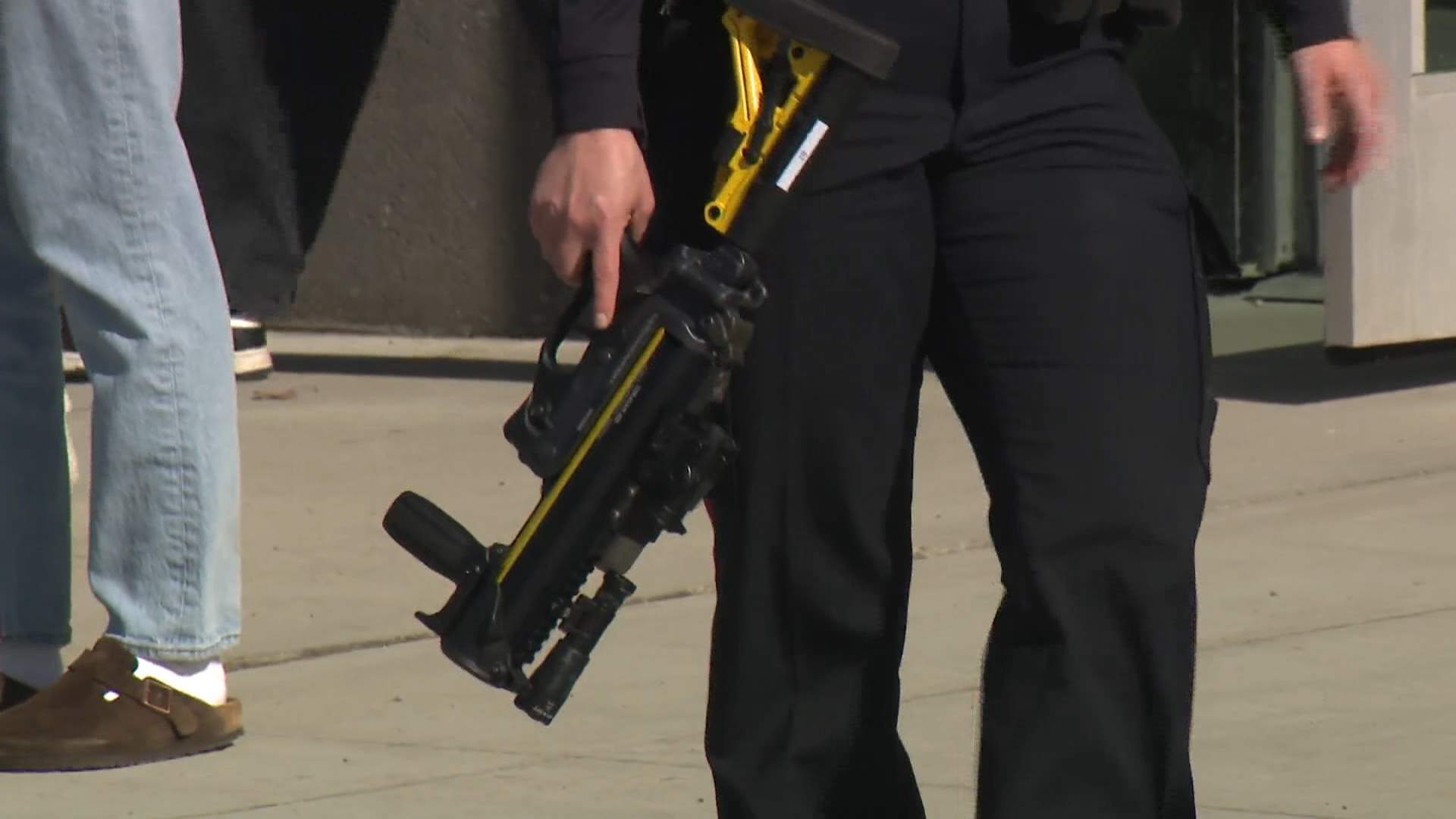
The issuance of a shelter-in-place order at Mount Royal University (MRU) represents a high-stakes execution of the Containment-Communication-Resolution (CCR) framework. When Calgary police identified a potential threat, the immediate shift from an open-access campus to a hardened environment was not a reactive panic, but a calibrated response to a localized security breach. Effectively managing a modern campus threat requires the simultaneous management of physical space, digital information flow, and jurisdictional handoffs between private campus security and municipal law enforcement.
The Architecture of a Shelter-In-Place Event
A shelter-in-place order is a tactical lockdown designed to minimize the target profile within a high-density area. In the MRU instance, the objective was the immediate immobilization of the student and faculty population to provide police with a "clear floor"—a static environment where any movement is categorized as either a threat or a breach of protocol.
The efficiency of this maneuver depends on three technical variables:
- Notification Latency: The delta between the verification of a threat and the delivery of the first mass notification. Every second of latency increases the probability of individuals entering the "kill zone" or hazard area.
- Hardening Velocity: The speed at which internal doors, labs, and communal spaces are physically secured.
- Information Fidelity: The accuracy of the description of the threat, which prevents the "phantom threat" effect where misinformation leads to secondary incidents or stampedes.
Tactical Synchronization Between CPS and Campus Security
The incident at Mount Royal University highlights a critical junction: the handover of command. Initial detection often falls to campus security—a private entity with limited detention powers—while resolution belongs to the Calgary Police Service (CPS).
The friction in this transition usually occurs during the Intelligence Handover. Campus security manages the Closed Circuit Television (CCTV) arrays and electronic access control systems (EACS). CPS brings the Tactical Unit and heavy ballistics. If the EACS is not integrated into a central command post that both parties can access, the police are essentially "blind" to the interior layout of the building they are entering.
The Spatial Containment Model
Police strategy in these scenarios follows a concentric circle model of containment.
- The Hot Zone: The immediate vicinity of the suspect or the suspicious object. At MRU, this necessitated the evacuation or total immobilization of specific wings.
- The Warm Zone: Areas adjacent to the threat where the shelter-in-place order is most strictly enforced.
- The Cold Zone: The perimeter of the campus where traffic is diverted and staging areas for emergency medical services (EMS) are established.
A failure in the Warm Zone—such as a student ignoring an alert to record the event on a mobile device—compromises the tactical integrity of the entire operation. It forces police to divert resources from neutralizing the threat to managing civilian compliance.
Psychological Infrastructure and Mass Notification Systems
Modern campus security relies heavily on the Multi-Modal Alerting Protocol. This isn't merely a single text message; it is a synchronized broadcast across desktop overrides, SMS, digital signage, and PA systems. The MRU incident serves as a stress test for these systems.
A significant bottleneck in these events is the Re-entry of Information. As thousands of students receive an alert, many respond by flooding 911 or campus security lines with inquiries. This creates a "Denial of Service" (DoS) effect on emergency communications. High-performing security strategies mitigate this by utilizing one-way broadcast channels that provide a "single source of truth," thereby protecting the bandwidth of the emergency dispatchers.
The Cost of False Positives vs. Latent Response
Analysts must view the MRU shelter-in-place through the lens of Type I and Type II errors.
- Type I Error (False Positive): Issuing a lockdown for a non-existent threat. The costs include lost instructional time, psychological stress, and "alert fatigue," which reduces compliance in future real events.
- Type II Error (False Negative): Failing to issue a lockdown during a genuine threat. The cost is measured in human life and massive institutional liability.
The Calgary Police Service opted for a "Zero-Failure" stance. Even if the order was "brief," the decision-making process prioritized the elimination of the Type II error. The brevity of the order indicates a high-speed verification process, where the threat was either neutralized or determined to be non-credible faster than the typical administrative friction allows.
Logistics of the "Clear" Signal
The transition from a shelter-in-place to an "all-clear" is often more complex than the lockdown itself. This is the De-escalation Phase.
Police cannot simply lift the order; they must conduct a systematic sweep to ensure that the environment is truly safe. This involves:
- Verification of all exits and entry points.
- Accountability checks of personnel in the affected zones.
- The psychological "cool-down" period to prevent chaotic egress from the campus, which could cause traffic accidents or impede secondary emergency vehicles.
Strategic Institutional Recommendations
For urban academic institutions, the MRU event reinforces the necessity of a Post-Incident Forensic Audit. This is not a search for blame, but a data-driven review of the system's performance.
The primary focus should be on EACS Granularity. Can the university lock down a single building without triggering a campus-wide panic? If the system is binary (all open or all closed), the institution lacks the tactical flexibility required for localized threats.
Furthermore, the integration of Metadata-Tagging on CCTV should be prioritized. In a shelter-in-place scenario, searching through hundreds of live feeds manually is inefficient. AI-driven systems that can identify "atypical movement patterns" or "human forms in restricted areas" provide the Calgary Police with actionable intelligence in real-time, reducing the duration of the lockdown and the associated economic and social costs.
The objective moving forward is the reduction of the Total Lockdown Duration (TLD). By sharpening the tools of verification and increasing the precision of notification, institutions can ensure that the safety of the population is maintained without the compounding trauma of prolonged, indefinite confinement.
Institutions must now pivot toward "active-informed" drills, where the focus moves beyond "hide and wait" to "receive, verify, and move." This shift in the civilian response layer is the only way to match the speed of modern, fluid threats in open-access public spaces.



